Flameback Cichlid
Haplochromis nyererei
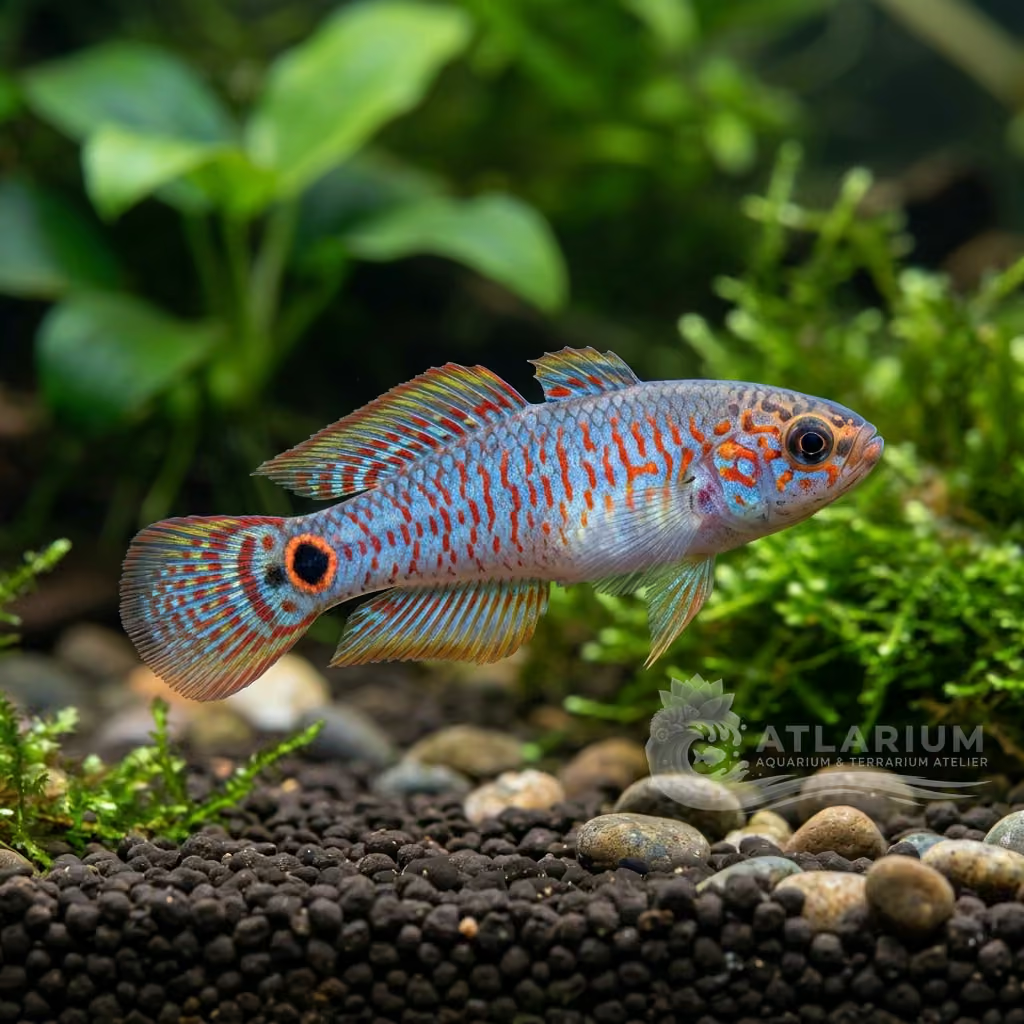
An exploding 'Sunburst' of a fish (10 cm / 4 inches). One of the most visually stunning, intensely colored, and highly endangered freshwater fish on the planet. The Alpha male shines with a glowing neon-yellow dorsal 'Flameback', a crimson-red lower body, and stark tiger-stripes. Psychotically aggressive, he requires a densely rock-filled tank and a massive harem of dull females to prevent him from harassing his mates to death. MUST never be mixed with other Victorian species.
Water Temperature
23 - 27 °C
pH Value
7.5 - 8.5
Water type
Freshwater
Tank level
Bottom and middle
Adult size
8 cm
Minimum tank volume
>= 100 L
Minimum group
>= 1
GH
10 - 20 dGH
KH
5 - 10 dKH
TDS
200 - 400 ppm
Conductivity
313 - 625 uS/cm

Species description
Geographical Origin and Habitat: A highly vulnerable relic of Lake Victoria (the Mwanza Gulf region in Africa). It is a specialized rock-dwelling Haplochromine cichlid. While the giant Nile Perch decimated open-water cichlids in the lake, the Nyererei survived by hiding tightly in extremely turbulent, rocky, wave-crashed island reefs close to shore, rarely swimming out into the deadly open abyss.
Taxonomy and Morphology: A very compact, bullet-shaped, thick Pundamilia cichlid. Males max out around 10 cm (4 inches), females slightly less. It boasts a powerful, blocky head and a mouth designed for snapping and prying insect larvae off hard substrates. It is intensely built for explosive bursts of speed rather than long-distance endurance swimming.
Social Behavior: Pure, unfiltered rage and hyperactivity. It acts exactly like the psychopathic Mbuna of Lake Malawi. The Alpha male is a hyper-aggressive, violent tyrant over his rock pile. He will incessantly 'shimmy' and shake violently, relentlessly chasing submissive fish at lightning speed across the entire length of the tank. If challenged by another male of his kind, they will lock jaws in a brutal, exhausting 'lip-lock' battle that can end in permanent injury or death for the loser. His sexual drive to chase females is totally boundless and exhausting to watch.
Coloration and Sexual Dimorphism: The ultimate 'Living Rainbow'. Highly Polymorphic (many wild color variants based on island location, like 'Python Island' or 'Makobe Island'). The sexual dimorphism is absolute: The females are depressing, dull, murky grey-brown with faint stripes. But the ALPHA MALE is a walking firework: His entire top back and upper fin glow in a blinding, neon SULFUR YELLOW to orange (the 'Flame-back'). His belly and lower flanks explode in deep BLOOD RED or crimson. The entire bright body is slashed vertically by thick, inky-black tiger stripes. The anal fin is studded with giant, glowing yellow fake 'egg spots' to trick females.

Care, breeding and tankmates
Aquarium Setup: Despite being only 4 inches, a 120 cm (4-foot / 55-gallon) tank is absolutely required to diffuse the Alpha's insane violence. You must create 'Safe Havens': build two massive, towering rock piles at opposite ends of the tank using dark slate or limestone. In the middle, leave open swimming space filled with dense, tall, hardy plants (like Vallisneria jungle or Giant Anubias) and heavy driftwood. The plants and wood act as 'Sight-Breakers' so the bullied grey females can escape the male's furious line-of-sight.
Diet and Feeding: Voracious Omnivore/Insectivore. DO NOT feed them a strict algae or Mbuna diet, or they will starve for nutrients. They demand high-quality, protein-heavy diets: Cichlid carnivore/krill pellets, massive amounts of frozen or freeze-dried Bloodworms, Mysis shrimp, and mosquito larvae. CRITICAL TO COLOR: You must feed them high-grade foods rich in Astaxanthin and Carotenoids (like krill or color-enhancing flakes), otherwise, their unbelievable glowing red and yellow colors will quickly fade into a muddy, pale pink in captivity.
Water Quality: Equatorial Victoria chemistry. Hard, alkaline water. pH 7.4-8.4 (much more forgiving than the caustic Lake Tanganyika). Moderate to High GH (8-15). Temp 24-28°C (75-82°F). Because of their high protein intake and frenetic activity, biological filtration must be heavily oversized to keep the water pristine; elevated nitrates will severely dull the male's red coloration and trigger lethargy.
Compatibility and Cohabitation: THE 'LAKE VICTORIA DOOMSDAY RULE': Because this species is critically endangered in the wild, aquarists are preserving their pure bloodlines. YOU MUST NEVER HOUSED IT WITH ANY OTHER VICTORIAN CICHLID (No other Haplochromis or Pundamilia). All Victorian females look like identical grey stripes. If housed together, the Alpha Nyererei will aggressively mate with the wrong females, spawning thousands of hideous, genetically polluted 'mutant hybrids'. Keep as a strict SPECIES TANK. HAREM MANDATE: You MUST buy 1 spectacular Flameback Male and a harem of AT LEAST 5 to 7 dull females. If you only provide 1 or 2 females, he will viciously run them into the glass and exhaust them until they die of heart failure from sexual stress.
Aquarium Breeding: Relentless maternal mouthbrooders. They breed fast and furiously. The fiery male does a violently trembling 'T-bone' dance against a flat rock. The drab female drops up to 30 large eggs, inhales them into her throat cavity, and nuzzles his bright yellow 'egg spots' to suck in his milt. She will violently hide in the thickest plants or darkest rock, completely starving herself for over 3 excruciating weeks. She eventually spits out 20-30 fully striped, aggressive little clones that immediately dart into the rubble.
Risks and Diseases: 1. THE HYBRIDIZATION TRAGEDY: Mixing them in an 'Assorted African Cichlid' tank that contains other Victorian species resulting in an irreversible mutant genetic line. 2. Homicide by Mating: Keeping a single male with a single female guarantees her violent death via endless sexual pursuit and exhaustion within two weeks. 3. Drastic color loss from poor, vegetable-based diets lacking crustaceans (Astaxanthin).

Geographic origin and distribution
A highly vulnerable relic of Lake Victoria (the Mwanza Gulf region in Africa). It is a specialized rock-dwelling Haplochromine cichlid. While the giant Nile Perch decimated open-water cichlids in the lake, the Nyererei survived by hiding tightly in extremely turbulent, rocky, wave-crashed island reefs close to shore, rarely swimming out into the deadly open abyss.
Origin
North AmericaAfrica and Madagascar

Fish profile
- Temperament
- Semi-aggressive
- They exhibit a remarkably bold and highly aggressive temperament. Males display stunning colors when defending their prime territories. They constantly interact with their environment and tankmates.
- Diet
- Omnivore
- They are unfussy omnivores requiring a highly varied diet. Spirulina flakes and cichlid pellets maintain their colors. Frozen brine shrimp offers excellent supplemental protein.
- Life expectancy
- 4-10 years
- Adult size
- 8 cm
- Sex ratio
- Harem
- Keep them in a strict harem of one male to multiple females. This intensely diffuses the dominant male's aggressive breeding advances. Multiple males will fight to the death in small tanks.
- Feeding frequency
- Twice daily
- Feed them once or twice daily in measured amounts. They feed aggressively and voraciously at the surface. Disperse food widely to allow subordinate fish access.
- Bioload
- Low to Medium
- This active African Cichlid generates a moderate bioload. Strong biological filtration is required for their health. Regular water changes maintain the necessary alkaline conditions.
- Flow
- Stagnant
- They prefer moderate water movement resembling Lake Victoria. Good surface agitation ensures proper oxygenation levels. Excessively turbulent water is not required or recommended.
- Jump risk
- Yes
- They pose a moderate jump risk during territorial chases. A tight lid is essential to prevent fatal escapes. Males often pursue females relentlessly near the surface.
- Reproduction
- Oviparous
- They are prolific maternal mouthbrooders that breed easily. The female holds eggs in her mouth until hatching. Provide numerous rocky caves for the female to hide.
- Compatibility & tankmates
- Aggressive
- They are highly aggressive and inherently territorial fish. They must only be kept with similarly robust cichlids. Mixing them with peaceful community fish is disastrous.
- Tank level
- Middle/Bottom
- They utilize all levels but favor the bottom half. They constantly dart in and out of rocky crevices. They will aggressively defend their chosen rock formations.

Scientific Parameters & Models
FishBase
Window to the official scientific data of the species
FishBase v25.04Data synced on: 06/15/2026
- Trophic level
- 2.6 ± 0.2 se
- Resilience
- High (less than 15 months)
- Phylogenetic uniqueness (PD50)
- 0.5
- Bayesian Length-Weight
- a = 0.01445, b = 2.99
- VulnerabilityLow vulnerability (10 / 100)

Related species
Recommendations grouped by close relatives, companion choices, and similar care.