Fahaka puffer
Tetraodon lineatus
The Fahaka Puffer is a massive, highly intelligent freshwater giant. Armed with a crushing beak for hard-shelled prey, it possesses a viciously aggressive temperament requiring a strict solitary setup.
Water Temperature
24 - 28 °C
pH Value
6.5 - 7.5
Water type
Freshwater
Tank level
Middle
Adult size
43 cm
Minimum tank volume
>= 500 L
Minimum group
>= 1
GH
5 - 15 dGH
KH
2 - 7 dKH
TDS
95 - 295 ppm
Conductivity
148 - 461 uS/cm

Species description
Geographical Origin and Habitat: Tetraodon lineatus, commonly known as the Fahaka puffer or Nile puffer, is native to the African continent. Its distribution is very wide and includes the Nile, Niger, Senegal, Gambia, and Volta river basins, as well as the Lake Chad basin. It inhabits large rivers, canals, lagoons, and floodplains, preferring shallow, slow-flowing waters with abundant submerged vegetation and sandy or muddy substrates in which it loves to bury itself.
Taxonomy and Morphology: It belongs to the class Actinopterygii, order Tetraodontiformes, family Tetraodontidae, and genus Tetraodon. It features a massive, rounded body without scales, covered instead with small, erectile dermal spines. It can reach exceptional size for a freshwater pufferfish, growing up to 43 centimeters (17 inches) in length. Like all pufferfish, it possesses the ability to inflate its body with water or air for defense.
Social Behavior: It is a solitary fish characterized by extreme territoriality and unmatched aggressiveness. It does not tolerate the presence of any other living being in its living space, including members of its own species. Despite its aggression, it shows extraordinary intelligence and complex cognitive abilities: it learns to recognize its owner, responds to visual stimuli outside the tank, and shows a strong curiosity for its surroundings.
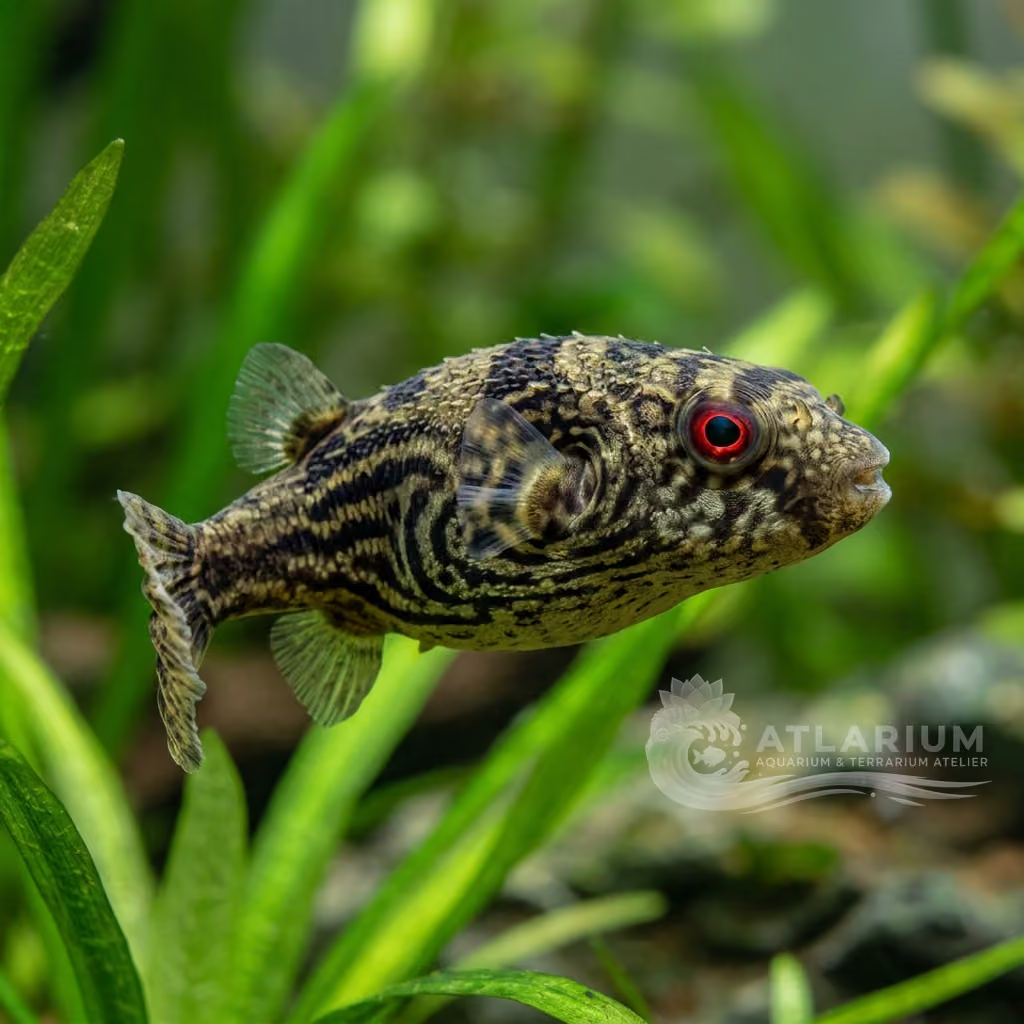
Coloration and Sexual Dimorphism: The coloration is characteristic and striking, consisting of a pattern of yellow, golden, and dark green or brown longitudinal stripes running along the entire body (hence the specific name lineatus). The belly is a uniform yellowish-white. There is no visible external sexual dimorphism; males and females are identical, and sex identification is possible only during the breeding season or through ultrasound analysis.

Care, breeding and tankmates
Aquarium Setup: Requires a large aquarium, with a minimum volume of at least 400-500 liters (approx. 100-130 gallons) for a single adult specimen. The bottom must consist exclusively of fine, non-sharp sand, at least 8-10 cm deep, to allow natural burying behavior. The decor should include resistant driftwood and smooth rocks. Any internal equipment (heaters, filter intakes) must be protected by grates, as the fish can bite through them.
Diet and Feeding: It is a carnivorous predator specialized in consuming mollusks and crustaceans. Its teeth (fused into four bony plates) grow continuously and must be worn down by offering hard-shelled foods: freshwater snails, mussels, clams, crabs, whole shrimp with shells, and small lobsters. Failure to provide these foods causes overgrown teeth, preventing the fish from feeding. Feed once a day or every other day as an adult.
Water Quality: Being scaleless, it is extremely sensitive to organic pollutants (ammonia, nitrites, nitrates) and therapeutic treatments. An exceptionally powerful and oversized biological and mechanical filtration system is required, combined with weekly 50% water changes. The ideal temperature is between 23°C and 26°C (73°F - 79°F), pH between 7.0 and 8.0, and medium-high hardness. Avoid excessively strong currents.
Compatibility and Cohabitation: Must be housed strictly alone in a single-specimen tank. Any attempt at cohabitation with surface, bottom, fast, or armored fish will result in violent attacks, mutilations, or the death of the tankmates. Even juveniles, which appear peaceful, suddenly develop lethal aggression upon reaching sexual maturity.
Aquarium Breeding: Breeding in captivity is extremely difficult and risky. It requires huge tanks (over 1000 liters) with dense visual barriers. Partners must be introduced only when they are ready and willing to spawn. Spawning occurs on the substrate, and the eggs are guarded by the male. Partners must be separated immediately after spawning to prevent the male from killing the female or vice versa.
Risks and Diseases: The most common risk is overgrown teeth, which requires manual filing under veterinary anesthesia if the fish does not consume hard foods. It is prone to internal and skin parasites. It contains tetrodotoxin, a lethal toxin present in its internal organs. It should never be handled with bare hands if they have open wounds, and must never be consumed.

Geographic origin and distribution
Tetraodon lineatus, commonly known as the Fahaka puffer or Nile puffer, is native to the African continent. Its distribution is very wide and includes the Nile, Niger, Senegal, Gambia, and Volta river basins, as well as the Lake Chad basin. It inhabits large rivers, canals, lagoons, and floodplains, preferring shallow, slow-flowing waters with abundant submerged vegetation and sandy or muddy substrates in which it loves to bury itself.
Origin
Africa and Madagascar

Fish profile
- Temperament
- Semi-aggressive
- Fahaka puffers are highly intelligent, personable, but incredibly aggressive to other aquatic life. They often form a strong bond with their owners, quickly learning to recognize them and begging for food. Despite their endearing personality, their predatory instincts make them merciless toward tank mates.
- Diet
- Omnivore
- They are specialized carnivores that require a diet rich in hard-shelled invertebrates to keep their teeth trimmed. Snails, clams, mussels, crayfish, and crab legs are excellent staple foods for this species. Without hard foods, their teeth will overgrow, requiring manual trimming by the aquarist.
- Life expectancy
- 10-15 years
- Adult size
- 43 cm
- Sex ratio
- Specific M:F ratio
- Sexing this species visually is generally impossible for the average aquarist. Because they must be housed individually regardless of sex, the sex ratio is functionally irrelevant. Attempting to keep multiple individuals together will inevitably result in severe injuries or fatalities.
- Feeding frequency
- Twice daily
- Juveniles should be fed daily to support their rapid growth and development. As they mature into adults, their metabolism slows, and they should only be fed every other day. Overfeeding adult Fahaka puffers can lead to severe health issues like fatty liver disease.
- Bioload
- High
- The Fahaka puffer produces a massive bioload due to its large adult size and messy eating habits. They require a heavy-duty filtration system, often combining large canister filters and frequent, substantial water changes. Waste parameters like ammonia and nitrite must be kept strictly at zero.
- Flow
- Stagnant
- They appreciate a moderate water flow that provides adequate turnover for the large tanks they require. Good surface agitation is necessary to maintain high dissolved oxygen levels, which they need. Powerheads can be used, provided there are low-flow resting areas available.
- Jump risk
- No
- Reproduction
- Oviparous
- Breeding the Fahaka puffer in a home aquarium is virtually impossible due to their extreme aggression. They require massive volumes of water to even tolerate another puffer's presence. Commercial captive breeding has not yet been successfully documented on a wide scale.
- Compatibility & tankmates
- With caution
- This species is notoriously aggressive and intolerant of tank mates, making it suitable only for solitary confinement. They possess powerful beaks capable of crushing shells and will easily kill any other fish. It is universally recommended to keep a Fahaka puffer completely alone.
- Tank level
- Middle
- They utilize all levels of the aquarium but spend a significant amount of time resting on the bottom. They often bury themselves partially in fine sand, waiting to ambush prey. A deep, soft sand bed is essential for their comfort and natural burrowing behavior.

Scientific Parameters & Models
FishBase
Window to the official scientific data of the species
FishBase v25.04Data synced on: 06/15/2026
- Trophic level
- 3.6 ± 0.5 se
- Resilience
- Medium (1.4 - 4.4 years)
- Generation time
- 4.5 years
- Phylogenetic uniqueness (PD50)
- 0.502
- Bayesian Length-Weight
- a = 0.02692, b = 2.91
- VulnerabilityModerate vulnerability (38 / 100)

Related species
Recommendations grouped by close relatives, companion choices, and similar care.