Dusky Narrow Hatchetfish / Triportheus
Triportheus angulatus
A colossal, hyper-active top-dweller (up to 18 cm). Built like a giant silver sardine with a deep chest. Moves at blinding speeds and requires enormous tanks (2+ meters) and heavy-duty lids. Reserved for 'Monster Fish' Amazonian community tanks.
Water Temperature
23 - 28 °C
pH Value
6 - 7.5
Water type
Freshwater
Tank level
Surface
Adult size
15 cm
Minimum tank volume
>= 180 L
Minimum group
>= 1
GH
2 - 15 dGH
KH
1 - 7 dKH
TDS
40 - 295 ppm
Conductivity
63 - 461 uS/cm

Species description
Geographical Origin and Habitat: Broadly found in the main channels of the Amazon and Orinoco rivers. Unlike delicate swamp hatchets, Triportheus dominate the upper layers of massive, fast-flowing rivers, large oxbow lakes, and open water channels in massive shoals.
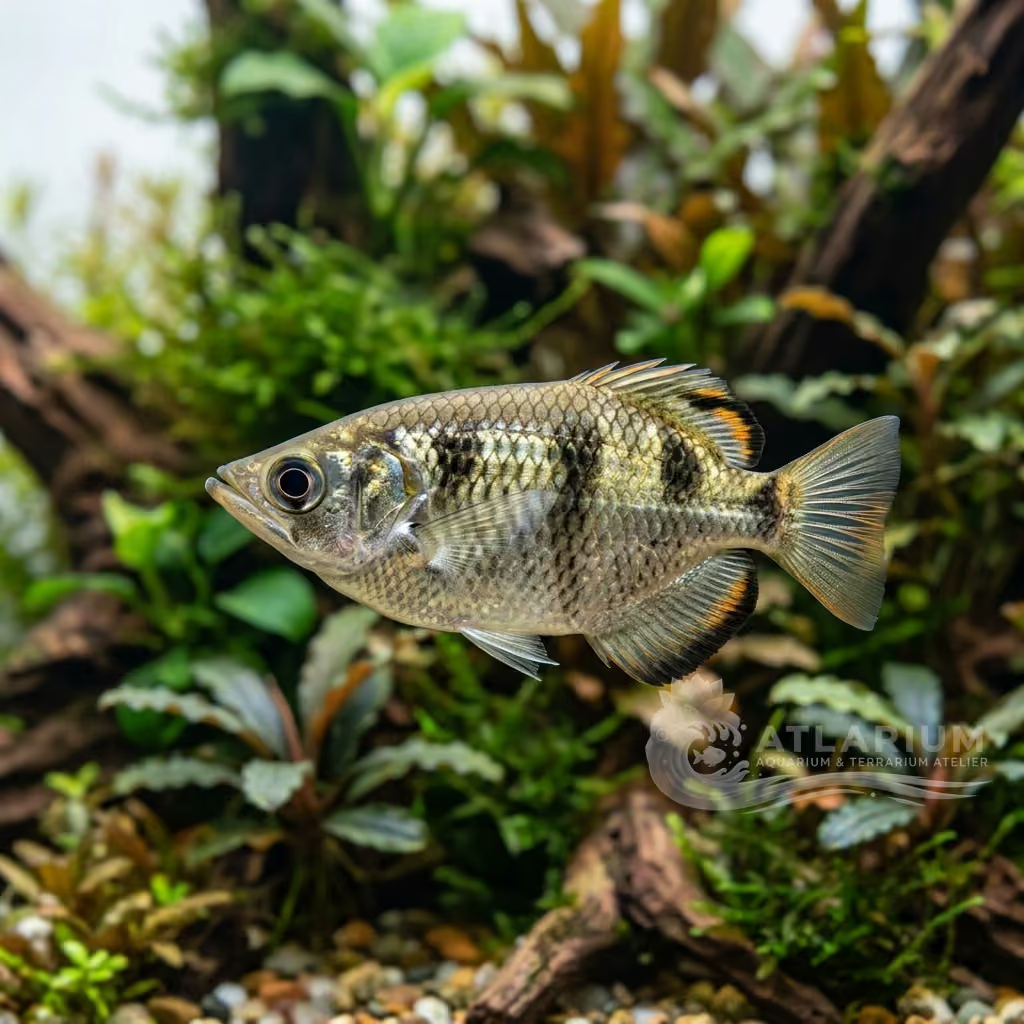
Taxonomy and Morphology: Despite its deep, keeled chest, it belongs to the independent Triportheidae family (not true Hatchetfish). A formidable beast reaching 16-18 cm (7 inches). Looks like a cross between a herring and a hatchetfish: elongated, incredibly hydrodynamic, with scythe-like pectoral fins and a heavily upturned mouth.
Social Behavior: Frantic, non-stop top-level swimmer. Unlike the hovering Gasteropelecidae, Triportheus blast around the tank at terrifying speeds in a tightly knit school (minimum 6). If spooked, the sheer force of the school panicking and jumping can shatter thin glass lids or knock unweighted lids entirely off the tank.
Coloration and Sexual Dimorphism: Strictly functional, lacking bright colors. The body is covered in large 'dirty' silver or dark golden scales, with a dark olive back to camouflage them from predatory birds. A faint, dusky horizontal band runs to the tail, ending in a subtle spot. Females are noticeably thicker and rounder.

Care, breeding and tankmates
Aquarium Setup: Strictly for Jumbo or Public aquariums. ABSOLUTE MINIMUM length is 200 cm (6-7 feet, 200+ gallons). It is cruel and fatal to keep them in standard tanks: their speed and mass guarantee they will repeatedly smash into short glass walls, crushing their snouts ('snout damage'). THE LID IS A MAJOR ISSUE: it must be heavy-duty and clamped down. They require very strong surface water currents (using wavemakers/powerheads) to swim against and burn off energy.
Diet and Feeding: Highly aggressive surface macro-omnivore. During feeding, the surface literally 'boils'. They devour massive quantities of large floating cichlid sticks, whole freeze-dried krill, large crickets, mealworms, and dried shrimp. While primarily surface feeders, they will occasionally dive to mid-water to catch falling food.
Water Quality: Quite robust and adaptable. The critical factor is not acidity, but OXYGENATION. As hyper-active river swimmers, they suffocate rapidly if O2 levels drop in stagnant tanks. pH 6.5-7.5. Temp 24-28°C (75-82°F). Powerful mechanical filtration required.
Compatibility and Cohabitation: The Amazonian 'Monster Fish' tank. Will swallow any fish under 1.5 inches whole during a feeding frenzy. Perfect top-dwellers for massive displays alongside giant Plecos (Panaque, Acanthicus), huge Geophagus or Severums, Silver Dollars, and calm juvenile Arowanas. Completely unsuitable for peaceful planted tanks, as their frantic pacing will stress timid fish to death.
Aquarium Breeding: Practically impossible and unrecorded in home aquaria. They scatter pelagic eggs in flooded river channels.
Risks and Diseases: 1. Catastrophic impact injuries (broken jaws, snapped spines) from swimming into glass walls in tanks under 6 feet long. 2. Suffocation if powerheads or air pumps fail in summer. 3. Blowing off the tank lid from the force of group jumping.

Geographic origin and distribution
Broadly found in the main channels of the Amazon and Orinoco rivers. Unlike delicate swamp hatchets, Triportheus dominate the upper layers of massive, fast-flowing rivers, large oxbow lakes, and open water channels in massive shoals.
Origin
Amazon, Orinoco, and Guianas

Fish profile
- Temperament
- Semi-aggressive
- They are active, boisterous, but fundamentally peaceful schooling fish. Their constant, rapid movement can be stressful to shy or slow-moving species. When kept in a spacious tank with a suitably large school, they provide incredible kinetic energy to the upper layers of the aquascape.
- Diet
- Omnivore
- In the wild, they are omnivorous surface feeders that hunt for insects and fallen fruits. In captivity, they eagerly devour floating flakes, pellets, and freeze-dried bloodworms. Providing a varied diet that includes live crickets or fruit flies greatly enriches their feeding behavior.
- Life expectancy
- 10 years
- Adult size
- 15 cm
- Sex ratio
- School
- They are best kept in a large school where sex ratio is largely irrelevant to their group dynamics. Keeping them in groups of six or more helps diffuse any minor squabbling and replicates their natural behavior. Males might display slightly different body profiles, but sexual dimorphism is generally minimal.
- Feeding frequency
- Twice daily
- They possess ravenous appetites and should be fed one to two times daily. Because they feed aggressively at the surface, it is important to ensure sinking food is also provided for bottom-dwelling tank mates. They will rapidly snap up any food hitting the water's surface, often splashing in the process.
- Bioload
- Medium to High
- As highly active, medium-sized characins, they contribute a moderate to high bioload to the aquarium. They consume substantial amounts of food and naturally produce a corresponding amount of waste. A powerful external canister filter and strict weekly water changes are necessary to keep water parameters stable.
- Flow
- Stagnant
- Coming from the larger river channels of the Amazon basin, they appreciate a moderate to strong current. Good surface agitation not only mimics their natural habitat but also keeps the water highly oxygenated. Powerheads or directional filter outflows will encourage their natural schooling behavior against the current.
- Jump risk
- Yes
- This species is a notorious and powerful jumper, evolved to snatch insects from overhanging branches. An incredibly tight and heavy lid is absolutely mandatory; even the smallest gap will eventually lead to a dried-out fish on the floor. Floating plants can mitigate this risk slightly, but a physical barrier is the only true prevention.
- Reproduction
- Oviparous
- Breeding in the home aquarium is incredibly rare and poorly documented. They are presumably egg-scatterers that release their eggs in open water during the rainy season. Simulating the complex environmental triggers required for spawning is very difficult in a standard captive environment.
- Compatibility & tankmates
- Peaceful
- They are generally peaceful but extremely active and can outcompete slower fish for food. They do best with other robust, active South American species like larger tetras, peaceful cichlids, or plecos. They should not be trusted with very small fish or shrimp, which may be viewed as a quick meal.
- Tank level
- Top
- They are dedicated surface and upper-water column dwellers. Their unique, elongated pectoral fins and flat dorsal profile are perfectly adapted for skimming just beneath the water's surface. They rarely dive to the lower levels of the tank unless extremely frightened.

Scientific Parameters & Models
FishBase
Window to the official scientific data of the species
FishBase v25.04Data synced on: 06/15/2026
- Trophic level
- 2.7 ± 0.3 se
- Phylogenetic uniqueness (PD50)
- 0.5
- Bayesian Length-Weight
- a = 0.01413, b = 2.91
- VulnerabilityLow vulnerability (19 / 100)

Related species
Recommendations grouped by close relatives, companion choices, and similar care.