Back to atlas
FishFreshwaterExpert

Encyclopaedia

Mbu Puffer (Giant Freshwater Puffer)

Tetraodon mbu

The Intelligent, Water-Dog Giant (65-75 cm / 26-30 inches). The absolute undisputed king and largest purely freshwater pufferfish on the planet. Unlike most of its viciously aggressive, fin-nipping smaller cousins, the colossal Mbu is famous worldwide as the 'Gentle Giant'. They are incredibly aware, highly intelligent fish that deeply bond with their owners, tracking them across the room like a dog. However, keeping them is a monumental, extremely expensive challenge: they require colossal 500+ gallon tanks, they are horrifically messy eaters, and they strictly, absolutely REQUIRE a constant daily diet of rock-hard, shelled food (clams, whole crabs, snails) to constantly grind down their continuously growing 'beak', otherwise their teeth will fuse shut, dooming them to starvation.

Family
Tetraodontidae
Origin
Bacino del Fiume Congo e Lago Tanganica (Africa)
Origin
Extra-Amazon South AmericaAfrica and Madagascar
Tank use
Used in 0 tanks

Share

Species challenges
Temperature

24 °C - 28 °C

pH

7 - 8

Water type

Freshwater

Tank level

Middle

Adult size

67 cm

Description

Geographic Origin and Biotope: The Gentle Giant of the Congo. Strictly endemic to the incredibly massive, dark, wild, and sprawling Congo River basin and the deepest reaches of Lake Tanganyika in Central Africa. They are slow-moving, hovering bottom-dwellers, tirelessly patrolling the sandy river beds, navigating through massive boulders and smooth stones on a never-ending hunt for their sole biological purpose: massive, hard-shelled freshwater snails and bivalves buried in the sand.

Taxonomy and Morphology: The Scaleless Water Blimp (Tetraodontidae). It is a true freshwater pufferfish, never requiring or tolerating saltwater or brackish conditions. The body is a bizarre, alien marvel: a massive, incredibly thick, scaleless, fat, sausage-like blimp. It is covered in microscopic, invisible spines that lie completely flat when calm. It swims via a bizarre 'drone' or 'helicopter' style, hovering and rapidly fluttering its tiny, clear pectoral fins. It lacks normal teeth; instead, its jaw bones are fused into a massive, incredibly powerful, solid bone 'Beak' divided into four lobes (Tetra-odon = Four Teeth). The infamous party trick (WHICH YOU MUST NEVER FORCE THEM TO DO) is their fatal defense mechanism: if attacked, they swallow massive amounts of water, inflating their stretchy stomach into an impossible, rigid, solid bowling ball, making them physically impossible for a predator to swallow.

Social Behavior: The Highly Emotional 'Water Dog'. The Mbu completely breaks the stereotype of the sociopathic, murdering pufferfish. It is globally adored because it is incredibly sentient, highly intelligent, and deeply aware of its surroundings. It has large, independent, chameleon-like eyes that track its owner across the room. It begs for food like a puppy and shows genuine curiosity and recognition. Surprisingly, despite being a 30-inch giant with a beak that can sever a human finger, it is remarkably peaceful, clumsy, and completely indifferent to small, fast-moving tankmates (as long as they don't look like snails). They are highly emotional and easily depressed: an Mbu kept in a bare tank or yelled at will turn dark, hide, and pout lethargically.

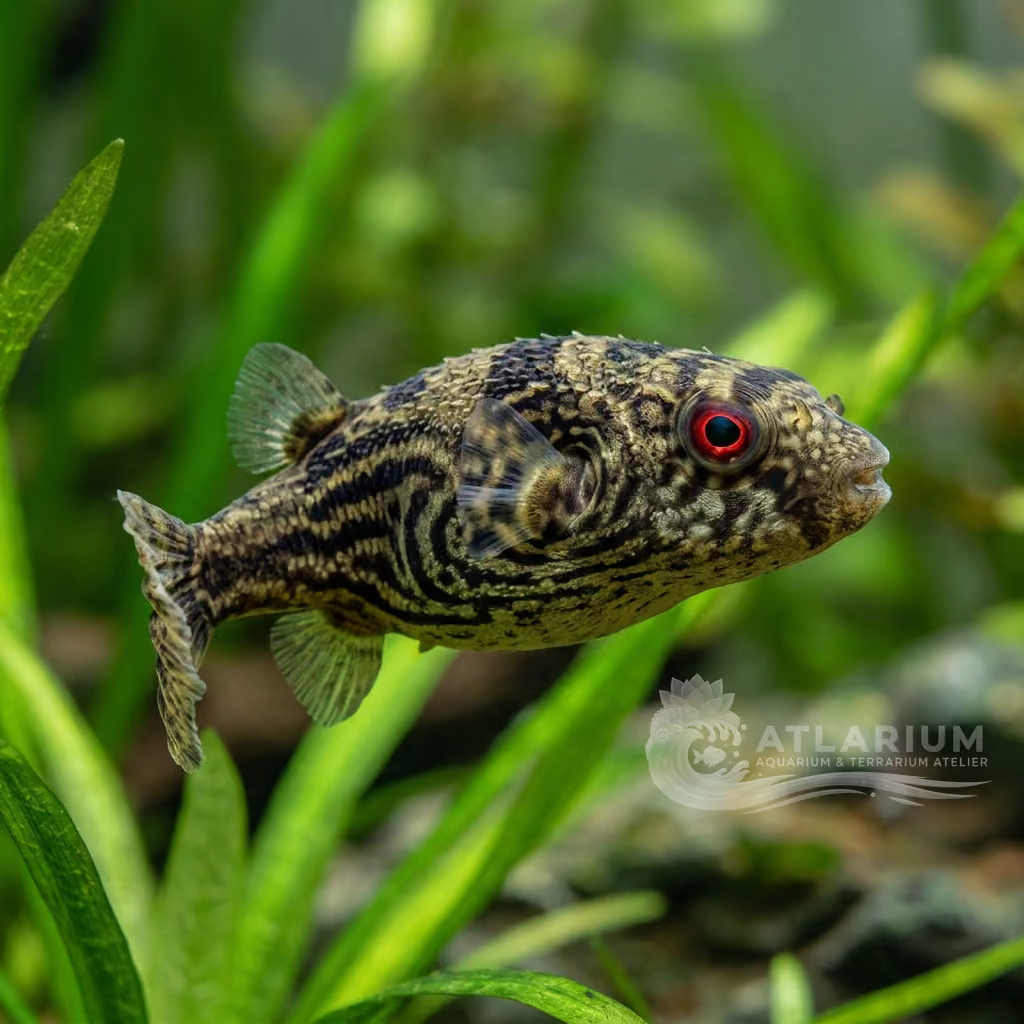
Coloration and Sexual Dimorphism: The Golden Labyrinth. They are breathtakingly patterned. The entire massive, fleshy back and upper flanks are a vibrant, intense mustard-yellow, bright gold, or glowing olive-green. This beautiful canvas is heavily and intricately overlaid with a stunning, hypnotic, and wildly complex labyrinth or 'maze' pattern of thick, stark black lines and reticulated webs. The massive, flabby underbelly and chin are completely smooth, pure, flawless snow-white. They have the magical ability to dramatically darken or lighten their colors based on their mood, stress, or to camouflage against the sand. Males and females look completely identical to the naked eye.

Care and observations

Tank Setup: The Massive 'Hovering' Arena (Wide Tanks Required). A 30-inch, incredibly thick 'blimp' requires monumental space. The Mbu is not a fast, straight-line swimmer; it clumsily hovers and turns around slowly in circles. Therefore, depth (front-to-back width) is just as important as length. You absolutely require a massive, custom-built aquarium or indoor tropical pond stretching a minimum of 8 to 10 feet long and, crucially, 3 to 4 FEET WIDE (250-300+ cm / 500-1000+ gallons). THE SOFT SAND MANDATE: Because they spend hours resting their massive, delicate, heavy, scaleless white bellies on the floor, you MUST use ultra-fine, soft silica sand. Rough gravel will heavily scratch, ulcerate, and infect their skin, leading to fatal belly sores.

Feeding: The Hydraulic Nut-Cracker Beak (THE SHELL WEAR-DOWN RULE). THIS IS A LIFE OR DEATH MANDATE. An Mbu puffer's four fused teeth (its beak) NEVER, EVER STOP GROWING. If you lazily feed it soft foods (like raw fish fillets, beef heart, or soft worms), the beak will grow so long that it permanently locks and fuses its mouth shut, making it impossible for the fish to open its jaws, slowly starving the intelligent animal to a depressed, agonizing death. YOU MUST EXCLUSIVELY, religiously, and constantly feed it heavily armored, rock-hard food: Whole, frozen, unopened Clams and Mussels (which it will violently crush, shattering the shells with a loud 'crack'), whole raw Crayfish/Crabs with the tough shells, whole jumbo shrimp with the shell, and hundreds of massive, live Apple Snails or Ramshorn snails. The brutal friction of crushing these hard shells naturally files and grinds down the growing teeth, keeping the puffer healthy and voraciously hungry!

Water Quality: The Ultimate Messy Eater and Toxic Nightmare. Crushing whole clams and spitting out clouds of sharp, shattered shells and massive, rotting chunks of flesh creates an unbelievable, catastrophic amount of rotting organic waste and ammonia. They are perhaps the messiest eaters in the hobby. THE FATAL SENSITIVITY: Because they are 'scaleless', they have absolutely ZERO biological tolerance or defense against high nitrates or ammonia spikes. Dirty water will chemically burn their delicate skin and eyes instantly. This combination requires extreme, massive, ultra-oversized Sump filtration (with automated Clarisea mechanical rollers), brutal bi-weekly sand-siphoning, and obsessive 50%+ weekly water changes. Keep nitrates strictly below 20ppm. Provide warm tropical water (24-26°C / 75-79°F) and neutral to alkaline African pH (7.0-8.0).

Compatibility: The Peaceful Giant's Blind Spot (Cautious Comm). The Mbu is a 'Gentle Giant'. It generally ignores and beautifully co-habitates with fast, peaceful, mid-water schooling fish (like massive Congo Tetras) or peaceful Geophagus cichlids in a millionaire-sized tank. THE BITE HAZARD DANGER: However, the Mbu is incredibly curious and explores the world with its massive, amputating beak. If you put a peaceful, stationary Plecostomus or armored catfish on the glass, the Mbu will mistake its hard, armored fins for a snail shell, and 'test bite' it out of sheer curiosity, accidentally amputating the pleco's fins or biting chunks of flesh out with a loud snap! Avoid aggressive cichlids that will nip the puffer's slow-moving fins, causing it severe stress and depression.

Reproduction: The Impossible Chimera (Zero Captive Breeding). Completely, utterly, and physically impossible to breed in a glass home aquarium. There is not a single confirmed, documented case of Mbu Puffers successfully spawning and raising fry in the amateur hobby. All Mbu puffers sold globally are wild-caught, captured directly from the deep Congo River by local fishermen and exported. Their massive size, complex migratory spawning triggers, and the aggressive nature of breeding completely prevent captive reproduction outside of highly secretive, commercial Asian aquaculture facilities (if they even exist).

Risks: 1. THE BEAK LOCK-JAW STARVATION (The Overgrowth Death): As mentioned, the absolute most common and tragic killer. Irresponsible, ignorant owners feed the puffer soft fish meat for a year. The massive beak overgrows, curling inwards, permanently locking the mouth shut. The deeply intelligent fish will stare at the owner, begging for food, slowly starving to a skeletal death, UNLESS the owner performs a terrifying, highly stressful, and dangerous amateur surgery: sedating the massive puffer in a bucket of Clove Oil anesthetic and using a Dremel grinding tool or bone-cutters to physically saw and sand down the fish's teeth while it is asleep, risking killing the fish from the anesthetic. 2. TOXIC AMMONIA BURN (Scaleless Vulnerability): Failure to perform massive water changes causes the rotting clam meat waste to spike the ammonia. The puffer's scaleless skin violently reacts, peeling, shedding massive chunks of white slime, burning its eyes cloudy blind, and killing the fish in a toxic, agonizing burn. 3. THE DRY INFLATION FATALITY (The Air-Gulp Death): NEVER, EVER net a puffer and lift it completely out of the water into the dry air. If the terrified puffer inflates itself by gulping dry air (Oxygen) instead of water, the air bubble gets permanently trapped in its stomach. When returned to the tank, the puffer will helplessly float upside down, unable to deflate or swim, and will slowly, agonizingly die of stress and starvation while trapped at the surface like a balloon.

Fish profile

Temperament
Estremamente intelligente, interattivo ma letalmente predatore verso quasi tutto ciò che si muove. Non è malvagio, semplicemente vede gli altri coinquilini come crostacei o molluschi da sgusciare.
Diet
Carnivoro / Durofago (Mangiatore di gusci). REQUISITO SALVAVITA: I loro denti fusi a becco crescono ininterrottamente per tutta la vita. Se non ricevono quotidianamente cibo con guscio duro (lumache giganti, granchi interi, cozze col guscio, vongole, chele di granchio, gamberoni non sgusciati), il becco crescerà fino a sigillargli la bocca, facendolo morire di inedia. A quel punto serve l'intervento del veterinario per limargli i denti con un Dremel sotto anestesia.
Tank level
Middle
Minimum group
1
Adult size
67 cm
Minimum tank
1,200 L
GH
10 dGH - 20 dGH
KH
n/a
TDS
n/a
Conductivity
n/a
Sex ratio
Rigorosamente Singolo. Tenere due Mbu adulti insieme è un disastro garantito, si sbranerebbero a morsi asportandosi pezzi di carne grandi come un pugno. Impossibile sessarli da vivi.
Feeding frequency
1 volta al giorno (esemplari giovani). 2-3 volte a settimana per gli adulti XXL, per non sovraccaricare la digestione e il filtro.
Bioload
Estremo (Uno dei massimi carichi organici possibili in acqua dolce)
Flow
Corrente da Moderata a Forte. Filtrazione ultra-sovradimensionata necessaria.
Reproduction
Impossibile e inesistente in cattività. Tutti gli esemplari, anche i piccolissimi "fagioli" venduti nei negozi specializzati, sono sistematicamente catturati nei fiumi africani (Wild Caught).
Compatibility
NON HA COMPAGNI. È un 'Wet Pet', va tenuto ASSOLUTAMENTE DA SOLO in vasca. Divorerà qualsiasi lumaca, crostaceo o gambero istantaneamente. Triturerà qualsiasi pesce di fondo. L'unico - e comunque rischioso - abbinamento talvolta testato in vasche pubbliche è con piccolissimi e veloci pesci di banco (es. grandi sciami di Tetra) che il palla ignora perché troppo piccoli e veloci per sprecare energie, ma le perdite notturne sono comunque preventivabili.

Image gallery

Licensed images linked to the species or, when marked, to the closest representative taxon.