Encyclopaedia

PlantFreshwaterIntermediate
©AI Generated·Proprietary

Elodea nuttallii

Elodea nuttallii

A cold-tolerant, incredibly resilient submerged stem plant originally from North America. Thriving across all light levels, it is an indestructible choice for backgrounds.

Taxonomy
Class:Liliopsida
Order:Alismatales
Family:Hydrocharitaceae
Genus:Elodea
Species:Elodea nuttallii

Share

Check out Elodea nuttallii on Atlarium

PracticeRecognition quizzesPhotos, names, origins, and puzzles to review Atlas species.Open quizzes
Water Temperature

10 - 25 °C

pH Value

6 - 8.5

Water type

Freshwater

Light

Low

CO2

Low

Expected height

60 cm

Expected width

10 cm

GH

8 - 25 dGH

KH

2 - 21 dKH

Species description

Geographical Origin and Habitat: Endemic to the temperate freshwater regions of North America, Elodea nuttallii (Western Waterweed) has become a notorious, globally distributed invasive species across Europe and Asia. It is an incredibly robust, cold-tolerant, true aquatic submerged stem plant. It aggressively dominates slow-moving rivers, glacial lakes, and cold-water ponds, forming massive, impenetrable floating mats or deeply rooted underwater forests that violently choke out native vegetation through sheer, rapid biomass accumulation.
Taxonomy & Genetics: Scientifically classified within the Hydrocharitaceae family, Elodea nuttallii is a true aquatic species globally famed for its extreme cold tolerance. Taxonomically, it is frequently confused with Egeria densa or its close cousin Elodea canadensis, but nuttallii is distinctively recognized by its very narrow, pointed, and slightly recurved (bent back) leaves. Genetically, it is completely hard-wired for explosive vegetative propagation via stem fragmentation. It completely lacks the mechanism for red pigments.
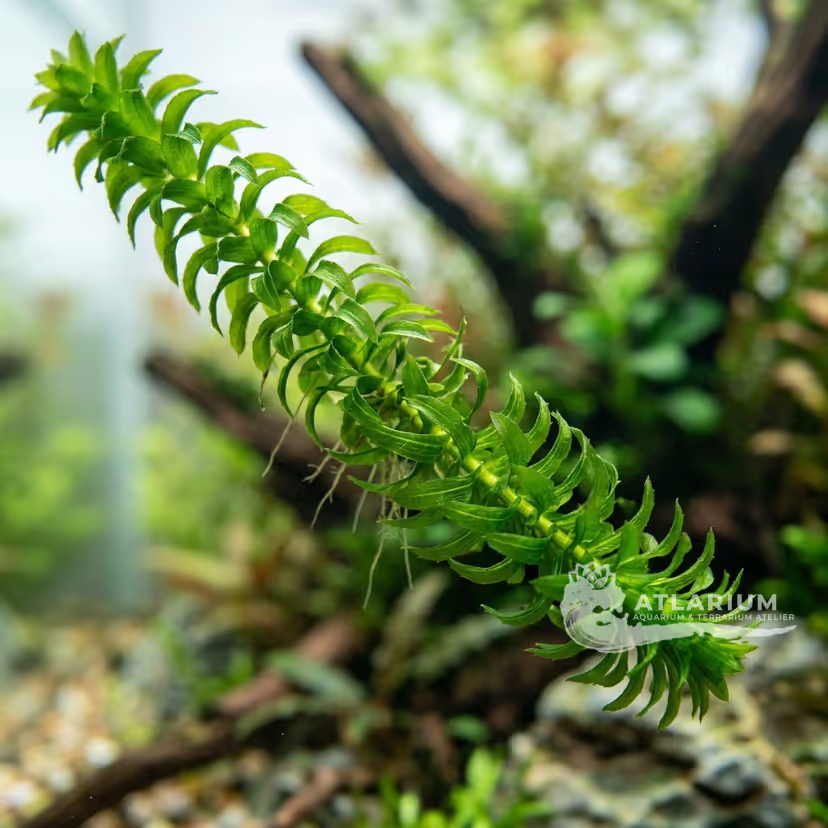
Physical Structure: The architectural structure of Elodea nuttallii is violently fast-growing, heavily branched, and strictly vertical. It is a massive, highly flexible submerged stem plant. The foundation is a slender, brittle stem that readily snaps (fragmentation) but deploys long, aggressive white roots directly from the stem nodes to anchor itself. The leaves are packed in whorls of 3 (rarely 4) along the stem. The foliage is strictly linear to narrowly lanceolate, small (1-2 cm), and distinctively recurved backward.
Color & Texture: The coloration is distinctly pure, intensely solid, and brilliantly uniform. Grown submerged under standard lighting, the flexible stems and whorls of recurved leaves are a solid, glowing pale apple-green to a translucent grassy-green. Because it completely lacks red anthocyanin pigments, it remains an intensely bright pure green even under blasting high-intensity light. The texture is distinctly crisp, very flexible, and highly translucent, giving the dense bush a delicate, slightly "prickly" appearance.

Care, breeding and tankmates

Lighting & CO2: It is an incredibly resilient, nearly indestructible titan that thrives across all light levels. While it will effortlessly survive in low-light, unheated goldfish bowls, under medium to high-intensity LED lighting, its growth rate becomes terrifyingly explosive, capable of growing several centimeters per day. If severely shaded, the lower leaves will turn translucent and rot. While it absolutely does not require pressurized CO2, adding it will drastically accelerate its already violent growth rate.
Nutrition & Substrate: As a colossal, wild-type aquatic stem plant, Elodea nuttallii is highly versatile but primarily an aggressive water-column feeder. Because it can be grown completely free-floating or planted in the substrate, it strictly demands heavy, continuous liquid fertilization (especially iron and potassium). It does not require premium aquasoil; it will readily root in plain cold gravel purely for anchorage. If starved of water-column nutrients, the dense green crowns will quickly turn white and the stems will dissolve.
Water Chemistry: Originating from temperate North America, it is practically invincible regarding standard water parameters, with one massive exception: it absolutely demands cold water. It thrives effortlessly in unheated or chilled cold-water aquariums (10-20°C), making it the ultimate native biotope or goldfish plant. If placed in a heated tropical tank (above 25°C), its stems become incredibly weak, thin, and it will violently melt and rot. It is exceptionally adaptable to pH (6.5 - 8.5) and thrives in hard alkaline water.
Space Management & Placement: Due to its terrifyingly rapid vertical growth and wildly dominant nature, this plant is strictly reserved as an extreme background plant or a free-floating surface mat for large, unheated aquariums. It MUST be planted in massive, dense bunches. Because it grows as a towering, heavily branching forest with recurved leaves, it will rapidly form a breathtaking, impenetrable green wall that bends across the water surface, violently drawing the eye and providing ultimate cover for breeding cold-water fish.
Pruning: Pruning is a constant, brutal, and necessary weekly procedure if you wish to control its massive spread. Never pull the rooted base out; it will disturb the substrate. To prune, you must aggressively cut the flexible, brittle stems anywhere along their length. The lower cut portion will violently branch out from the nodes. You can immediately replant the cut tops (the crown) into the substrate to rapidly propagate the forest. If you do not ruthlessly prune it, the plant will completely choke the aquarium.
Risks & Diseases: The absolute greatest threat to this plant is tropical heat (25°C+), which will cause the entire plant to literally melt and turn to slimy mush. Because its growth rate is so violently fast, it will rapidly strip the water column of all available nutrients. The moment it runs out of food, the green stems will become brittle, turn yellow, and dissolve into massive amounts of organic waste. The third major risk is certain liquid algaecides or glutaraldehyde (liquid carbon), which will violently melt the plant.

Geographic Origin and Distribution

Endemic to the temperate freshwater regions of North America, Elodea nuttallii (Western Waterweed) has become a notorious, globally distributed invasive species across Europe and Asia. It is an incredibly robust, cold-tolerant, true aquatic submerged stem plant. It aggressively dominates slow-moving rivers, glacial lakes, and cold-water ponds, forming massive, impenetrable floating mats or deeply rooted underwater forests that violently choke out native vegetation through sheer, rapid biomass accumulation.

Origin

North AmericaCosmopolitan or introduced

Plant profile

Placement
Background
This plant is best placed in the background of the aquarium due to its rapid vertical growth. It can also be left floating near the surface where it provides excellent cover for fry. Dense groupings in the back corners help conceal equipment.
Botanical form
Stem, Floating
It features long, slender stems densely packed with small, slightly recurved leaves. The stems are flexible and sway gracefully with the water current. Its bright green coloration provides a fresh, vibrant look to the aquascape.
Growth
Fast
Elodea nuttallii exhibits a very fast growth rate under almost any lighting conditions. It can quickly reach the water surface and may overshadow slower-growing foreground plants if unchecked. Regular maintenance is necessary to keep its aggressive growth in check.
Substrate
None
Elodea nuttallii shares a resilient nature with its relatives, thriving without any specialized or nutrient-enriched substrate. It typically acts as a fast-growing floating plant or can be lightly tucked into any basic sand or gravel bed. The delicate roots it eventually produces are solely for physical anchoring rather than feeding, as it vigorously absorbs nutrients from the water itself. A shallow depth of just a few centimeters is enough to secure its stems and prevent them from floating freely around the tank.
Column fertilization
Recommended
Liquid column fertilization is highly beneficial since this species absorbs most of its nutrients through its leaves. A comprehensive liquid fertilizer containing potassium and trace elements promotes healthier, greener foliage. It thrives even without CO2 injection but responds positively to it.
Root fertilization
None
Root tabs are generally not necessary for this predominantly stem-feeding species. While it does form thin roots to anchor itself into the substrate, its primary nutrient uptake occurs in the water column. A basic substrate is usually sufficient for its cultivation.
Trimming
Occasional
Trim the stems regularly by cutting them at the desired height to prevent the plant from overtaking the tank. Replant the tops to propagate or discard them to control the population. Frequent pruning encourages bushier, more compact lower growth.
Propagation
Cuttings, Fragmentation
Propagation is straightforward and involves simply taking stem cuttings. Snip a healthy stem and replant the upper portion directly into the substrate. It also naturally develops side shoots that can be separated and replanted.
Sensitivity
Moderate
This species is highly adaptable and resilient to a wide range of water parameters. However, it can be sensitive to liquid carbon additives (glutaraldehyde), which may cause the plant to melt. It prefers cooler to moderate temperatures and may struggle in very warm discus tanks.
Layout role
Midground, Background
It serves as an excellent background filler or a fast-growing floating plant to combat algae during the initial setup phase. Its dense foliage creates a perfect hiding spot for breeding fish and fry. It adds a natural, wild appearance to simple aquatic layouts.

Image gallery

Licensed images linked to the species or, when marked, to the closest representative taxon.

Related species

Recommendations grouped by close relatives, companion choices, and similar care.

Variants and close relatives

Same atlas type, nearby scientific identity, genus, or family.

Egeria densa

Egeria densa

Elodea densa

View details->
Elodea canadensis

Elodea canadensis

Tracheophyta

View details->
Egeria najas

Egeria najas

Elodea najas

View details->
Hydrilla verticillata

Hydrilla verticillata

Hydrilla verticillata

View details->
Jungle Val

Jungle Val

Vallisneria spiralis

View details->
Dwarf vallisneria

Dwarf vallisneria

Vallisneria nana

View details->
Vallisneria asiatica var. biwaensis

Vallisneria asiatica var. biwaensis

Vallisneria asiatica var. biwaensis

View details->
Vallisneria sp. 'Mini Twister'

Vallisneria sp. 'Mini Twister'

Vallisneria sp. 'Mini Twister'

View details->
Vallisneria spiralis "Tortifolia"

Vallisneria spiralis "Tortifolia"
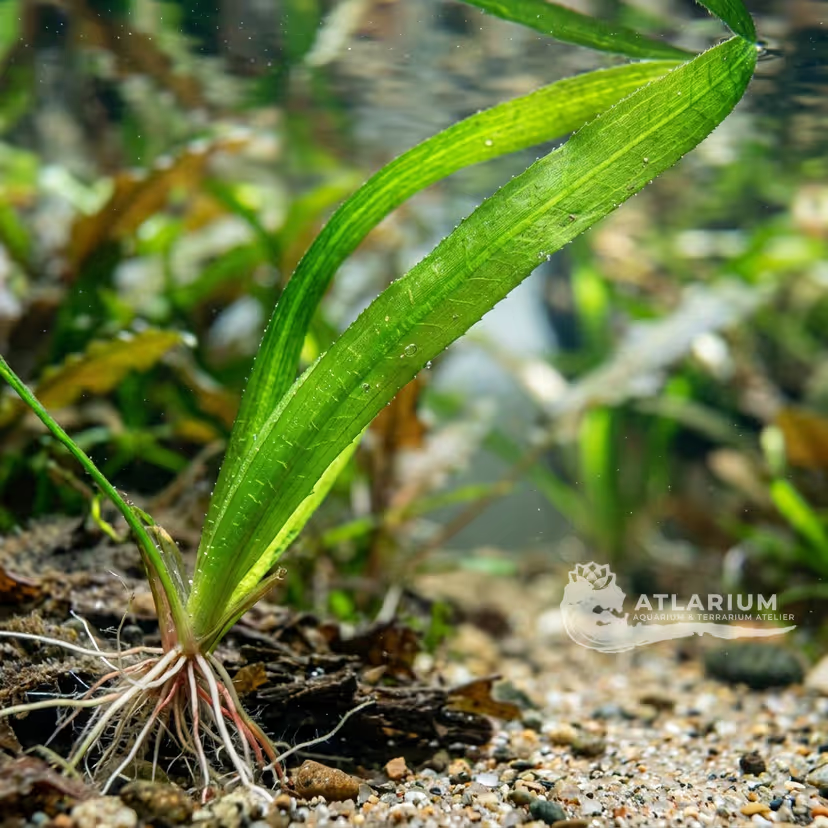
Vallisneria spiralis "Tortifolia"

View details->
Vallisneria australis

Vallisneria australis

Vallisneria australis

View details->
Vallisneria australis 'Curly'

Vallisneria australis 'Curly'

Vallisneria australis 'Curly'

View details->
Vallisneria australis 'Marmor'

Vallisneria australis 'Marmor'

Vallisneria australis 'Marmor'

View details->
Vallisneria gracilis

Vallisneria gracilis

Vallisneria gracilis

View details->
Vallisneria nana "Tiger"

Vallisneria nana "Tiger"

Vallisneria nana "Tiger"

View details->
Limnobium spongia

Limnobium spongia

Limnobium spongia

View details->
Vallisneria sp. 'Natans'

Vallisneria sp. 'Natans'

Vallisneria sp. 'Natans'

View details->

Recommended companions

Compatible cards from coherent ecosystems with matching parameters.

Ramshorn Snail
Invertebrate

Ramshorn Snail

Planorbella duryi

View details->
Orange dwarf crayfish (CPO)
Invertebrate

Orange dwarf crayfish (CPO)

Cambarellus patzcuarensis "Orange"

View details->
Montezuma dwarf crayfish
Invertebrate

Montezuma dwarf crayfish

Cambarellus montezumae

View details->
Malaysian Trumpet Snail
Invertebrate

Malaysian Trumpet Snail

Melanoides tuberculata

View details->
Daggerblade Grass Shrimp
Invertebrate

Daggerblade Grass Shrimp

Palaemon pugio

View details->
Electric Blue Crayfish
Invertebrate

Electric Blue Crayfish

Procambarus alleni

View details->
Olive nerite snail
Invertebrate

Olive nerite snail

Vitta usnea

View details->
Spotted nerite snail
Invertebrate

Spotted nerite snail

Neritona juttingae

View details->
Thick-lipped nerite snail
Invertebrate

Thick-lipped nerite snail

Neritona labiosa

View details->
Tiger nerite snail
Invertebrate

Tiger nerite snail

Vittina turrita

View details->
Swamp dwarf crayfish
Invertebrate

Swamp dwarf crayfish

Cambarellus puer
View details->
Asian apple snail
Invertebrate

Asian apple snail

Pila ampullacea

View details->
Bladder snail
Invertebrate

Bladder snail

Physella acuta

View details->
Channelled apple snail
Invertebrate

Channelled apple snail

Pomacea canaliculata

View details->
Chinese mystery snail
Invertebrate

Chinese mystery snail

Cipangopaludina chinensis

View details->
Ear pond snail
Invertebrate

Ear pond snail

Radix auricularia

View details->

Similar care

Cards with similar requirements, difficulty, habitat, and husbandry profile.

Najas marina

Najas marina

Najas marina

View details->
Najas guadalupensis

Najas guadalupensis
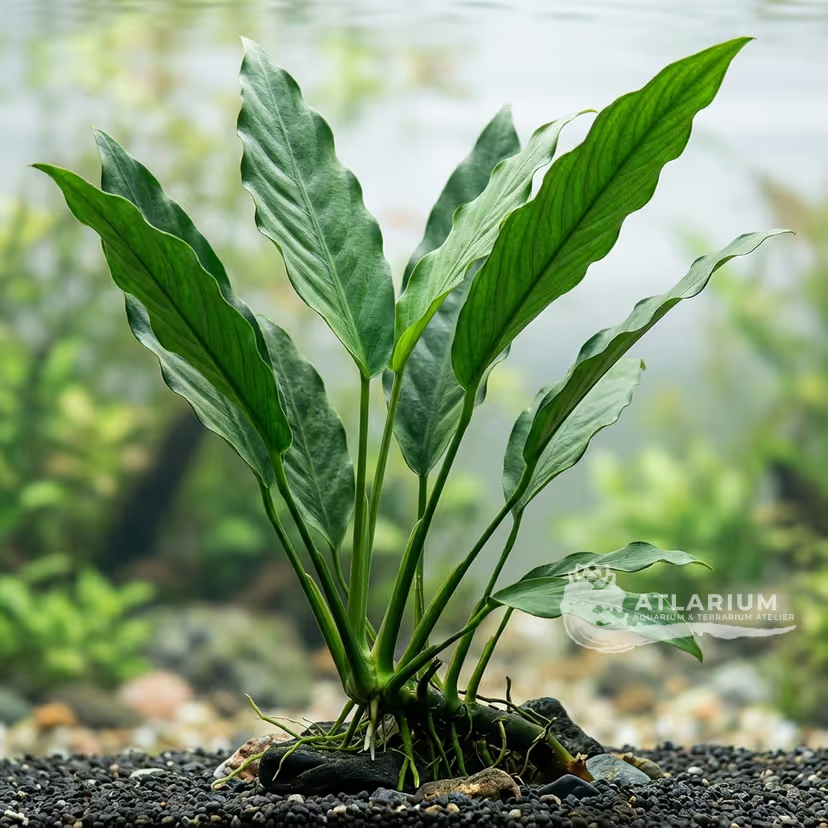
Najas guadalupensis

View details->
Anubias heterophylla

Anubias heterophylla
Anubias heterophylla

View details->
Curly Waterweed (Lagarosiphon major)

Curly Waterweed (Lagarosiphon major)

Lagarosiphon major

View details->
Aegagropila linnaei

Aegagropila linnaei

Aegagropila linnaei

View details->
Azolla mexicana

Azolla mexicana

Azolla mexicana

View details->
Anubias afzelii

Anubias afzelii

Anubias afzelii

View details->
Anubias gracilis

Anubias gracilis

Anubias gracilis

View details->
Amblystegium riparium

Amblystegium riparium

Amblystegium riparium

View details->
Apalanthe granatensis

Apalanthe granatensis

Apalanthe granatensis

View details->
Najas conferta

Najas conferta

Najas conferta

View details->
Azolla caroliniana

Azolla caroliniana
Azolla caroliniana

View details->
Blyxa aubertii

Blyxa aubertii

Blyxa aubertii

View details->
Ottelia alismoides

Ottelia alismoides

Ottelia alismoides

View details->
Anubias gigantea

Anubias gigantea

Anubias gigantea

View details->
Ottelia ulvifolia

Ottelia ulvifolia

Ottelia ulvifolia

View details->
Last updated: 06/30/2026
Elodea nuttallii Care Guide & Tank Setup | Atlarium