One-spot Betta
Betta unimaculata
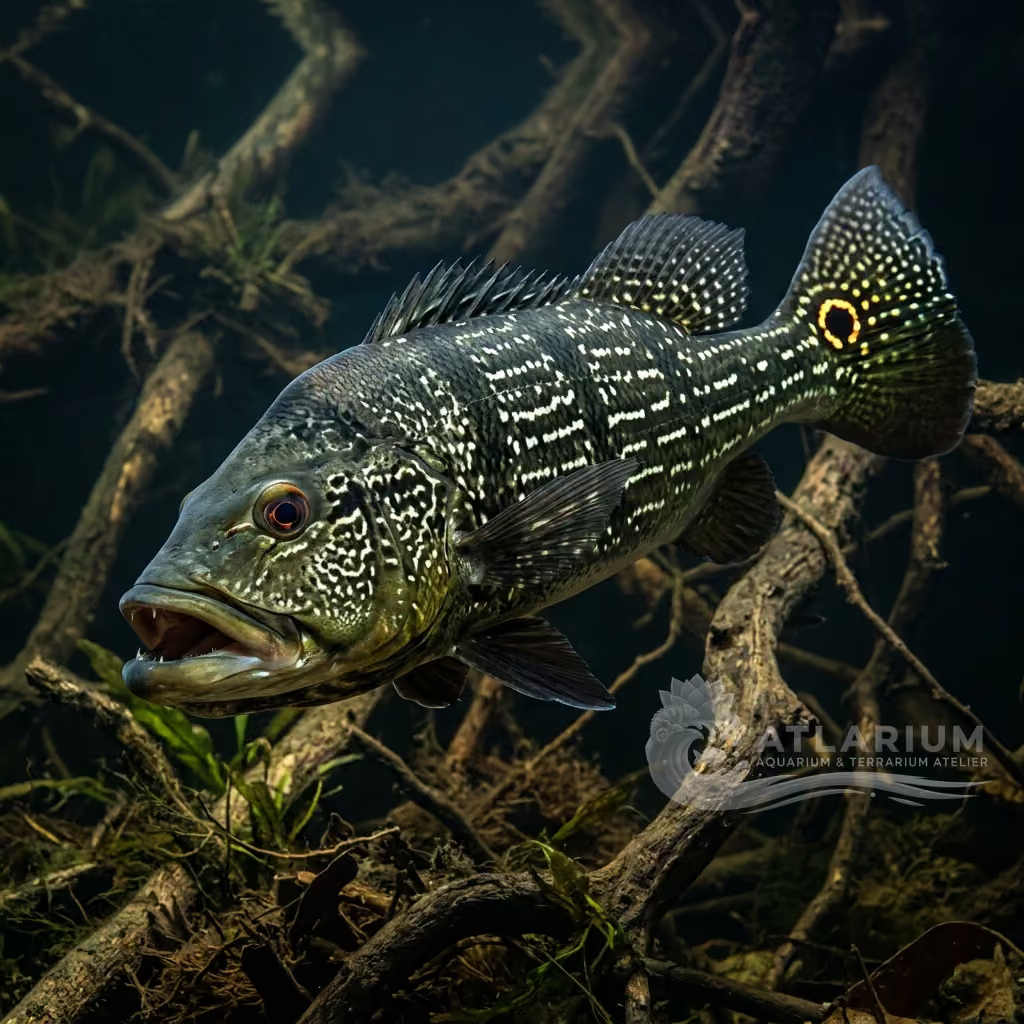
The 'Giant One-Spot Betta' (12 cm). Among the largest existing Bettas, a massive oral brooder and river predator from Borneo. Brown-golden coloration with blue/green iridescences and the unmistakable large black spot at the base of the tail. Impressive for its size and rustic charm.
Water Temperature
22 - 27 °C
pH Value
5.5 - 7.5
Water type
Freshwater
Tank level
All levels
Adult size
12 cm
Minimum tank volume
>= 100 L
Minimum group
>= 1
GH
1 - 15 dGH
KH
1 - 7 dKH
TDS
25 - 295 ppm
Conductivity
39 - 461 uS/cm

Species description
Geographical Origin and Habitat: Endemic to the Mahakam River basin in East Kalimantan (Indonesian Borneo). Populates clear forest streams flowing over smooth rock, sand and leaf litter, often ascending mountain streams.
Taxonomy and Morphology: Howong Betta (Betta unimaculata). One of the "giants" of the family (unimaculata group). "Unimaculata" (one spot) refers to the black ocellus present on the caudal peduncle, sometimes faded. Very wide head adapted for incubation and robust scales.
Social Behavior: Aggressive and intolerant predator. Although juveniles may tolerate each other, adults (especially females among themselves) will fight fiercely. Requires very large tanks if kept in a group, but a single pair is much safer.
Coloration and Sexual Dimorphism: Brownish base color. Males develop stunning bluish or metallic green-gold reflections on the cheeks (opercula) and flanks, while females are noticeably duller and lacking iridescence. Females are often the angriest of the pair.

Care, breeding and tankmates
Aquarium Setup: Robust tank of at least 100 cm (40 inches). Requires a lot of free water to swim, massive woods to serve as visual hiding places, and above all a SEALED lid: they have the muscular power to push or break through light lids and jump out.
Diet and Feeding: Voracious macro-predator. Literally eats anything that fits in its mouth (including small fish). Feed large frozen or live insects (crickets, mealworms, large earthworms) and cichlid pellets. Be careful not to overfeed.
Water Quality: Extraordinarily adaptable. Lives without problems in weakly acidic to slightly alkaline waters (pH 5.5-7.5), but appreciates clean, highly oxygenated water and regular water changes given the massive size that generates pollution.
Compatibility and Cohabitation: Unsuitable for the classic community aquarium. Cohabits only with fish of similar or larger size that are not aggressive (e.g. large Barbs, peaceful bottom-dwelling Cichlids). Any fish smaller than 5 cm (2 inches) will be actively hunted and eaten in one bite.
Aquarium Breeding: Mouthbrooder. The male incubates a cloud of large eggs for 14-21 days. Due to his voracity, young inexperienced males tend to swallow the first broods. Needs total tranquility.
Risks and Diseases: Exceptional jumper. If there is even 1 cm (half an inch) of gap near the filter cables, the Betta unimaculata will find it and end up dried on the floor. It is a physically powerful fish and almost unassailable by common diseases.

Geographic origin and distribution
Endemic to the Mahakam River basin in East Kalimantan (Indonesian Borneo). Populates clear forest streams flowing over smooth rock, sand and leaf litter, often ascending mountain streams.
Origin
Central America and CaribbeanSouth and Southeast Asia

Fish profile
- Temperament
- Semi-aggressive
- While generally peaceful toward unrelated tankmates, Betta unimaculata exhibits strong territoriality and intraspecific aggression, particularly among males. Males engage in dramatic ritualized displays involving gill flaring and mouth gaping to establish dominance. Despite their large size, they can be easily intimidated and outcompeted by highly active or aggressive species.
- Diet
- Omnivore
- In their natural habitat, this species is strictly carnivorous, preying on terrestrial insects, larvae, and small aquatic invertebrates. Captive specimens will eventually accept dry pellets, but their primary diet should consist of high-quality live or frozen foods such as Artemia, Daphnia, and bloodworms. Large adults can occasionally be fed small earthworms, though feeding must be strictly regulated to prevent obesity.
- Life expectancy
- 3-5 years
- Adult size
- 12 cm
- Sex ratio
- 1:1 ratio
- This species is best kept in compatible pairs (1:1 ratio) to prevent territorial conflicts, as randomly selected individuals may not coexist peacefully. A small group can also be maintained, provided the aquarium is sufficiently large and heavily decorated to disperse intraspecific aggression. Allowing a pair to form naturally from a group of juveniles is highly recommended for breeding success.
- Feeding frequency
- Twice daily
- It is recommended to feed Betta unimaculata once or twice daily, providing small portions that are consumed within a few minutes. This species is highly prone to obesity and digestive issues, so incorporating one fasting day per week is beneficial. During breeding preparation, feeding frequency can be slightly increased for the female to support egg production.
- Bioload
- Low to Medium
- Betta unimaculata has a low-to-medium bioload because it is typically kept in pairs or small groups, though its relatively large size and carnivorous diet produce moderate waste. Efficient but gentle filtration, such as a sponge filter or a canister filter turned down, with a turnover rate of 4-5 times the tank volume per hour is recommended. Regular water maintenance and debris removal are necessary to maintain high water quality.
- Flow
- Stagnant
- This species prefers weak-to-moderate water flow, reflecting the calm, slow-moving pools and margins of their native Bornean streams. Although they can inhabit flowing headwaters, they seek out stagnant sections and sheltered zones near vegetation. Excessive water current will stress the fish and can cause the mouthbrooding male to swallow or spit out the eggs prematurely.
- Jump risk
- Yes
- The jumping risk for Betta unimaculata is exceptionally high, as this species is renowned for its ability to leap out of the water through the smallest openings. In the wild, this behavior helps them navigate between isolated pools and escape predators, but in captivity, a tight-fitting lid is absolutely mandatory. Some breeders even secure the top with plastic wrap to ensure there are no gaps.
- Reproduction
- Oviparous
- Betta unimaculata is a paternal mouthbrooder, making its reproduction highly fascinating but moderately challenging. Following a protracted courtship and spawning embrace, both parents collect the eggs, and the female spits them into the male's mouth, where he incubates them for 10-14 days. During this period, the male must not be disturbed, as stress can easily cause him to swallow the entire brood.
- Compatibility & tankmates
- Species only
- Due to its size and specific requirements, Betta unimaculata is not suitable for standard community aquariums. It can be housed with peaceful, similarly sized tankmates like certain small cyprinids or loaches, provided they are not small enough to be eaten or active enough to cause stress. However, keeping them in a dedicated species-only setup for a single pair is the most successful approach.
- Tank level
- All levels
- Betta unimaculata utilizes all levels of the aquarium, swimming actively between the substrate and the surface. As a labyrinth fish, it frequently visits the surface to breathe atmospheric air, but it also enjoys resting and foraging among leaf litter and roots at the bottom. Aquarists should leave a few centimeters of space between the water surface and the lid to preserve a humid air layer.

Scientific Parameters & Models
FishBase
Window to the official scientific data of the species
FishBase v25.04Data synced on: 06/15/2026
- Trophic level
- 3.3 ± 0.4 se
- Resilience
- High (less than 15 months)
- Phylogenetic uniqueness (PD50)
- 0.5
- Bayesian Length-Weight
- a = 0.01, b = 2.97
- VulnerabilityLow vulnerability (10 / 100)

Related species
Recommendations grouped by close relatives, companion choices, and similar care.