

SOS Aquarium
Plant Diseases & Deficiencies
Identify nutritional deficiencies, pests, and aquatic plant pathologies.
Copy the link or share this page so you can easily find it again.
SOS Aquarium
Plant Diseases & Deficiencies
Identify nutritional deficiencies, pests, and aquatic plant pathologies.
 Environmental (Water Quality)
Allelopathy
Allelopathy is a phenomenon of true 'chemical warfare' between plants. Some plant species actively secrete allelochemical compounds (like phenols or alkaloids) from their roots or leaves into the surrounding water to inhibit the germination, root development, and growth of nearby rival plants, thus securing light and nutrients for themselves. In the aquarium hobby, the presumed mutual toxicity between Cryptocoryne and Vallisneria, or stunted growth near large bushes of Microsorum pteropus, is well known.
 Environmental (Water Quality)
Ammonia Burn
Ammonia (NH3) is highly toxic to fish, but in minute concentrations, it is the preferred nitrogen source for plants. However, violent spikes in ammonia cause chemical burns and osmotic destruction of delicate plant tissues. This phenomenon is extremely common during the first weeks of starting an aquarium when heavily fertilized active soils (like ADA Aqua Soil Amazonia) are used, which intentionally release massive amounts of ammoniacal nitrogen to feed carpeting plants. If the pH is alkaline (above 7.0), ammonium (NH4+) converts into the more lethal ammonia (NH3), worsening the burns.
 Nutritional Deficiency
Calcium Deficiency (Ca)
Calcium is the literal 'glue' (calcium pectate) holding plant cell walls together. Crucially, Calcium is completely immobile in plant tissue. Once laid down in a leaf, it cannot be moved. Thus, when the tank runs out of Calcium, the older leaves stay perfect, but the new growth immediately suffers catastrophic structural failure.
 Environmental (Water Quality)
Carbon / CO2 Deficiency
By dry weight, a plant is over 45% pure Carbon. It is the absolute 'master variable' in planted aquariums. Without dissolved CO2 gas, the most expensive fertilizers and lighting are utterly useless. When plants are driven hard by intense lighting but starved of CO2, they shut down and leak organics, which directly triggers the most dreaded algae of all: Black Beard Algae (BBA).
 Environmental (Water Quality)
Copper Toxicity
Although copper (Cu) is an essential trace element required by plants in microscopic amounts for plastocyanin synthesis and photosynthetic electron transport, it becomes highly lethal at even slightly elevated concentrations (above 0.1 mg/l). Copper toxicity is almost always hobbyist-induced through the use of fish parasite medications (like Ich or Oodinium treatments) or improper use of powerful copper sulfate-based algaecides/molluscicides. It blocks iron uptake and destroys cellular enzymes.
 Environmental (Water Quality)
Crown and Stem Rot
Mechanical and asphyxic rot of the stem or rhizome commonly occurs due to human error during planting, not nutritional deficiencies. When rosette or rhizomatous plants (like Anubias, Microsorum, Bucephalandra) are planted too deeply, burying the 'crown' or rhizome in the sand or soil, the soft tissues drown and rot. In stem plants (Rotala, Ludwigia), planting too many stems bunched together in a single hole deprives the lower portions of light and oxygen, causing them to blacken and snap.
 Environmental (Water Quality)
Cryptocoryne Melt
Cryptocoryne melt is one of the most terrifying phenomena for beginners, yet it is a natural biological survival mechanism, not an infection. It can also affect Vallisneria and Bucephalandra. New water chemistry, light, oxygen or CO2 availability — especially the transition from farm-grown emersed form to submersed life — can trigger the plant to draw on rhizome and root reserves, dissolve its old leaves, and grow new ones adapted to the tank.
 Environmental (Water Quality)
Emersed to Submersed Transition (Melt)
Almost 95% of commercially sold aquarium plants (in pots or in-vitro) are grown in hydroponic greenhouses in an emersed state. Emersed leaves are physically and structurally different from submersed ones: they possess a thick waxy cuticle to retain water and stomata open to the air. When the plant is suddenly submerged under water, these leaves become useless and unable to breathe or absorb dissolved nutrients. As a survival mechanism, the plant reabsorbs energy from the old leaves (causing them to melt) to desperately build new aquatic leaves adapted to the underwater environment.
 Environmental (Water Quality)
Epiphytic Algal Smothering
Plants often die not from internal deficiencies, but because they are physically strangled and smothered by epiphytic algae. Aggressive algae like BBA (Black Beard Algae), GSA (Green Spot), and staghorn grip tightly to the leaf epidermis. When algae cover exceeds 50-60% of the leaf surface, the plant is physically unable to photosynthesize: light is shielded by the algae layer, and O2 and CO2 gas exchanges are blocked. This leads to the necrotic death of the individual leaf.
 Pest / Infestation
Herbivore Damage
Mechanical damage caused by herbivorous fish or snails is often misdiagnosed as nutritional deficiencies, particularly confused with a lack of potassium. However, the margins of the holes created by animals have sharp, jagged edges or translucent scrapes, unlike deficiency necrosis which has yellowed, faded borders. Loricariids (like Ancistrus and Plecostomus) tend to scrape the top layer of the leaf epidermis, particularly on Echinodorus, leaving a network of intact veins. Snails and fish like Cichlids or herbivorous Characins bite off entire pieces of the leaf.
 Nutritional Deficiency
Iron Deficiency (Chlorosis)
Iron is the quintessential micronutrient and the engine of chlorophyll production. Because Iron is immobile within the plant, it cannot be recycled from old tissues. Therefore, a sudden drop in water column iron levels will exclusively strike the brand new growing tips.
 Environmental (Water Quality)
Light Burn (Photoinhibition)
The most persistent myth in the hobby is 'more light equals faster growth and zero algae'. The rise of hyper-powerful LED fixtures (like Chihiros or Twinstar) has led to countless tanks literally getting sunburned. When the sheer volume of photons hitting a leaf exceeds the plant's capacity to process that energy (due to a lack of dissolved CO2), photoinhibition occurs. The excess light physically destroys the photosynthetic machinery inside the plant cells.
 Environmental (Water Quality)
Liquid Carbon Toxicity
'Liquid carbon' (sold as a CO2 alternative or algaecide) contains glutaraldehyde or similar polymers. While tolerated by many plants at recommended doses, it acts as a mild biocide that destroys the cellular structure of algae. Some very primitive aquatic plants or those with thin cuticles cannot tolerate the chemical aggression of glutaraldehyde, even at minimum doses. Overdosing, often used to fight algae, leads to irreversible tissue liquefaction.
 Nutritional Deficiency
Magnesium Deficiency (Mg)
Magnesium is the literal core atom of the chlorophyll molecule, just like iron is for our blood. Without it, the plant cannot absorb light. Since Magnesium is one of the two primary minerals determining General Hardness (GH), soft water or unbalanced hard water can easily lead to severe deficiency. It is a highly mobile element, meaning the plant will strip it from old leaves to supply the new growth.
 Nutritional Deficiency
Nitrogen Deficiency (N)
Nitrogen is the fuel block of DNA, proteins, and chlorophyll. While fish waste naturally produces Nitrogen via the nitrogen cycle (ammonia to nitrate), high-tech planted aquariums consume massive amounts of N. When the plant load far exceeds the bioload, Nitrogen bottoms out at zero.
 Nutritional Deficiency
Phosphorus Deficiency (P)
Historically demonized as the ultimate 'algae trigger', Phosphorus (measured as Phosphate, PO4) is actually essential for plant cell division and root development via ATP (Adenosine Triphosphate). Thanks to modern methods like the Estimative Index, we now know that starving a tank of phosphates doesn't kill algae; it only stunts plant growth, causing decaying leaves that actually trigger algae.
 Nutritional Deficiency
Potassium Deficiency (K)
Potassium (K) is a critical macronutrient, crucial for enzyme activation and osmoregulation in plants. Unlike Nitrogen and Phosphorus, which are supplied by fish waste, Potassium must be supplemented in nearly all planted aquariums. Because it is highly mobile, symptoms always manifest strictly on older leaves first.
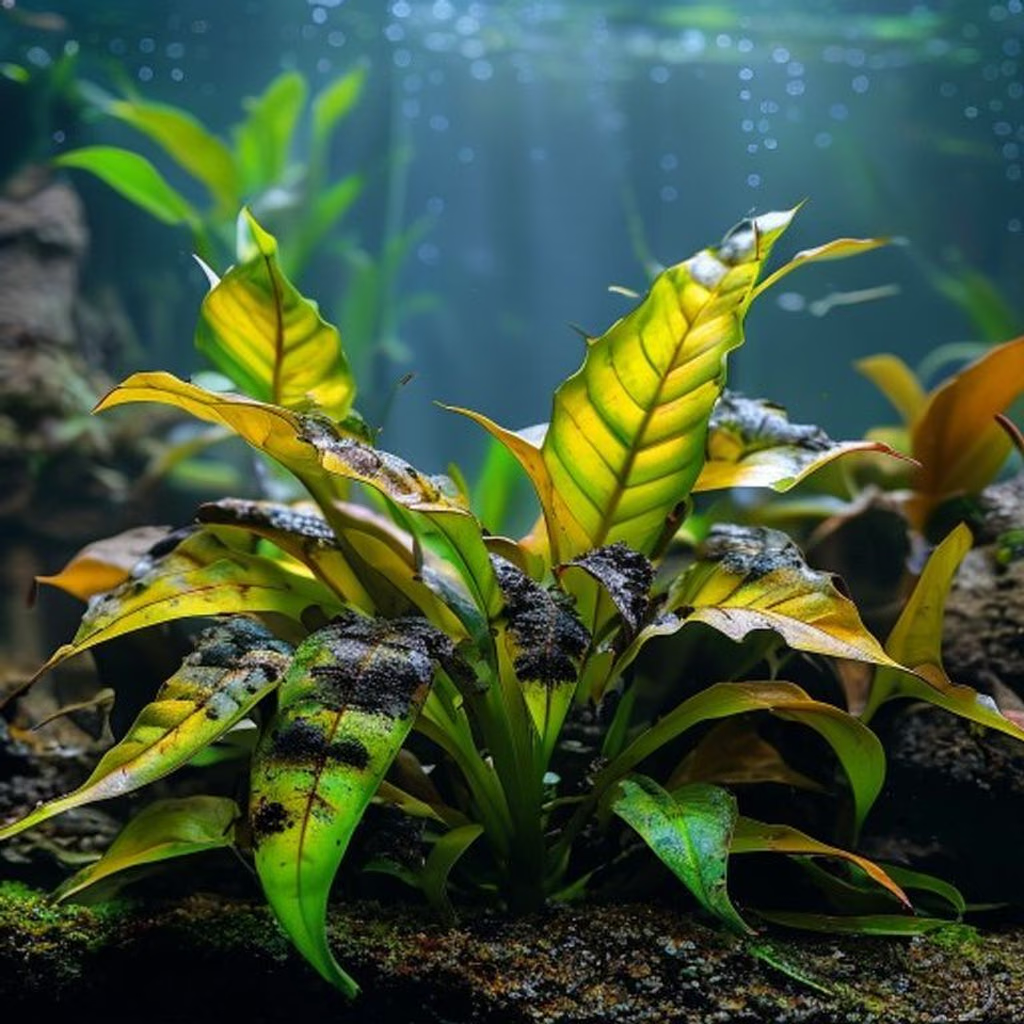 Bacterial
Rhizome Rot (Anubias Disease)
Epiphytes like Anubias, Bucephalandra, and Java Ferns possess a thick, crawling stem called a rhizome. This rhizome is their lifeline. Rhizome rot is a catastrophic, bacterial tissue-eating disease (often driven by Erwinia or Pseudomonas species). It rapidly destroys the vascular tissue in a matter of days and is highly contagious to other epiphytes in the water column.
 Environmental (Water Quality)
Substrate Compaction & H2S
Root asphyxiation occurs when the aquarium substrate becomes excessively anoxic (oxygen-deprived). In deep sand beds or very fine, undisturbed substrates, the lack of water circulation favors the settlement of anaerobic bacteria that produce hydrogen sulfide (H2S), a highly toxic gas. Plant roots trapped in these zones rot, turning black and mushy. Hydrogen sulfide typically smells like 'rotten eggs', and if released in large quantities into the water column, it can instantly kill fish and invertebrates.
 Nutritional Deficiency
Sulfur Deficiency
Sulfur (S) is a fundamental structural macronutrient, often overlooked in the aquarium hobby compared to the classic NPK. It is absorbed by plants as sulfate (SO4-2) and is vital for the synthesis of essential amino acids like cysteine and methionine, as well as for chlorophyll. Since commercial fertilizers (like potassium sulfate) provide sulfur as a 'byproduct', a true deficiency in the aquarium is extremely rare but can occur in systems using pure RO water and fertilizers formulated exclusively with nitrates/chlorides.
 Environmental (Water Quality)
Temperature Shock
Aquatic plants are poikilothermic: their metabolism is directly regulated by water temperature. While tropical fish often prefer temperatures of 28-30°C, almost all aquarium plants (often of sub-tropical origin) thrive best between 21 and 24°C. Above 28°C, cellular respiration accelerates faster than photosynthesis: the plant literally burns more energy than it can produce, starving itself. A sudden temperature drop (e.g., during a winter water change) instead causes the collapse of lymphatic vessels.
 Nutritional Deficiency
Trace Elements Deficiency (B, Mn, Zn)
Apart from the big NPK macros and Iron, plants require microscopic traces of Manganese, Boron, Zinc, Copper, and Molybdenum. These act as enzymatic 'keys' to unlock protein synthesis and DNA replication. This deficiency usually only plagues high-tech tanks running on 100% pure RO water without proper comprehensive micro-fertilization.