Salvinia auriculata agg.
Salvinia auriculata agg.
Salvinia auriculata agg. is a very fast-growing floating aquatic fern, perfectly suited for creating shaded areas and providing refuge at the water's surface. This robust plant effectively absorbs excess nutrients, contributing to a healthier and more balanced aquarium ecosystem.
Water Temperature
12 - 30 °C
pH Value
5 - 8
Water type
Freshwater
Light
Medium - High
CO2
Low - High
KH
0 - 14 dKH

Species description
Geographical Origin and Habitat: Salvinia auriculata agg. originates from the tropical and subtropical regions of the Americas, spanning from the southern United States down to Argentina. It thrives in still or slow-moving aquatic environments such as ponds, lakes, ditches, and swamps, where it forms expansive floating mats. Its adaptability to various conditions has made it a cosmopolitan species in many similar climates, often considered invasive outside its native range due to its rapid proliferation.
Taxonomy & Genetics: The suffix "agg." stands for "aggregate," indicating a complex of closely related species to Salvinia auriculata that are morphologically very similar and challenging to distinguish without detailed microscopic or genetic analysis. This group includes species like Salvinia molesta and Salvinia natans, although S. molesta is often treated separately due to its more aggressive characteristics. All these ferns belong to the Salviniaceae family, a group of primitive aquatic plants that reproduce via spores rather than flowers and seeds.
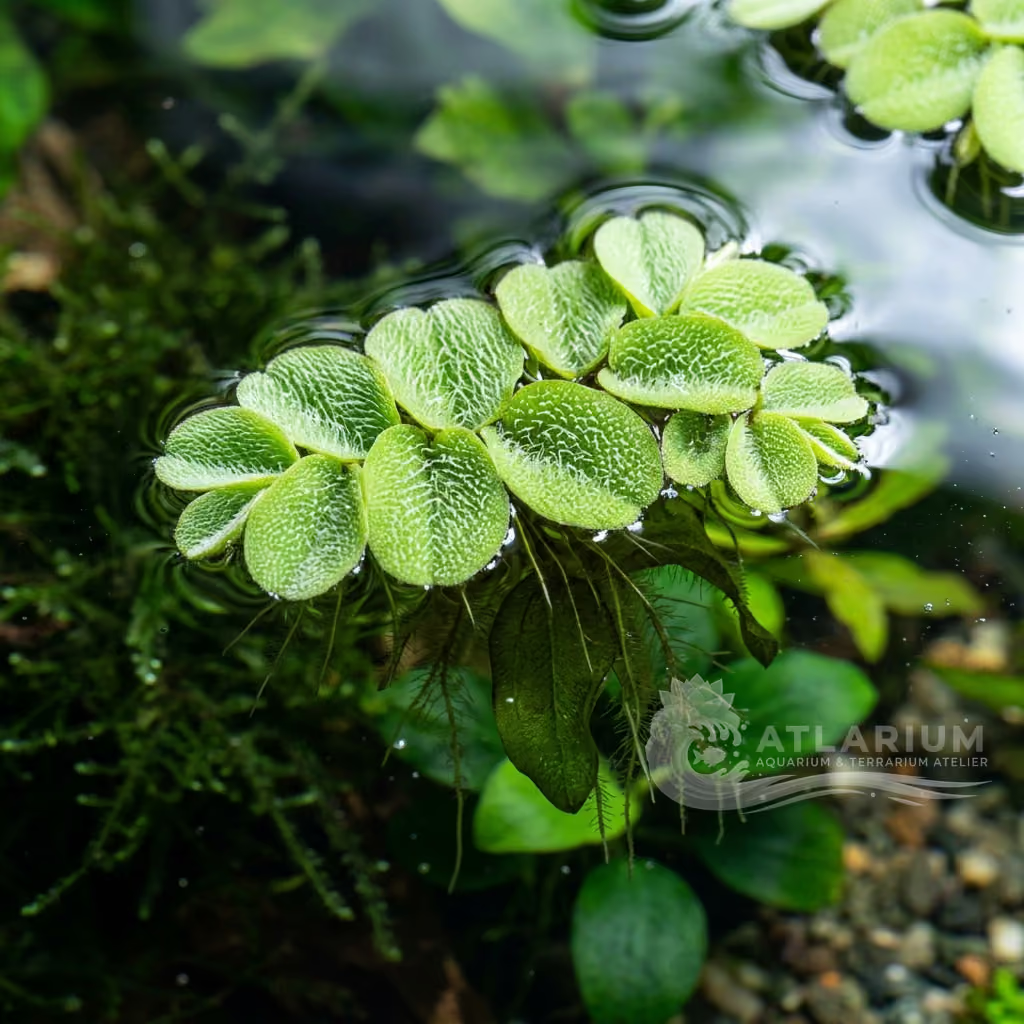
Physical Structure: Salvinia auriculata agg. is a floating fern characterized by small, elliptical or rounded leaves arranged in pairs on the water surface, with a third submerged leaf modified into root-like structures. The floating leaves are covered in water-repellent hairs that form tiny air pockets, giving them a velvety appearance and ensuring buoyancy. These structures allow the plant to resist submersion and glide easily across the water. Its submerged root system, although not anchored in the substrate, serves for nutrient absorption and provides refuge for microfauna.
Color & Texture: The leaves of Salvinia auriculata agg. display a vibrant bright green or greenish-yellow color, which can intensify or darken depending on light intensity and nutrient availability. The upper surface is covered with dense hairs, giving it a unique, velvety, and hydrophobic texture to the touch, distinguishing it from other floating plants. This hairy covering not only aids in buoyancy but also provides a distinctive and decorative appearance, making it attractive for aquascaping.

Care, breeding and tankmates
Lighting & CO2: For Salvinia auriculata agg., medium intensity lighting is generally sufficient to support vigorous and rapid growth. Too intense light can lead to excessive growth and a dense mat, while insufficient light might slow its development and cause decline. It does not require CO2 injection, as it absorbs carbon directly from the atmosphere, but benefits from good air circulation above the
Water Chemistry: surface to facilitate this gas exchange.
Nutrition & Substrate: As a floating plant, Salvinia auriculata agg. absorbs nutrients directly from the water column, rendering substrate irrelevant for its nutrition. It is an excellent consumer of nitrates and phosphates, helping to keep the water clean and prevent algal growth, which makes it particularly useful in aquariums with high fish bioloads. A general liquid fertilization, with a good balance of macro and micronutrients, will be sufficient to ensure its health and rapid expansion.
Water Chemistry: Salvinia auriculata agg. thrives in a water temperature range of 20 to 28 degrees Celsius, making it compatible with most tropical aquariums. It prefers slightly acidic to neutral pH, between 6.0 and 7.5, and a carbonate hardness (KH) ranging from 2 to 12. Maintaining these parameters stably is crucial for its health, although it is a relatively tolerant plant capable of adapting to minor fluctuations.
Space Management & Placement: Given its nature as a floating plant, Salvinia auriculata agg. positions itself on the water surface, providing shade for plants and animals below and creating a more natural environment. While the technical data might list "midground," it is essential to clarify that Salvinia is a pure floating plant and does not root in the substrate. It is advisable to confine its expansion to specific areas of the aquarium to prevent it from completely obscuring the surface, which would compromise light for submerged plants and gas exchange.
Pruning: Salvinia auriculata agg. has a "very fast" growth rate, meaning regular and vigorous pruning is essential for its maintenance. Without proper management, it can quickly cover the entire water surface, suffocating other plants and reducing oxygenation. Pruning simply involves physically removing excess plants with a net or by hand, aiming to keep approximately 50-70% of the surface free to allow light penetration and gas exchange.
Risks & Diseases: Despite its robustness, Salvinia auriculata agg. can be susceptible to nutrient deficiencies if the water is too poor, manifesting as leaf yellowing. Excessive condensation build-up on the aquarium lid can sometimes cause rot of the upper leaves due to a lack of air exchange. It is also important to be careful not to introduce common floating plant pests from external environments, such as undesirable snails or aquatic insects.

Geographic origin and distribution
Salvinia auriculata agg. originates from the tropical and subtropical regions of the Americas, spanning from the southern United States down to Argentina. It thrives in still or slow-moving aquatic environments such as ponds, lakes, ditches, and swamps, where it forms expansive floating mats. Its adaptability to various conditions has made it a cosmopolitan species in many similar climates, often considered invasive outside its native range due to its rapid proliferation.
Origin
North AmericaAmazon, Orinoco, and GuianasExtra-Amazon South AmericaCentral America and CaribbeanCosmopolitan or introduced

Plant profile
- Placement
- Midground
- It is placed floating directly on the water's surface. It is incredibly useful for creating shaded areas in the aquarium, which benefits shy fish and helps control algae growth below. However, care must be taken to ensure it does not completely block light from reaching demanding underwater plants.
- Botanical form
- Floating
- This floating fern features small, oval leaves covered in complex, water-repellent hairs that keep the plant afloat. Beneath the surface, it develops modified, root-like structures that trail in the water to gather nutrients. The intricate surface hairs give the leaves a very unique, almost velvety texture.
- Growth
- VERY_FAST
- The growth rate is extremely fast, especially when provided with strong lighting and high nutrient levels. It can quickly cover the entire surface of an aquarium within a few weeks. Regular removal of excess plants is mandatory to maintain proper gas exchange and light penetration.
- Substrate
- None
- As a free-floating aquatic plant, it has no interaction with the aquarium substrate. Its root-like modified leaves hang suspended in the water column to absorb nutrients directly. Therefore, substrate choices have zero impact on the health or growth of this species.
- Column fertilization
- Recommended
- Liquid fertilization is the only way to feed this plant effectively. A comprehensive fertilizer containing nitrogen, phosphorus, potassium, and trace elements is highly recommended. Because it grows so fast, it is excellent at soaking up excess nutrients, making it a great natural filter.
- Root fertilization
- None
- Root fertilization is completely inapplicable for this species as it never roots in the substrate. All nutrients must be supplied via the water column. Adding root tabs to the aquarium will only benefit this plant if those nutrients leach into the water.
- Trimming
- Occasional
- Maintenance involves physically removing excess plants from the water surface rather than trimming them with scissors. Scooping out a portion of the colony weekly prevents it from blocking too much light. Ensure that discarded plants are disposed of properly and never introduced into local waterways. Regular thinning keeps the remaining plants healthy and vibrant.
- Propagation
- Division
- Propagation is incredibly fast and occurs naturally as the plant splits and forms new branches. As it grows across the surface, it constantly divides into new, independent plants. To control the population, simply scoop out handfuls of the plant and dispose of them properly.
- Sensitivity
- Moderate
- While generally hardy, Salvinia auriculata agg. is sensitive to strong surface agitation and excessive splashing, which can sink or damage its delicate leaves. It also dislikes condensation dripping onto its surface in closed-lid aquariums. High humidity combined with poor ventilation can lead to leaf rot. Ensure adequate airflow above the water surface for best results.
- Layout role
- Floating
- In the aquascape, Salvinia auriculata agg. serves to create a natural, shaded environment reminiscent of a tropical stream or pond. The dangling roots provide a sense of depth and offer excellent hiding places for fry and small fish. It helps to diffuse intense lighting, creating a softer mood for the tank. Additionally, it aids in biological filtration by absorbing excess nutrients.

Related species
Recommendations grouped by close relatives, companion choices, and similar care.