Encyclopaedia

Plant atlas
PlantFreshwaterEasy
©AI Generated·Proprietary

Amblystegium riparium

Amblystegium riparium

Amblystegium riparium: aquatic moss of the family Amblystegiaceae. Light: Low to high.

Taxonomy
Class:Liliopsida
Order:Hypnales
Family:Amblystegiaceae
Genus:Amblystegium
Species:Amblystegium riparium

Share

Check out Amblystegium riparium on Atlarium

PracticeRecognition quizzesPhotos, names, origins, and puzzles to review Atlas species.Open quizzes
Water Temperature

10 - 26 °C

pH Value

5.5 - 8

Water type

Freshwater

Light

Medium - High

CO2

Low

GH

0 - 20 dGH

KH

0 - 14 dKH

Species description

Amblystegium riparium is a cosmopolitan aquatic moss, widely distributed across Europe, North America, Northern Asia, and parts of Africa. It colonizes highly diverse freshwater and damp habitats, including slow-moving rivers, forest streams, canals, ponds, and lake shores. It grows anchored to solid surfaces like rocks, submerged tree roots, and woody debris, enduring frequent periods of emersed growth and seasonal water level fluctuations. Classified in the Amblystegiaceae family, this pleurocarpous moss shares morphological affinities with other aquatic moss species, making visual distinction sometimes complex without microscopic analysis. Genetically, Amblystegium riparium possesses high tolerance for pollutants and low oxygen levels, adapting to live in eutrophic waters with high levels of phosphates and nitrates that would be toxic to other plants.

Care, breeding and tankmates

It tolerates a wide range of pH (5.0-8.0) and hardness (KH 2-21 dKH). It is a temperature-adaptable moss (4°C-30°C), but prefers temperatures below 25°C to avoid vegetative slowdown. It can tolerate moderately polluted waters. The primary risk is the accumulation of dirt and organic debris within the filaments, which can cause cyanobacteria or hair algae growth that smothers the moss. Introducing detritivorous shrimp helps keep the moss clean.

Geographic Origin and Distribution

This species originates from: Cosmopolitan.

Origin

Europe, Mediterranean, and West AsiaNorth AmericaAfrica and MadagascarEast Asia

Plant profile

Placement
Epiphyte

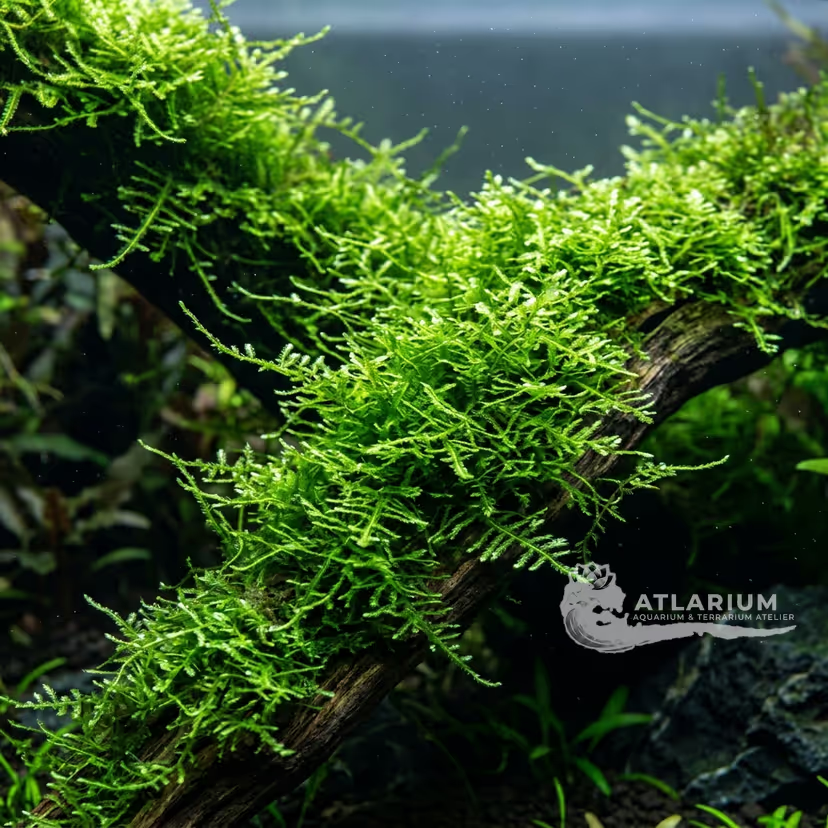
It is ideally placed attached to hardscape materials such as driftwood, rocks, or mesh pads in the foreground or midground. Because it does not root into the substrate, it must be tied down with cotton thread or fishing line until its rhizoids anchor naturally. Placing it in an area with gentle to moderate water flow helps keep it free of detritus. It should not be buried in gravel or sand, as the covered portions will quickly rot.

Botanical form
Moss

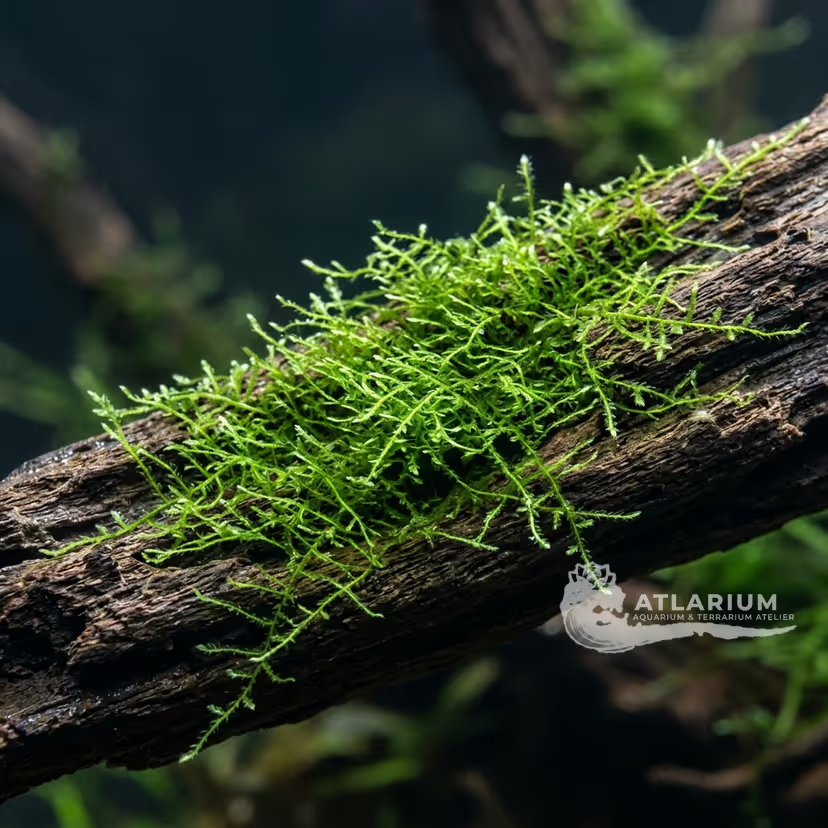
This moss features delicate, branching fronds that create a soft, feathery appearance underwater. The stems are extremely thin, covered in tiny, vibrant green leaves that can vary slightly in shape depending on the specific gravity and flow. It naturally tends to grow outward and upward, often creating a creeping or weeping effect over hardscape. The overall structure provides excellent hiding places for small shrimp and fish fry.

Growth
Medium

The growth rate is moderate to fast, depending strongly on lighting intensity and the availability of CO2. Under low light, it will grow slowly and appear more stringy, while higher light and CO2 injection will result in rapid, compact, and bushy growth. Once established, it can quickly cover large areas of hardscape, requiring regular maintenance. It is one of the more vigorous mosses when conditions are optimal.

Substrate
None

This versatile moss is inherently epiphytic and has absolutely no demand for a nutrient-rich substrate. It anchors itself to submerged roots, stones, and driftwood using tiny hair-like structures called rhizoids. Attempting to plant this moss into a traditional substrate layer will often lead to smothering; rather, it should be allowed to freely attach to hardscape where it can efficiently absorb nutrients through its leaves.

Column fertilization
Recommended

Liquid column fertilization is the only effective way to feed this plant, as it entirely lacks a true root system. A regular, light dosing of a comprehensive liquid fertilizer will ensure healthy, continuous growth. It is particularly responsive to potassium and micronutrients. Caution should be taken not to overdose, as excessive nutrients combined with high light can lead to hair algae entangling the delicate fronds.

Root fertilization
None

Root fertilization is completely unnecessary and ineffective for this species. It does not possess true roots, only rhizoids used for anchoring to surfaces. Placing root tabs beneath the moss will yield no benefits and may only pollute the water column. All nutritional needs must be met via the water column.

Trimming
Occasional

Trimming is crucial to maintain the health and shape of the moss pad. Over time, the lower layers may become shaded and die off, causing the entire clump to detach from its anchor. Regular, aggressive pruning with curved spring scissors will encourage dense, healthy new growth. The trimmed pieces must be carefully netted out of the aquarium, as any stray fragments will easily establish themselves elsewhere.

Propagation
Division

Propagation is incredibly simple and occurs through mechanical division. You can simply pull a clump apart or use the trimmings to start a new patch. Attach the small fragments to a new piece of hardscape using thread, fishing line, or cyanoacrylate superglue. Given good water quality, these small pieces will quickly grow out and form a new, cohesive mat.

Sensitivity
Moderate

This moss is highly sensitive to chemical treatments, particularly liquid carbon additives (like glutaraldehyde) and copper-based medications, which can cause it to melt rapidly. It is also sensitive to accumulating detritus; if debris settles within the fronds, it can suffocate and promote algae growth. It prefers cooler water temperatures and may suffer or thin out in excessively warm aquariums.

Layout role
Epiphyte, Midground

It plays an essential role in softening the look of hardscape, making wood and rocks appear naturally aged and integrated into the environment. It is frequently used to create 'trees' by attaching it to branchy driftwood or to form lush, textured carpets over flat stones. Its intricate texture contrasts beautifully with broad-leaved plants. Additionally, it serves a functional role as a premium grazing and hiding area for dwarf shrimp.

Image gallery

Licensed images linked to the species or, when marked, to the closest representative taxon.

Related species

Recommendations grouped by close relatives, companion choices, and similar care.

Recommended companions

Compatible cards from coherent ecosystems with matching parameters.

Orange dwarf crayfish (CPO)
Invertebrate

Orange dwarf crayfish (CPO)

Cambarellus patzcuarensis "Orange"

View details->
Ramshorn Snail
Invertebrate

Ramshorn Snail

Planorbella duryi

View details->
Montezuma dwarf crayfish
Invertebrate

Montezuma dwarf crayfish

Cambarellus montezumae

View details->
Cherry Shrimp
Invertebrate

Cherry Shrimp

Neocaridina davidi

View details->
Swamp dwarf crayfish
Invertebrate

Swamp dwarf crayfish

Cambarellus puer

View details->
Malaysian Trumpet Snail
Invertebrate

Malaysian Trumpet Snail

Melanoides tuberculata

View details->
Daggerblade Grass Shrimp
Invertebrate

Daggerblade Grass Shrimp

Palaemon pugio

View details->
Green babaulti shrimp
Invertebrate

Green babaulti shrimp

Caridina cf. babaulti "Green"

View details->
Azolla caroliniana

Azolla caroliniana

Azolla caroliniana

View details->
Azolla mexicana

Azolla mexicana

Azolla mexicana

View details->
Acorus gramineus

Acorus gramineus

Acorus gramineus

View details->
Anubias "nangi"

Anubias "nangi"

Anubias "nangi"

View details->
Anubias barteri var. angustifolia

Anubias barteri var. angustifolia

Anubias barteri var. angustifolia

View details->
Anubias barteri var. barteri

Anubias barteri var. barteri

Anubias barteri var. barteri

View details->
Anubias barteri var. caladiifolia

Anubias barteri var. caladiifolia

Anubias barteri var. caladiifolia

View details->
Anubias barteri var. coffeifolia

Anubias barteri var. coffeifolia

Anubias barteri var. coffeifolia

View details->

Similar care

Cards with similar requirements, difficulty, habitat, and husbandry profile.
Anubias barteri var. glabra

Anubias barteri var. glabra

Anubias barteri var. glabra

View details->
Climacium japonicum

Climacium japonicum

Climacium japonicum

View details->
Anubias gilletii

Anubias gilletii

Anubias gilletii

View details->
Anubias heterophylla

Anubias heterophylla
Anubias heterophylla

View details->
Anubias barteri var. nana 'Petite' ('Bonsai')

Anubias barteri var. nana 'Petite' ('Bonsai')

Anubias barteri var. nana 'Petite'

View details->
Anubias afzelii

Anubias afzelii

Anubias afzelii

View details->
Anubias barteri var. nana 'Golden Heart'

Anubias barteri var. nana 'Golden Heart'

Anubias barteri var. nana 'Golden Heart'

View details->
Anubias barteri var. nana

Anubias barteri var. nana

Anubias barteri var. nana

View details->
Anubias barteri var. nana 'Round Leaf'

Anubias barteri var. nana 'Round Leaf'

Anubias barteri var. nana 'Round Leaf'

View details->
Marimo Moss Ball

Marimo Moss Ball

Cladophora aegagropila

View details->
Anubias gracilis

Anubias gracilis

Anubias gracilis

View details->
Christmas Moss

Christmas Moss

Vesicularia dubyana

View details->
Callicostella prabaktiana

Callicostella prabaktiana

Callicostella papillata prabaktiana
View details->
Cryptocoryne beckettii "Viridifolia"

Cryptocoryne beckettii "Viridifolia"

Cryptocoryne beckettii "Viridifolia"

View details->
Aegagropila linnaei

Aegagropila linnaei
Aegagropila linnaei

View details->
Anubias minima

Anubias minima

Anubias minima

View details->
Last updated: 06/16/2026
Amblystegium riparium Care Guide & Tank Setup | Atlarium