Hydrocotyle leucocephala
Hydrocotyle leucocephala
Brazilian Pennywort is an adaptable, fast-growing plant that can be planted or left free-floating. An excellent choice for beginners, providing lush green tangles.
Water Temperature
20 - 28 °C
pH Value
6 - 7.5
Water type
Freshwater
Light
Medium
CO2
Low
Expected height
30 cm
Expected width
15 cm
GH
2 - 20 dGH
KH
2 - 15 dKH

Species description
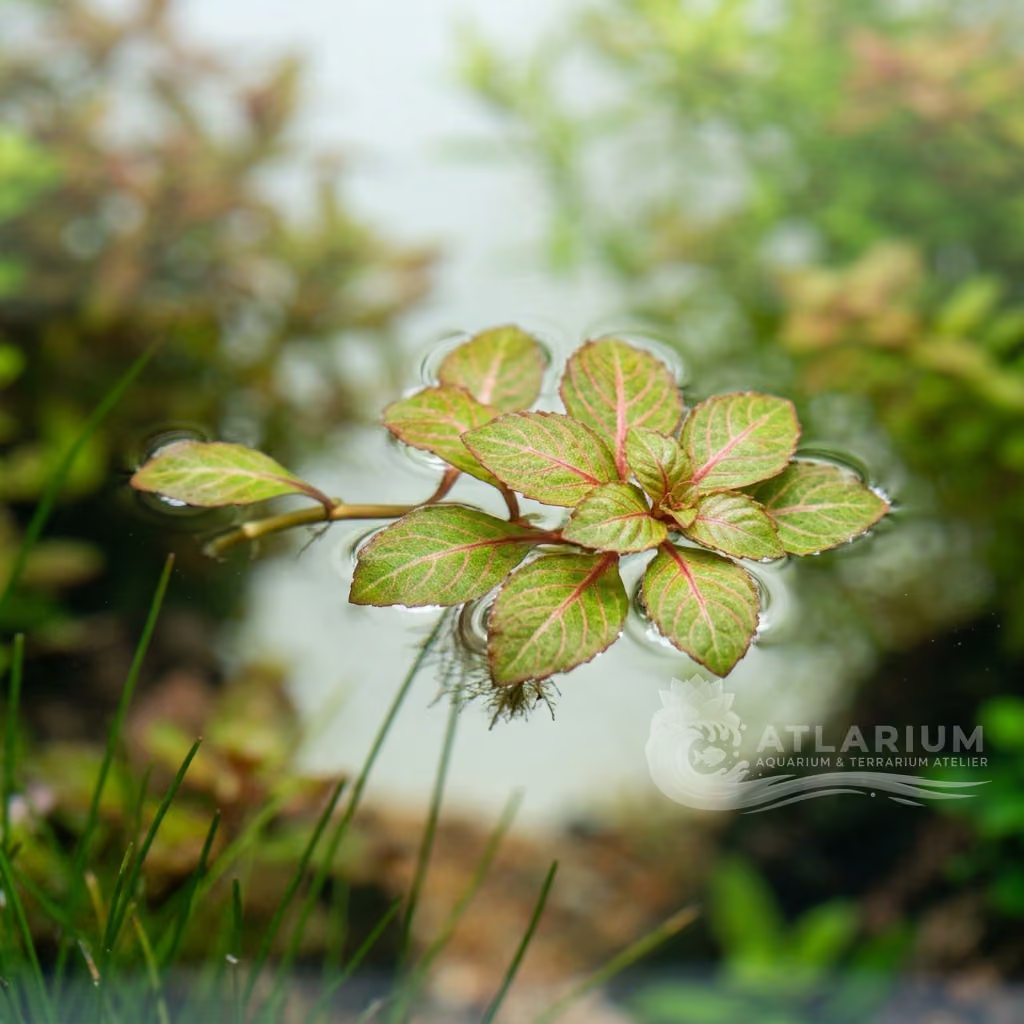
Geographical Origin and Habitat: Known in the aquarium hobby as Brazilian Pennywort, *Hydrocotyle leucocephala* is endemic to temperate and tropical South America. It populates humid margins of jungle streams, shallow swamps, and seasonally flooded muddy lands. In nature, its prevalent habit is that of a creeping groundcover or free-floating plant, forming vast tangles on the water surface to escape the asphyxial zones of the bottom.
Taxonomy & Genetics: A dicotyledon of the Araliaceae family (formerly Apiaceae). It shares its biological family with the well-known English ivy (*Hedera helix*), whose climbing habits it closely resembles. The specific epithet *leucocephala* derives from Greek (leuko = white, cephalo = head), in reference to the graceful white umbrella-shaped inflorescences (white heads) that pop out of the water from the upper nodes.
Physical Structure: A caulescent architecture highly modified for creeping and floating. The fleshy, succulent, fragile, and thick stems bear alternate leaves arranged on one side of the stem or in a zigzag pattern. From the nodes, along with the erect leaf petioles, impressively long (up to 15 cm) downward-pointing white adventitious roots burst forth. The leaf is unmistakable: large (up to 4-5 cm), rounded in the shape of a kidney, shield, or coin, with slightly scalloped margins.
Color & Texture: Chromatically, it exhibits a fresh and uniform meadow green or pastel green color, without ever developing reddish variations, even under glaring light. The leaf blade shows light, paler radial veins. The texture is robust and papery, less delicate than its *tripartita* or *verticillata* cousins, making it fairly resistant to the exploratory bites of the most curious fish.

Care, breeding and tankmates
Lighting & CO2: A real green tank for beginners. Incredibly adaptable: it grows decently even in the dark corners of old aquariums, directing its stems vertically towards the surface. Under intense light, it doubles its growth rate, shrinking its leaves and thickening its stems. CO2 injection is not strictly necessary, as much of its development occurs as a floating or semi-emersed plant, allowing it to take in atmospheric carbon dioxide.
Nutrition & Substrate: It is the perfect "machine" for knocking down nitrates. It absorbs almost all of its massive need for organic nitrogen, phosphorus, and potassium directly from the water column through the countless and conspicuous floating roots at the nodes, making the substrate almost irrelevant (it grows lushly even free-floating, without ever touching the soil).
Water Chemistry: Invulnerable and plastic. It resists soft, acidic Amazonian water or hard, alkaline, calcareous waters typical of African cichlids (pH 6.0 to 8.0, GH 2-20). Ideal temperature 22-26°C, tolerating lows of 15°C and summer highs above 30°C. It actively helps to biologically filter and oxygenate the aquarium, absorbing heavy metals and nitrogenous waste.
Space Management & Placement: Extremely versatile. It can be planted in groups in the background like an ascending tangle, but its best (and most natural) applications are twofold: leaving it to free-float on the surface, creating a perfect protective green umbrella for fry, Betta fighting fish, or Gouramis; or tying/wedging it onto emerged branches and driftwood in a paludarium, where it will behave like a true cascading liana.
Pruning: A nightmare for scissors due to its astounding growth rate (it can lengthen by 5 cm a week). Prunings must be ruthless and regular to prevent the wide surface leaves from completely shading the aquarium. Cut the stems (topping) below a node and remove excess branches. Remove the oldest submerged leaves which, by nature, turn yellow, detach, and fall to the bottom.
Risks & Diseases: No pathogen worries it. The real risk is the abuse of its floating nature: if left to run on the surface, it will lethally block gas exchange (oxygenation) and nullify illumination for the plants below. Herbivorous fish do not disdain it: Platies or Apple Snails will gladly chew the young and tender submerged leaf blades, although not to the point of killing the plant.

Geographic origin and distribution
Known in the aquarium hobby as Brazilian Pennywort, *Hydrocotyle leucocephala* is endemic to temperate and tropical South America. It populates humid margins of jungle streams, shallow swamps, and seasonally flooded muddy lands. In nature, its prevalent habit is that of a creeping groundcover or free-floating plant, forming vast tangles on the water surface to escape the asphyxial zones of the bottom.
Origin
Amazon, Orinoco, and GuianasExtra-Amazon South America

Plant profile
- Placement
- Midground
- This versatile plant can be planted in the background, woven through driftwood, or left floating at the water surface. When floating, it provides excellent shade and hiding spots for small fish. Its large, round leaves offer a distinct visual contrast.
- Botanical form
- Stem, Floating
- Also known as Brazilian Pennywort, it has long, flexible stems with alternate, round to kidney-shaped leaves. The leaves are light green and can grow quite large under good conditions. Emersed growth may produce small, inconspicuous white flowers.
- Growth
- Fast
- It is known for its very rapid growth rate, especially when left floating closer to the light source. It can easily outgrow its space if not monitored. Regular trimming is usually necessary to keep it in check.
- Substrate
- None
- Hydrocotyle leucocephala, also known as Brazilian Pennywort, has virtually no specific substrate demands and is commonly grown floating or draped over hardscape. When planted, its stems can be loosely tucked into sand, gravel, or soil, though the roots mainly serve as a simple mechanical anchor. The plant primarily relies on its extensive white adventitious roots to absorb all necessary nutrients directly from the water column. Consequently, substrate depth and mineral composition play a minimal role in its overall cultivation and success.
- Column fertilization
- Recommended
- It draws the vast majority of its nutrients directly from the water column. A comprehensive liquid fertilizer containing both macro and micronutrients is highly recommended. It is an excellent indicator plant for nitrate or iron deficiencies.
- Root fertilization
- None
- While it can be planted in the substrate, root fertilization is generally not required. It develops fine, white roots at each node that primarily serve to anchor the plant or draw nutrients directly from the water. It thrives even in plain gravel or sand.
- Trimming
- Occasional
- Trimming is straightforward: simply pinch or cut the stem at any point to control its length. The trimmed top can be replanted or left to float. The remaining stem will sprout a new side shoot from the nearest node.
- Propagation
- Cuttings
- Propagation is as simple as cutting the stem and replanting or floating the severed portion. Each node is capable of producing roots and a new growth tip. It naturally propagates by fragmenting or growing side branches.
- Sensitivity
- Moderate
- It is incredibly hardy and tolerates a wide range of temperatures and pH levels. However, it can melt if exposed to very poor water quality or severe nutrient depletion. Its leaves are prone to accumulating debris if water flow is too low.
- Layout role
- Midground, Foreground
- Its primary role is to add a fast-growing, cascading element to the aquascape. It is often used to soften the harsh lines of hardscape or to create a natural, jungle-like canopy. It is also highly valued in breeding tanks for surface cover.

Image gallery
Licensed images linked to the species or, when marked, to the closest representative taxon.

Related species
Recommendations grouped by close relatives, companion choices, and similar care.