Picasso Triggerfish
Rhinecanthus aculeatus
The Abstract Demolitionist (12 inches / 30 cm). Extremely smart like a water-dog, but they will physically pick up rocks in their mouth and drop them against the glass.
Water Temperature
24 - 28 °C
pH Value
8.1 - 8.4
Water type
Marine
Tank level
All levels
Adult size
30 cm
Minimum tank volume
>= 300 L
Minimum group
>= 1
KH
7 - 12 dKH

Species description
Geographical Origin and Habitat: Originating from the vast shallows of the tropical Indo-Pacific Ocean (ranging heavily from East Africa and the Red Sea across to Hawaii and Micronesia). The Picasso Triggerfish rigidly inhabits and violently defends warm, sandy rubble zones immediately adjacent to shallow lagoons, coral flats, and mixed rock patches, frequently residing in sunlit waters less than 10 meters (30 feet) deep.
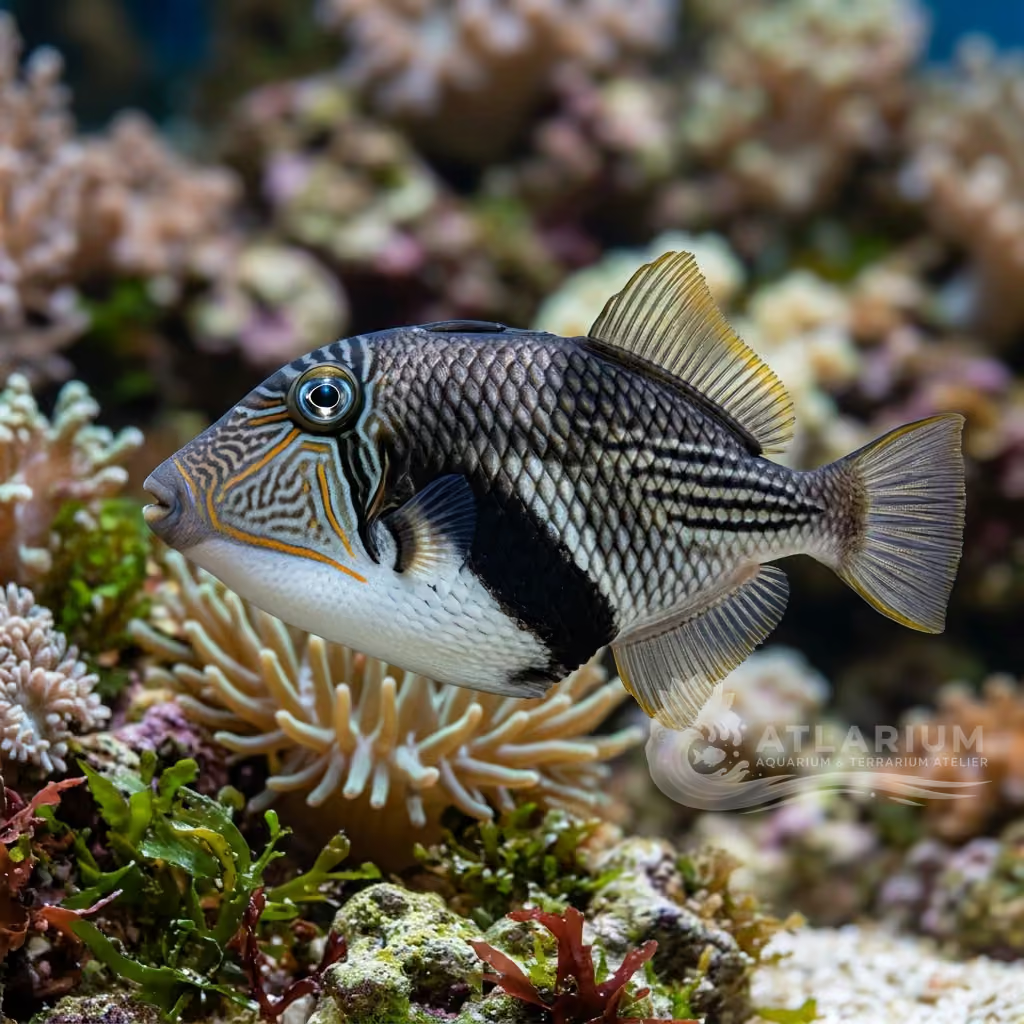
Taxonomy and Morphology: A universally iconic ambassador of the Balistidae family. It gained legendary global fame in Hawaii as the state fish, the "Humuhumunukunukuapua'a" (a title shared closely with the Rectangular Triggerfish, *R. rectangulus*). It features a highly compressed, solid oval body, boasting eyes positioned astonishingly high on its head, enabling it to scan the entire reef while burying its nose in the sand to root out prey. It sports the unbreakable locking dorsal "trigger" spine. Along the caudal peduncle (base of the tail), it brandishes three distinct, abrasive horizontal rows of tiny, backward-facing sharp spines (the namesake "aculeatus"). It reaches approximately 30 cm (12 inches) as a robust adult.
Social Behavior: Highly dynamic, stunningly intelligent, strictly diurnal, and aggressively territorial. It is a tireless underwater architect: it will dedicate entire days to lifting and throwing massive rocks with its mouth, violently blowing jets of water to excavate massive craters in the sand, and compulsively rearranging your entire tank's layout. Once it establishes its benthic territory, it operates as an intolerant, dictatorial predator, aggressively repelling anyone who nears its turf. Every single night, it faithfully returns to the exact same rock crevice, reversing in and tightly locking its trigger spine.
Coloration and Sexual Dimorphism: A swimming, vivid cubist painting, brushed in bold yet pastel tones. The belly is a stark, creamy milky-white, while the back gently fades into sandy-beige. The visual masterpiece lies on the flanks and face: striking, sharp diagonal neon-blue lines cross the face, intersected by a dark vertical band masking the high-set eyes. The distinctive yellow mouth is sharply outlined by an electric-blue racing stripe. The flank explodes with a wild, geometric wedge pattern surrounded by angular dark stripes, culminating in a reddish-black thorny tail peduncle. **Zero Visual Dimorphism:** Males and females sport the exact same astonishing cubist canvas and geometric layout.

Care, breeding and tankmates
Aquarium Setup: It mandates a spacious, heavily reinforced footprint (minimum 400-500 liters / 100-130 Gallons, extending at least 150 cm / 5 feet long). It must strictly be a "Fish-Only" (FOWLR) system. Providing a thick, deep bed of fine oolitic or sugar-sized coral sand is an absolute biological imperative to allow it to satisfy its obsessive "sand-blowing" and excavation instincts. You must utilize massive, heavy base rocks placed directly on the glass bottom and securely cemented; if you simply lay rocks on the sand, the Picasso WILL relentlessly dig under them, triggering a catastrophic avalanche that can shatter your tank glass. Heavily shield all exposed pump cables and PVC.
Diet and Feeding: A pure, unadulterated benthic predator armed with terrifyingly strong jaws and chisel teeth. Because its teeth grow continuously like a rodent's, you MUST provide a heavily abrasive, crunchy diet to grind them down: feed whole, raw shell-on shrimp, crushed live clams or mussels, thick crab legs, tough squid, and chunks of white fish, heavily supplemented with macro-algae or Nori. It is a ravenous garbage disposal that will eagerly crush extra-large carnivore pellets. Omitting hard, crunchy foods will rapidly result in alarming, uncontrollable tooth overgrowth.
Water Quality: Like most Balistidae, it is virtually indestructible, but its dietary habits produce industrial-scale biological waste. Optimal parameters: Specific Gravity 1.022-1.025, pH 8.1-8.4, 24-27°C (75-81°F). The mechanical filtration (filter socks or roller mats) must be utterly impeccable and cleaned constantly to capture the massive, cloudy dust storms it kicks up while blowing sand, alongside the regurgitated, chewed-up fragments of crab shells. A vastly oversized commercial protein skimmer is critically essential to prevent lethal nitrate spikes.
Compatibility and Cohabitation: The "Bully Architect". 100% utterly incompatible with Reef aquariums: it will gleefully shatter and devour every single crab, snail, sea urchin, starfish, or ornamental shrimp, and will frequently bite the tips off expensive SPS stony corals either to uncover hidden worms or simply out of sheer destructive boredom. It can ONLY coexist in massive tanks alongside equally heavily armored, brutally assertive fish (large Tangs, fully grown Emperor Angelfish, Groupers, or giant Pufferfish). If you introduce a small, peaceful, or timid fish, the Picasso will relentlessly chase and stress it to death, frequently biting crescent-shaped chunks out of its fins.
Aquarium Breeding: Impossible to replicate in domestic systems. In the wild ocean shallows, ripe females brutally excavate massive nesting craters deep into the sand. Upon laying, they transform into vicious, terrifyingly protective demons, launching frontal, rapid-fire attacks to relentlessly drive away massive fish, sea turtles, or the exposed legs and fins of oblivious human tourists who wander too close. The microscopic eggs adhere to the rubble and hatch incredibly fast, bursting forth as a cloud of pelagic larvae into the open current.
Risks and Diseases: 1. Unintentional Structural Collapse: Its pathological obsession with digging and moving boulders can and will undermine towering rock-scapes, causing them to collapse violently onto the bottom glass, risking catastrophic flooding. 2. Lethal Exploratory Bites (Aquarist Danger): It will boldly attack and sample glass thermometers (shattering them) and human fingers during maintenance (inflicting deep, painful puncture wounds). 3. Tragic Jaw Lock (Overgrowth): Feeding it an exclusive, pathetic diet of soft flakes or mushy thawed mysis will cause its teeth to protrude completely out of its mouth, preventing it from ever sealing its jaws or chewing, leading directly to a slow, heartbreaking death by starvation.

Geographic origin and distribution
Originating from the vast shallows of the tropical Indo-Pacific Ocean (ranging heavily from East Africa and the Red Sea across to Hawaii and Micronesia). The Picasso Triggerfish rigidly inhabits and violently defends warm, sandy rubble zones immediately adjacent to shallow lagoons, coral flats, and mixed rock patches, frequently residing in sunlit waters less than 10 meters (30 feet) deep.
Origin
Cosmopolitan or introducedAfrica and MadagascarTropical oceans and reefs

Fish profile
- Temperament
- Semi-aggressive
- They are bold, highly intelligent, and extremely territorial. They are known to recognize their owners and can even be trained to hand-feed, though caution is advised. Their belligerent nature requires careful planning when selecting tank mates.
- Diet
- Omnivore
- They are carnivorous predators equipped with powerful crushing jaws. Their diet must include hard-shelled items like clams, shrimp, and squid to keep their teeth worn down. High-quality marine pellets can also be offered as a dietary supplement.
- Life expectancy
- 10-15 years
- Adult size
- 30 cm
- Sex ratio
- Solitary
- They should strictly be kept as solitary specimens in a home aquarium. Introducing another Picasso Trigger or a closely related species will result in a fight to the death. They are extremely intolerant of conspecifics.
- Feeding frequency
- Twice daily
- Feed them two to three times a day with varied meaty foods. They are voracious eaters and will quickly consume whatever is offered. Ensure enough food is provided to reduce their natural aggression towards tank mates.
- Bioload
- High
- The Picasso Triggerfish generates a very heavy bioload due to its messy eating habits and size. A powerful protein skimmer and robust biological filtration are absolutely critical. Regular water changes are necessary to keep nitrate levels in check.
- Flow
- Moderate
- Rhinecanthus aculeatus needs steady, moderate circulation distributed across the aquarium rather than a narrow, forceful jet. It mandates a spacious, heavily reinforced footprint (minimum 400-500 liters / 100-130 Gallons, extending at least 150 cm / 5 feet long). It must strictly be a "Fish-Only" (FOWLR) system. This preserves useful water exchange while retaining calmer shelter for rest and feeding.
- Jump risk
- Yes
- Like many marine fish, they are capable of jumping out of an open aquarium. A tight-fitting lid or a secure mesh cover is highly recommended. This is especially true during feeding frenzies or territorial disputes.
- Reproduction
- Oviparous
- Breeding has not been successfully accomplished in the home aquarium. In the wild, they lay eggs in a nest dug in the sand, aggressively guarded by the female. Their pelagic larval stage makes captive rearing virtually impossible.
- Compatibility & tankmates
- Semi-aggressive
- They are highly aggressive and should only be kept in a aggressive fish-only marine setup. Large angelfish, tangs, and large wrasses can make suitable companions. They will decimate corals, small fish, and all mobile invertebrates like crabs and snails.
- Tank level
- All levels
- They are highly active swimmers that will utilize all levels of the aquarium. They need plenty of open swimming space as well as caves to sleep in. They frequently rearrange the substrate and smaller rocks to their liking.

Scientific Parameters & Models
FishBase
Window to the official scientific data of the species
FishBase v25.04Data synced on: 06/15/2026
- Trophic level
- 3.2 ± 0.1 se
- Resilience
- High (less than 15 months)
- Generation time
- 2.7 years
- Phylogenetic uniqueness (PD50)
- 0.5078
- Bayesian Length-Weight
- a = 0.02042, b = 2.91
- VulnerabilityLow to moderate vulnerability (30 / 100)

Related species
Recommendations grouped by close relatives, companion choices, and similar care.