Threespot dascyllus
Dascyllus trimaculatus
A resilient damselfish that starts life displaying three vivid white spots on a velvety black body. It grows into a bold, fiercely territorial adult, best suited for large setups with large fish.
Water Temperature
24 - 27 °C
pH Value
8.1 - 8.4
Water type
Marine
Tank level
Bottom and middle
Adult size
14 cm
Minimum tank volume
>= 280 L
Minimum group
>= 1
KH
8 - 12 dKH

Species description
Geographical Origin and Habitat:
This species features an incredibly wide distribution throughout the tropical Indo-Pacific. It is found from the Red Sea and East Africa to the Line and Pitcairn Islands, ranging north to southern Japan and south to Sydney, Australia. It inhabits outer reef slopes and deep lagoons at depths up to 55 meters, often associated with large sea anemones.
Taxonomy and Morphology:
Belonging to the family Pomacentridae, it has a deep, stocky, and laterally compressed body with a strongly arched back. Adults can reach a maximum length of about 14 centimeters. It features strong fins and a small, terminal mouth equipped with conical teeth adapted for capturing zooplankton in the water column.
Social Behavior:
Juveniles frequently live in close association with large sea anemones (such as Entacmaea quadricolor) or shelter within branching Pocillopora corals. As they mature, they lose this symbiotic dependence and become highly territorial, bold, and aggressive, defending their chosen territory against much larger fish.
Coloration and Sexual Dimorphism:
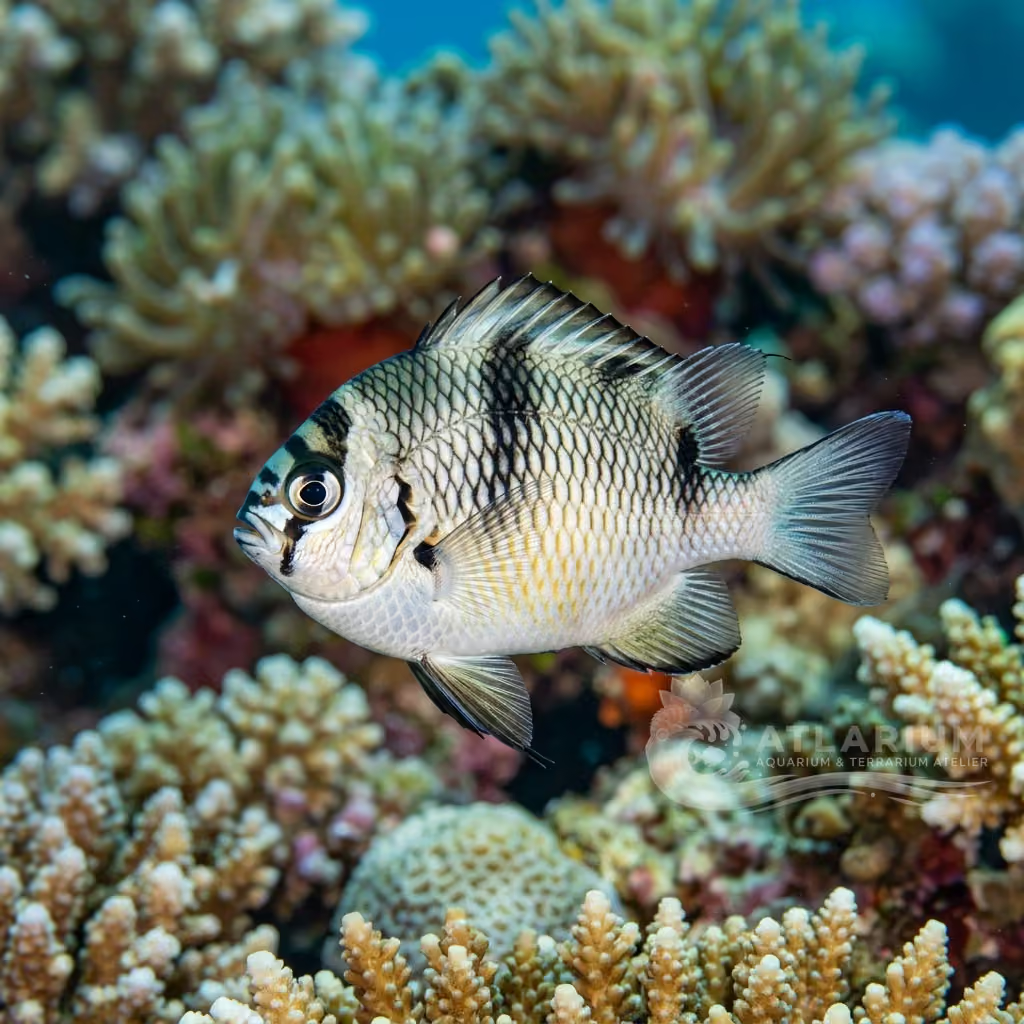
Juveniles exhibit a deep, velvety black color marked by three prominent, bright white spots: one on the forehead and one on each flank. As they grow into adulthood, the body color fades to a dull dark gray or brownish-black, and the white spots shrink or disappear completely. No visible external sexual dimorphism is present.

Care, breeding and tankmates
Aquarium Setup:
Although juveniles can be kept in smaller tanks, a minimum aquarium volume of 200 liters is highly recommended for adults due to their aggressive behavior. The tank should feature plenty of live rock arranged to create visual barriers, caves, and crevices, allowing other tankmates to hide and escape its territorial aggression.
Diet and Feeding:
An exceptionally hardy omnivore with a voracious appetite, it will readily accept almost any food offered. Provide a varied diet containing high-quality flake and pellet foods, frozen items like mysis, brine shrimp, and chopped krill, along with plant matter. It feeds actively at all levels of the water column.
Water Quality:
It is legendary for its tolerance of fluctuating water conditions, making it a common choice for cycling new aquariums (though this practice is discouraged today). For optimal health, maintain temperature between 23°C and 28°C, pH between 8.0 and 8.4, specific gravity between 1.020 and 1.025, and nitrates below 30 ppm.
Compatibility and Cohabitation:
Due to its severe adult aggressiveness, it must only be housed with robust tankmates that can defend themselves, such as tangs, large angelfish, dottybacks, and triggerfish. Avoid housing it with small, shy species like gobies, firefish, or anthias, as they will be constantly harassed and stressed.
Aquarium Breeding:
One of the few marine species that breeds relatively easily in home aquariums. They form monogamous pairs; the female deposits adhesive eggs on a cleared, smooth hard surface. The male guards and aggressively fans the eggs until they hatch, which usually occurs within 3 to 4 days of spawning.
Risks and Diseases:
This fish is incredibly disease-resistant and rarely succumbs to infections, making it physically easy to keep. However, the biggest risk is behavioral, as its territorial nature makes introducing new fish to the aquarium very difficult. Any new additions are likely to be targeted and attacked by the established dascyllus.

Geographic origin and distribution
This species features an incredibly wide distribution throughout the tropical Indo-Pacific. It is found from the Red Sea and East Africa to the Line and Pitcairn Islands, ranging north to southern Japan and south to Sydney, Australia. It inhabits outer reef slopes and deep lagoons at depths up to 55 meters, often associated with large sea anemones.
Origin
Tropical oceans and reefsAfrica and MadagascarEast AsiaAustralia, New Guinea, and Oceania

Fish profile
- Temperament
- Aggressive
- The Domino Damselfish is universally recognized as one of the most aggressive and highly territorial damselfish in the marine hobby. While they are incredibly cute and relatively peaceful as tiny juveniles, their temperament drastically shifts as they grow into pugnacious adults. They will fiercely defend their established territory from any intruder, regardless of the intruder's size. Due to this bold and belligerent nature, they should only be kept with similarly robust and aggressive fish.
- Diet
- Omnivore
- They are highly omnivorous and possess a very robust appetite, readily accepting a wide variety of foods. Their natural diet consists of plankton, small crustaceans, and various algae found in the reef environment. In captivity, they should be offered a varied diet including high-quality marine flakes or pellets, supplemented heavily with frozen mysis shrimp, brine shrimp, and chopped seafood. Providing some herbivore preparations containing Spirulina will ensure they receive necessary plant matter for long-term health.
- Life expectancy
- 10-20 years
- Adult size
- 14 cm
- Sex ratio
- Solitary
- There are no reliable, distinct physical differences between male and female Domino Damselfish, making visual sexing virtually impossible for hobbyists. They are known to be protogynous hermaphrodites, meaning individuals can change sex from female to male under certain social conditions. Because of their extreme intra-species aggression, keeping them in pairs or groups is only advised in very large systems. If a pair is desired, introducing a group of juveniles and allowing a pair to naturally form, while removing the others, is the safest approach.
- Feeding frequency
- 2-3 times daily
- To sustain their active metabolism and continuous swimming behavior, they should be fed multiple times a day. Offering small to moderate portions two to three times daily is highly recommended. This frequent feeding schedule not only keeps them healthy and vibrant but can also slightly reduce their natural aggression toward tank mates by preventing hunger-induced territoriality. Care must be taken not to overfeed, ensuring all food is consumed within a few minutes to prevent water degradation.
- Bioload
- Medium
- The bioload of the Domino Damselfish is generally considered moderate compared to other fish of similar size. As very active swimmers that consume substantial amounts of food, they produce a noticeable amount of waste. Proper filtration and regular water changes are essential to maintain high water quality, especially as they reach their maximum size. Despite this, they are incredibly hardy and often tolerate less-than-ideal water conditions better than many delicate reef fish.
- Flow
- Strong
- Domino Damselfish thrive in environments with moderate to strong water movement, simulating the dynamic currents of their natural reef habitats. Robust water flow provides them with exercise and helps to keep oxygen levels optimally high, which is important for their active lifestyle. Using powerheads or wavemakers to create varying currents across the aquarium is highly beneficial. However, ensure there are still some relatively calmer zones within the rockwork where they can rest at night.
- Jump risk
- No
- Reproduction
- Oviparous
- Breeding Domino Damselfish in captivity is entirely possible and occurs relatively frequently in well-established reef tanks. They are substrate spawners, with the male aggressively defending a chosen nesting site, usually a cleaned piece of flat rock or shell. The female deposits hundreds of small adhesive eggs, which the male then fertilizes and meticulously guards and fans until they hatch. Raising the microscopic larvae is extremely challenging, requiring specialized setups and a constant supply of rotifers and other tiny live foods.
- Compatibility & tankmates
- Reef safe
- This species exhibits a very high level of territoriality and aggression, particularly as it matures. It is completely incompatible with docile, shy, or smaller fish, which it will continuously harass, sometimes to the point of death. They are best kept with large, semi-aggressive to aggressive tank mates like tangs, large angelfish, or triggerfish that can easily stand their ground. Housing multiple Domino Damselfish together is risky unless introduced simultaneously into a very large aquarium.
- Tank level
- Middle/Bottom
- In the aquarium environment, they are highly active and utilize almost all levels of the water column. They will frequently dart from the substrate up to the surface in search of food or to inspect their surroundings. However, they naturally tend to congregate around rockwork, coral heads, or anemones, which they use as their central territory and refuge. You will typically see them hovering in the mid-water regions directly above their chosen rocky home.

Scientific Parameters & Models
FishBase
Window to the official scientific data of the species
FishBase v25.04Data synced on: 06/15/2026
- Trophic level
- 3 ± 0.24 se
- Resilience
- High (less than 15 months)
- Phylogenetic uniqueness (PD50)
- 0.5005
- Bayesian Length-Weight
- a = 0.03467, b = 2.93
- VulnerabilityLow vulnerability (10 / 100)

Related species
Recommendations grouped by close relatives, companion choices, and similar care.