Paravortex spp.
Paravortex
Paravortex is retained at genus level for a marine-fish-associated flatworm context. A 1986 aquarium report described a provisionally placed species that left its host, developed young off-host and rapidly reinfected fish. The same report found a formalin bath effective in that case and found neon gobies ineffective as cleaner fish. Dark spots are not a diagnosis, and the report supplies no universal dose, quarantine or fallow schedule.
Water type
Marine
Biological group
Rhabditophora
Record type
Genus
Recognition confidence
Low
Ecological functions
Parasite, Potential pathogen
Aquarium impact
Potentially harmful
Culture and management
Not cultured
Typical size
No value supported by reliable evidence
Visible to the naked eye
No value supported by reliable evidence
Useful starting magnification
No universal threshold supported by reliable evidence

Identity, habitat, and ecological role
Identity and evidentiary boundary: Paravortex is kept at genus level because the direct aquarium report describes a new turbellarian only provisionally placed in that genus. Its “black ich” presentation is a useful observation label, not a diagnosis: a dark spot, pigment change or damaged skin does not by itself identify a flatworm or establish infection. The supported conclusion must retain the marine host, observed stage and limits of the reported placement rather than promote a visible sign to species certainty.
Reported life-cycle pattern: In the published aquarium case, worms increased in length on fish and then left the host. Off-host adults continued to grow and developed as many as 160 young. Ciliated young discharged from the adult body wall quickly reinfected available fish. The reported cycle took about 10 days at 24.5 °C and reached very high burdens after successive generations. Those are study conditions, not a timetable, burden estimate or lifecycle proof for an unidentified aquarium finding.
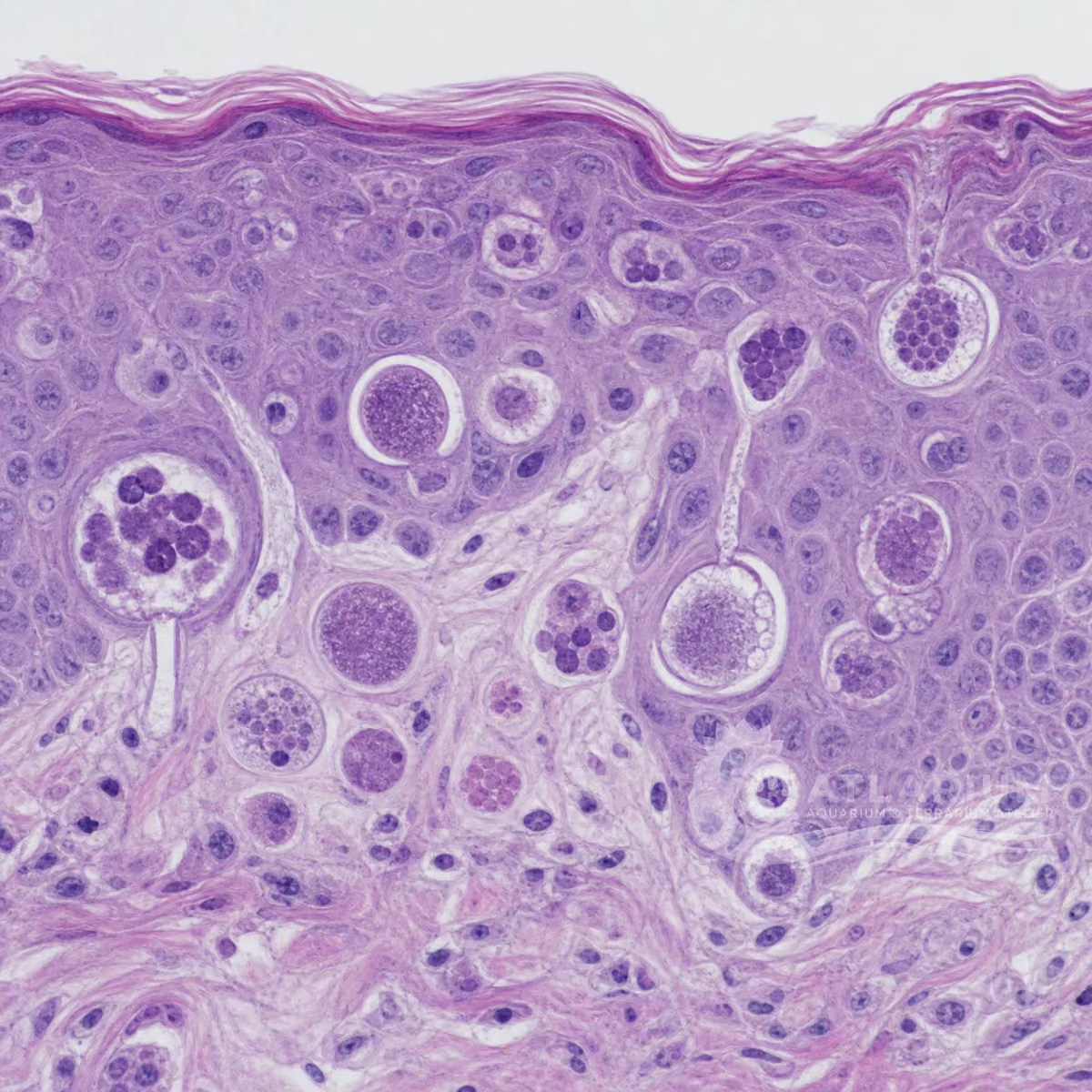
Marine host and disease context: The provisionally placed species parasitized tropical marine fish in several families, with yellow tang the principal host in the study. At high burden, worms concentrated on the body and fish developed acute focal dermatitis with an associated Vibrio infection. This association matters when reading a sick fish, but it does not establish that every dermatitis, bacterium or dark mark has the same cause. Host species, tissue condition, burden and differential diagnosis remain necessary.
Role and interpretive limit: The source supports a parasite and potential-pathogen context for its documented fish-associated event. Adults left the host, developed young off-host and those young reinfected fish, so a visible sign cannot be interpreted apart from stage and host context. The evidence does not establish the host range, virulence, current taxonomy or management of every organism labelled Paravortex. It also does not turn a dark spot into proof of infection, contagion or a need for treatment.

Observation, culture, and ecological relationships
Document the host event: Record the marine fish, lesion location, time course, affected animals and water context before interpreting a dark spot as Paravortex. The direct report involved tropical marine fishes and used yellow tang as its principal study host, but that does not make every yellow tang lesion or every aquarium fish a match. Preserve host and sample context because the record concerns a provisionally placed species, not a universal black-spot diagnosis.
Observe stage and timing: The documented parasite increased in length on fish, left the host, then continued development off-host. Ciliated young emerged from the adult body wall and quickly reinfected available fish. Its reported life cycle took about 10 days at 24.5 °C; that is a study condition, not a general timetable for an unknown flatworm, aquarium or temperature. A single photograph cannot establish whether an observed mark belongs to that sequence.
Read burden with the fish: In the report, heavy infections concentrated on the body and were associated with acute focal dermatitis and a Vibrio infection. That association does not prove that Paravortex initiates every dermatitis, that bacteria are absent or present, or that one visible spot predicts severity. Assess the fish, lesion trend and other plausible causes together. Worsening tissue damage, abnormal behaviour or mortality needs qualified fish-health assessment rather than a conclusion drawn from colour alone.
Culture and cleaner-fish limit: This card provides no culture, propagation or cleaner-fish method. The report observed off-host development as part of a parasite life cycle; reproducing that sequence would add biological risk rather than clarify an ordinary aquarium observation. Neon gobies were ineffective as cleaner fish in the documented case and themselves became infected. Do not infer that another cleaner organism will remove Paravortex or use animals as a diagnostic or control experiment.
Documented host relationship: The source documents a direction of interaction: a provisionally placed Paravortex species parasitized several families of tropical marine fish, with yellow tang most often observed in that study. Adults later left the host, developed off-host young and those young reinfected available fish. This supports a parasite and potential-pathogen context for that reported event. It does not define the host range, virulence or life cycle of all organisms called Paravortex.
Treatment, control and prevention limits: A formalin bath eradicated the parasite in the reported aquarium case, but the source supplies no concentration, route, duration, repeat schedule or host-safe universal regimen. The same study found neon gobies ineffective as cleaner fish. Its lifecycle observation does not validate praziquantel, a fixed fallow interval, universal quarantine, no-transfer rule or disinfection protocol. Keep any response conditional on diagnosis, fish welfare and qualified fish-health advice.

Geographic origin and distribution
Origin
Tropical oceans and reefs

Identification and observation data
- Record type
- Genus
- This is a genus-level Paravortex card, not a confirmation from a black spot. The direct report described a new marine-fish turbellarian provisionally placed in Paravortex. Its host, stage and intact diagnostic material matter. Do not convert a dark lesion, a trade label or a similar-looking flatworm into a species name or a confirmed aquarium infection.
- Recognition confidence
- Low
- Identification confidence is limited. The study's fish-associated worm, off-host development and reinfection pattern give a specific comparison, but a visible dark mark does not show those characters. Record the host, tissue site, stage, scale and timing. An observation must remain at the genus or broader flatworm level unless the available material and qualified assessment support more.
- Biological group
- Rhabditophora
- The reported organism was described as a turbellarian provisionally placed in Paravortex, in an older Graffillidae/Rhabdocoela context. This profile uses benthic microfauna only as an aquarium navigation group. It does not settle current higher taxonomy, identify every flatworm, or transfer the reported marine parasite relationship to an unrelated benthic observation. The card leaves order and origin unfilled: published rank trees differ, and named Paravortex species span distinct regions.
- Ecological functions
- Parasite, Potential pathogen
- Parasite and potential pathogen are context-bound roles. In the published aquarium case, the reported worm parasitized marine tropical fish, left the host, developed young off-host and rapidly reinfected available fish. Heavy infections were associated with focal dermatitis and Vibrio infection. These observations do not establish cause, burden, host range or clinical outcome for every Paravortex-labelled finding.
- Aquarium impact
- Potentially harmful
- Impact can be harmful when an appropriately supported fish-associated event follows the documented reinfection sequence. The report reached very high burdens in its study conditions, but one black spot is not a severity score or diagnosis. Read lesions with the affected fish, trend and alternative causes. Escalate progressive dermatitis, abnormal behaviour or mortality to qualified fish-health assessment.
- Culture and management
- Not cultured
- Paravortex is not a home culture organism. The source documents off-host development within a parasite life cycle, not a safe maintenance method. No propagation, cleaner-fish trial or transfer procedure is provided. Keep an observation tied to its host and system; deliberately reproducing or moving a suspected parasite is not an identification method and can increase biological risk.
- Typical size
- No value supported by reliable evidence
- No typical-size range is sealed. The direct Paravortex report describes growth and developmental stages but does not support a single genus-wide micrometre range. Existing 100–1,000 μm values are therefore not retained. Measure any intact sample with scale, stage and host site, but size alone cannot identify Paravortex, reproduce the reported life cycle or decide clinical significance.
- Visible to the naked eye
- No value supported by reliable evidence
- No naked-eye visibility scalar is sealed. The reported aquarium problem involved fish-associated worms and dark-spot presentations, but the source does not define a universal visibility threshold for Paravortex. A mark on a fish can be a host response, pigment or another cause. Document visible findings as observations and keep identity conditional until diagnostic material and context support it.
- Useful starting magnification
- No universal threshold supported by reliable evidence
- No minimum magnification scalar is sealed. The source does not make 100×, 400× or any other setting a Paravortex-identification threshold. Magnification records how an observation was made, not whether a dark spot has been diagnosed. Preserve host, stage, sample condition and scale; qualified morphology or other suitable methods may be needed before a consequential species or treatment conclusion.

Links to Aquarium SOS

Microworld ecological network
Links based on documented kinship, food webs, biofilms, and ecological functions.