FreshwaterMarineMicrobial communities and symbioses
Filter biofilm

Filter biofilm

Comunità microbica su supporto filtrante

On a sponge, ceramic medium or another submerged filter support, biofilm is changing attached community material rather than a named bacterium or a visible maturity test. Freshwater and marine aquarium studies show distinct biofilter communities; freshwater studies also document nitrification and succession. A brown or slippery layer confirms only that aggregate material is present, not which members are active, what process dominates, or which intervention is justified.

Water type

Freshwater / Marine

Biological group

Comunità microbica su supporto filtrante

Record type

Community

Recognition confidence

Medium

Ecological functions

Nitrifier, Decomposer

Aquarium impact

Context-dependent

Culture and management

Passive aquarium growth

Typical size

Value not applicable

Visible to the naked eye

Yes, as an aggregate or structure

Useful starting magnification

No universal threshold supported by reliable evidence

Identity, habitat, and ecological role

Identity and taxonomic resolution: Filter biofilm is a support-associated community, not a species, strain or fixed nitrifier list. Cells, extracellular matrix and particles coexist and change through time. Studies of aquarium biofilters document community succession rather than a required pair of bacteria. A coating, filter label or nitrogen value cannot establish its member identity, activity, dominant lineage or functional capacity. Keep the conclusion at community level unless suitable evidence answers a narrower question.
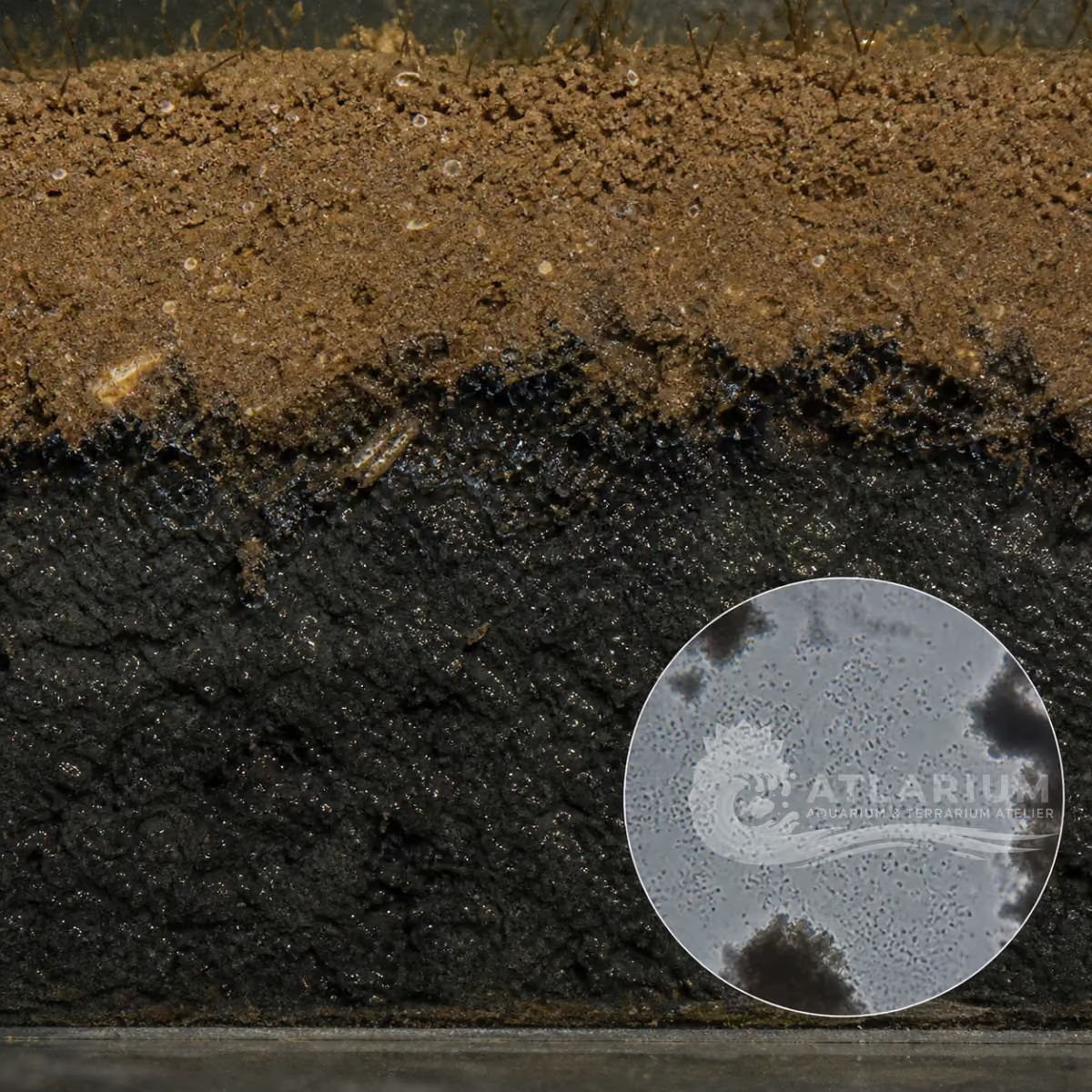
Morphology and dimensions: Biofilm may appear as a coating, film, deposit or colonised texture on sponge, ceramic or another filter medium. These are aggregate forms, not diagnostic body plans. Thickness, colour and feel can reflect matrix, retained particles and multiple components. No single size range is useful because the visible layer and its microscopic members are different scales. Microscopy can document structure, but a compatible image cannot identify a nitrifier, heterotroph or process.
Habitat and microhabitat: The relevant microhabitat is the wetted filter support, with local flow, oxygen, nutrient supply and surface material. Aquarium evidence directly covers freshwater and marine systems, which can hold distinct biofilter communities. The reviewed sources do not establish brackish filter biofilm or transferability between salinities. Record the actual water type, medium and system context before comparing two filters that merely look alike.
Role in the food web: Nitrification and organic-matter processing can occur in filter-associated communities, but their extent depends on composition and conditions. In sampled freshwater aquariums, ammonia oxidation coincided with ammonia-oxidizer detection as communities changed through succession. Heterotrophs also compete with nitrifiers for resources and space. These roles remain conditional: a film cannot reveal which substrate is transformed, who contributes, or whether capacity meets system demand.

Observation, culture, and ecological relationships

Where to look and how to sample: Begin with the exact support: identify the medium, water path, water type, date and the observation question. A surface scrape, expressed liquid and a whole piece of media recover different material, so their results are not interchangeable. Record the location and method with each sample. Sampling can describe material from that place, but it is not by itself a test of filter performance, biomass, maturity or community composition elsewhere in the system.
How to observe and identify: Observe the support, aggregate texture and visible material before assigning a biological meaning. There is no universal starting magnification for the whole community. Microscopy can reveal cells and matrix without naming nitrifiers, heterotrophs or their activity; nitrogen measurements describe water chemistry rather than membership. Stop at filter biofilm unless validated evidence supports a narrower question. Colour, odour and one image do not supply that evidence.
Presence and meaning in the aquarium: A filter film can be ordinary attached biomass, but it does not demonstrate biological maturity, good or poor water quality, contamination, animal illness, or a need for control. Interpret change with the precise support, water type, flow, trend and measured chemistry. Freshwater biofilters changed through succession in the reviewed study, so one observation does not predict another filter's members or performance. Document first; do not treat appearance as an intervention threshold.
Culture, maintenance or use: This entry is passive development on a filter support, not a culture recipe or an inoculation claim. Support and local conditions shape the community, and material from one filter is not an authenticated culture for another. The reviewed sources do not provide a universal maturity date, medium, cleaning interval, transfer procedure, dosing or preventive practice. Any management choice must retain the system objective and measured context rather than treating a generic filter film as the target.
Documented ecological relationships: Filter biofilm links resources moving through a support with microbial transformations. In freshwater aquarium biofilters, ammonia oxidizers were detected alongside changing communities, while heterotrophic members compete for resources. This supports context-bound relations between resources, attached communities and nitrogen transformation. It does not guarantee the same taxa, proportions or capacity in another filter, and it is not a stocking, inoculation or co-culture recommendation.
Risks, biosecurity and limits: A visible filter biofilm is not an animal-disease diagnosis and does not prescribe treatment. The reviewed sources establish no universal medicine, removal, inoculation, transfer, disinfection, dosing, control or prevention protocol. Do not infer a named organism, nitrification maturity or contamination from a layer's colour or texture. If animal health or water quality is in question, define that separate problem and use evidence appropriate to its actual cause, support and system context.

Geographic origin and distribution

Origin

Tropical oceans and reefs

Identification and observation data

Record type
Community
This is a community entry for material attached to a defined filter support, not a species, strain, or fixed nitrifier list. Cells, matrix and particles can change with the support and time. Similar-looking media can host different communities, so a visible coating cannot name its members, certify activity, or define a universal filter microbiome.
Recognition confidence
Medium
Confidence is medium for recognising attached biomass on a documented filter support, but not for naming its members or function from colour, texture, odour, a nitrogen value, or one microscopic image. Keep the support, water type, sampling method and system context with the observation. Without validated evidence, identification must stop at support-associated community level.
Biological group
Comunità microbica su supporto filtrante
Filter biofilm is placed with microbial communities and symbioses as a navigation group, not a taxonomic rank. The reviewed aquarium evidence directly covers separate freshwater and marine settings, whose communities are not interchangeable. This label does not identify an individual organism, make two media equivalent, or establish a shared community across salinities.
Ecological functions
Nitrifier, Decomposer
Nitrifier and decomposer are conditional community functions. Freshwater aquarium studies document nitrification and succession, and biofilter studies show heterotrophic members alongside nitrifiers. Neither role guarantees a rate, taxon, benefit, or mature state in an unknown filter. Support, chemistry, resource supply and composition determine the actual contribution.
Aquarium impact
Context-dependent
Impact is context dependent. Attached biomass may be part of normal filter ecology, yet a visible film alone does not prove maturity, water quality, contamination, animal illness, or a need to intervene. Track the exact support, change over time and independently measured chemistry before assigning meaning. One filter observation cannot predict another system's performance.
Culture and management
Passive aquarium growth
Passive development means that the community establishes on a defined wetted support under its local conditions; it is not a universal culture recipe. A sample from one filter is not a verified inoculum or transferable culture. The reviewed evidence supplies no general maturity date, cleaning interval, feed, dosing, transfer or preventive practice for this community label.
Typical size
Value not applicable
No single size range is assigned. Filter biofilm is an aggregate of cells, extracellular matrix and particles, while the visible layer and its microscopic members are different scales. Thickness, area or patch shape describe the observed material rather than a diagnostic organism or function. Retain a scale and state whether the measurement concerns the whole layer or a component.
Visible to the naked eye
Yes, as an aggregate or structure
The community may be visible as a coating, deposit or colonised texture on a filter support. What is seen is aggregate material, not a census of organisms. Similar films can have different matrices and communities, and visibility cannot establish nitrification, contamination, maturity or a need for treatment. Use it to document support and location, not to identify function.
Useful starting magnification
No universal threshold supported by reliable evidence
No universal starting magnification is assigned because the appropriate method depends on the component and question. Microscopy can show cells and matrix, but it cannot identify nitrifiers, heterotrophs or activity from appearance alone. Record support, scale and preparation; a narrower taxonomic or functional conclusion needs validated evidence suitable for that specific question.

Links to Aquarium SOS

Filter biofilm: microscope identification and ecology | Atlarium