FreshwaterBrackishMarineMicrobial communities and symbioses
Substrate microbiome

Substrate microbiome

Comunità microbica di sabbia e ghiaia

A location-defined community associated with sand or gravel, not a fixed bacterial recipe. Pore space, depth, grain properties, oxygen, organic inputs and disturbance can create different neighbouring microhabitats. It may include organisms linked to decomposition, nitrification or nitrate reduction, but neither a visible layer nor a nominal substrate depth proves a composition, process, benefit, disease, or treatment need.

Water type

Freshwater / Brackish / Marine

Biological group

Comunità microbica di sabbia e ghiaia

Record type

Community

Recognition confidence

Medium

Ecological functions

Decomposer, Nitrifier, Denitrifier

Aquarium impact

Context-dependent

Culture and management

Passive aquarium growth

Typical size

Value not applicable

Visible to the naked eye

No, not as an individual

Useful starting magnification

No universal threshold supported by reliable evidence

Identity, habitat, and ecological role
Identity and taxonomic resolution: Substrate microbiome is a community-level label for organisms, extracellular matrix, particles and small consumers associated with sand or gravel. It is not a species, strain, standard inoculum, or fixed member list. In an artificial aquarium, bacterial communities sampled from sand differed from water, fish and plants. Identify a sample by its exact depth, location and method; colour, odour or one microscopic field cannot name its members or represent the whole bottom.
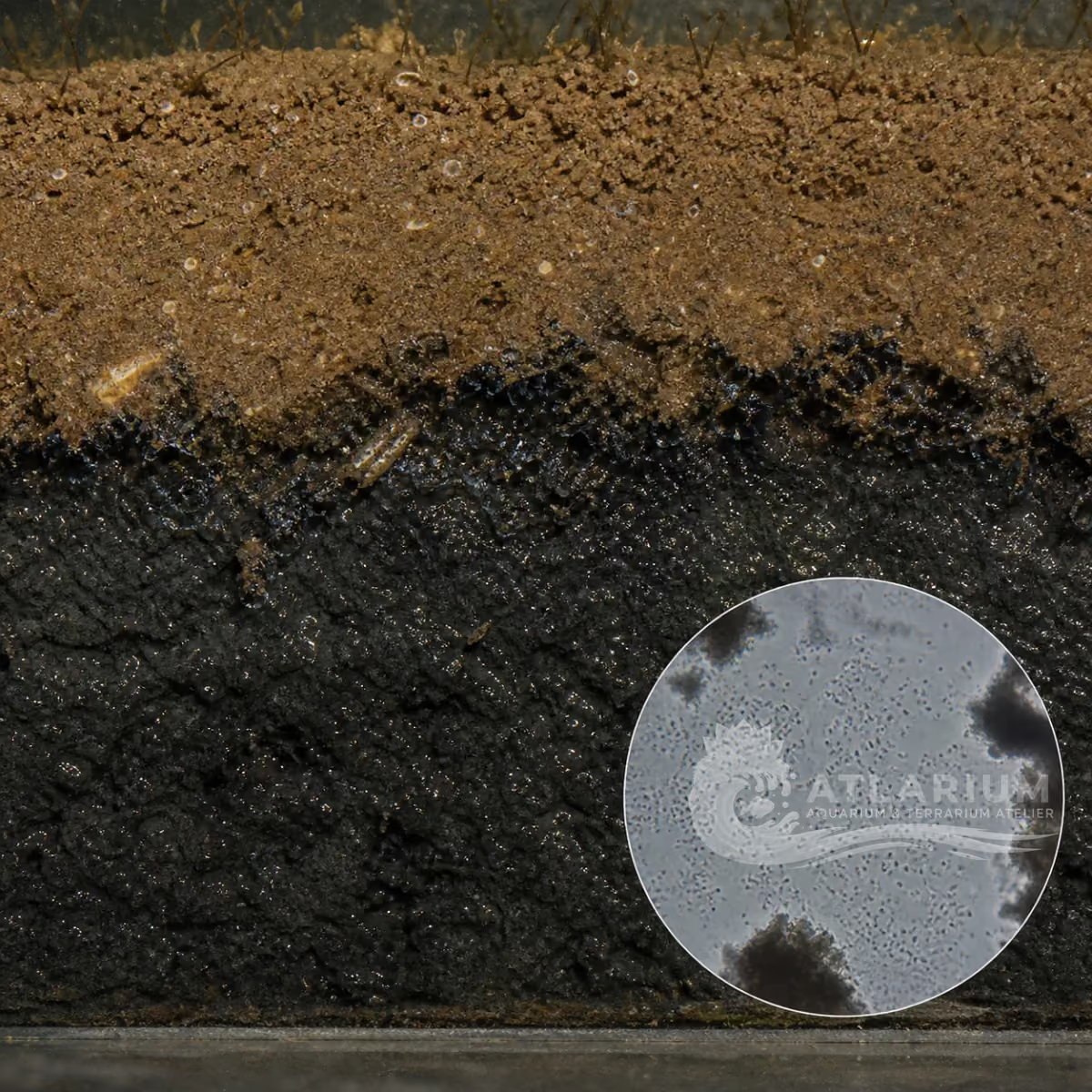
Morphology and dimensions: The observable material is biofilm on grains plus organic particles in pore spaces, not one diagnostic body. Grain size, layer thickness, colour or texture describe substrate architecture but not community membership or function. There is no community-wide size range: cells, matrix, detritus and mobile microfauna occupy different scales. State the measured component with a calibrated scale; a visible layer cannot establish activity, nitrification, nitrate reduction, or health relevance.
Habitat and microhabitat: Substrate creates neighbouring habitats at grain surfaces, water-filled pores and depths. Oxygen, organic inputs, movement, mineralogy and compaction can alter conditions over short distances. Model-sediment microprofiles show why oxygen and nitrate processes need measured gradients, not nominal depth. Freshwater and marine aquarium studies treated sediment and water as distinct habitats; water-type labels do not make communities or management transferable between salinities.
Role in the food web: Components of a substrate community can process organic matter and participate in aerobic nitrification or nitrate reduction when organisms and local conditions permit. These process labels do not guarantee nitrogen removal. In experimental aquaria, communities changed through succession and disturbance, and shifts need not track routine water chemistry. The food-web role remains conditional on sampled place, resources, oxygen regime and direct process evidence, not an assumed bacterial pair.

Observation, culture, and ecological relationships

Where to look and how to sample: Take a small sample from the exact layer and location that prompted the observation, recording surface material, deeper sediment, gravel-associated film or detritus between grains. Note date, aquarium, grain type, depth, nearby flow, recent feeding or maintenance, and the intended analysis. A scrape, core, siphoned suspension and free-water drop recover different fractions. Keep tools and containers clean enough for the method; a one-site sample cannot prove absence or composition elsewhere.
How to observe and identify: Decide whether the question concerns detritus, attached structure, mobile microfauna, cells or a nitrogen process. Low-power microscopy and a calibrated scale can document a component, not certify the whole community. DNA sequencing describes sampled genetic material, not necessarily an active transformation. Oxygen or nitrate microprofiles and process assays answer different questions. Keep identification at community or component level unless method and evidence justify more precision.
Presence and meaning in an aquarium: Read a substrate finding with position, trend, organic loading, water movement, animal condition and measured chemistry. A layer can be ordinary colonisation, while a change may reflect altered inputs or microhabitats; neither follows from colour alone. In a seven-week freshwater experiment, sand and gravel changed chemistry and Pseudomonas presence under those conditions. That result is not a diagnosis, universal risk estimate, or proof that an individual aquarium's substrate causes a problem.
Culture, maintenance or use: This community assembles passively on a substrate and changes with local conditions; it is not a single culture with a home recipe. Aquarium evidence documents succession after perturbations, not a fixed maturity date or universally beneficial mixture. Define the actual objective and monitor relevant measures rather than preserving visible colour or texture. The sources do not establish a universal inoculation, transfer, cleaning, dosing, replacement, treatment, control or prevention protocol.
Documented ecological relationships: Sand-associated organisms receive organic particles and dissolved compounds from water and can interact across oxygen and nutrient gradients. In an artificial aquarium, bacteria differed among sand, water, fish and plant samples; in marine tanks, water and sediment communities changed after defined perturbations. This supports location-dependent interactions and possible nutrient transformations, not a prescribed organism combination or a claim that one detected group causes observed chemistry.
Risks, biosecurity and limits: Do not infer disease, contagion, toxicity, failed denitrification or therapy from appearance, odour, bubbles, depth or one bacterial detection. That experiment measured Pseudomonas presence, not disease in a particular animal or an intervention threshold. For progressive illness or mortality, assess signs and measured water data and seek appropriate veterinary or laboratory advice. Control and prevention must address the documented cause and context; this evidence is not a universal remedy.

Geographic origin and distribution

Origin

Tropical oceans and reefs

Identification and observation data

Record type
Community
This is a community-level entry for microbes, extracellular matrix, particles and small consumers associated with sand or gravel. It is not a named species, a standard inoculum, or a fixed list of organisms. Surface grains, pore spaces and deeper material may carry different assemblages, so a sample represents its recorded microhabitat rather than the whole aquarium bottom.
Recognition confidence
Medium
Confidence is medium for recognizing the ecological category only. Colour, odour, depth, texture or a single microscopic field cannot identify the community's members, prove nitrification or denitrification, or diagnose a health problem. Sequence data can describe sampled DNA but do not by themselves show activity; oxygen, nitrate and process measurements answer different questions.
Biological group
Comunità microbica di sabbia e ghiaia
Substrate microbiome belongs to the microbial-communities-and-symbioses context because the label refers to a place-associated assemblage, not a taxonomic rank. Aquarium studies found sand, sediment and water communities to differ, and sediment microprofiles show that adjacent layers can have different chemical conditions. The group label must not be read as a shared membership across freshwater, brackish and marine systems.
Ecological functions
Decomposer, Nitrifier, Denitrifier
Decomposer, nitrifier and denitrifier are conditional process labels. Organic-matter processing and aerobic nitrification can occur where organisms, oxygen and substrates support them; nitrate reduction depends on local conditions and cannot be inferred from a nominal sand depth. The named roles describe possible functions of components of the sampled community, not a universal service supplied by every substrate.
Aquarium impact
Context-dependent
Impact is context-dependent. In freshwater experimental tanks, sand or gravel changed measured water chemistry and Pseudomonas presence under the study conditions; this does not assign cause or disease to an individual aquarium. Marine aquarium studies also show community succession and disturbance responses. Interpret a substrate observation with location, trend, husbandry, animal signs and measured water parameters rather than surface appearance.
Culture and management
Passive aquarium growth
Passive means that the community assembles and changes on the substrate; it is not a recipe or a promise of maturation at a fixed date. Feeding, mineral composition, water movement, oxygen supply and disturbance can change its microhabitats. The cited studies do not establish an inoculation, transfer, cleaning, dosing or culture protocol that is safe or effective for every aquarium.
Typical size
Value not applicable
No single size range is meaningful because this entry includes cells, extracellular matrix, particles, pore spaces and small consumers rather than one organism. A microscopic measurement must state which component was measured and use a calibrated scale. Grain size is a property of the substrate, not a diagnostic body size for the community or evidence that a particular microbial process is occurring.
Visible to the naked eye
No, not as an individual
The community is not identifiable as a discrete object with the naked eye. Sand colour, a brown layer, detritus, bubbles or a surface film may make material visible, but none reveals membership, abundance, activity, infection risk or nitrogen transformation. Visible change is a reason to document the site and context, not a basis for assigning a taxon or management label.
Useful starting magnification
No universal threshold supported by reliable evidence
There is no universal first magnification because the question may concern grain-associated structure, mobile microfauna, cells, or a particular stain. Start with the preparation and scale appropriate to the target, then record depth and sampling method. Microscopy can describe what is present in the field, whereas community composition and chemical processes require separate, appropriately validated methods.

Links to Aquarium SOS