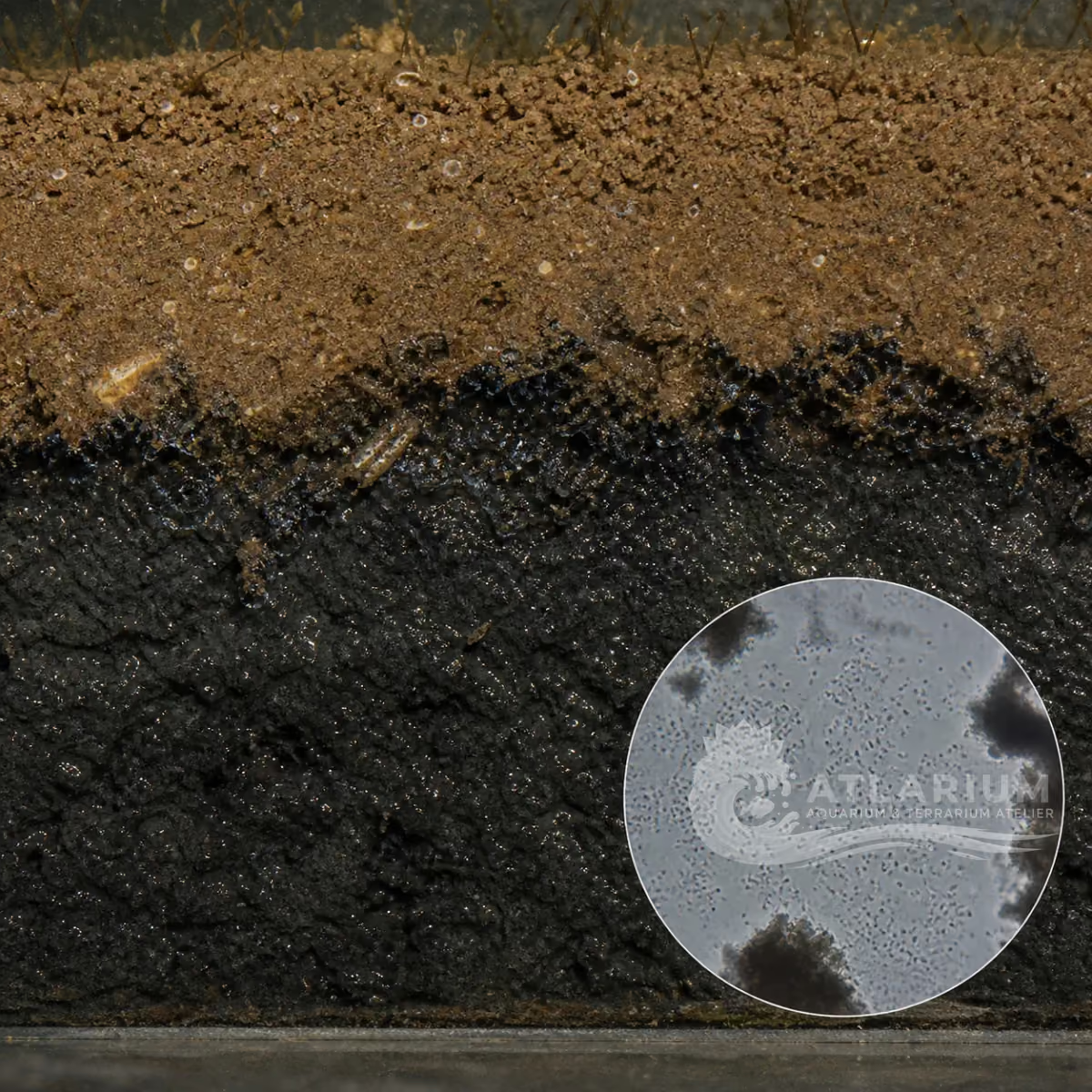
Marine live rock community
Comunità marina su substrato calcareo
Marine live rock is a colonised calcareous support and the changing community associated with it, not one species or a standard microbiome. In two experimental saltwater aquaria, defined additions of live rock and sediment shifted sampled microbial assemblages and nutrient-cycling measurements. That evidence supports careful, context-bound observation; a visible rock cannot certify its members, functions, safety or value in another system.
Marine
Comunità marina su substrato calcareo
Community
Medium
Primary producer, Decomposer, Nitrifier, Denitrifier, Symbiont
Context-dependent
Passive aquarium growth
Value not applicable
Yes, as an aggregate or structure
No universal threshold supported by reliable evidence

Identity, habitat, and ecological role

Observation, culture, and ecological relationships

Geographic origin and distribution
Origin

Identification and observation data
- Record type
- Community
- This is a community card for a colonised marine calcareous support, not a species card and not a certificate of a standard microbiome. The observation includes support, attached material and associated organisms whose membership changes with place and time. The phrase marine live rock does not establish the origin, supplier, coral composition, microbial purity or function of a particular piece.
- Recognition confidence
- Medium
- Confidence is medium only for recognising a visibly colonised support at community resolution. Coralline cover, pores, films or small mobile organisms can orient the observation, but none identifies the microbial membership, a named taxon or activity. The reviewed sequencing work also treats operational taxonomic units as imperfect taxonomic proxies. Keep identity at community level unless a defined component has separate evidence.
- Biological group
- Comunità marina su substrato calcareo
- This group is navigated as a microbial-community and symbiosis context because it joins a mineral support, attached cover, water and microscopic members. It is not a single microbiological lineage. Water, sediment and different rock microhabitats can carry distinct assemblages in the same aquarium, so the group label should never be used to assume a shared microbiome, source history or transferable ecological role.
- Ecological functions
- Primary producer, Decomposer, Nitrifier, Denitrifier, Symbiont
- Producer, decomposer, nitrifier, denitrifier and symbiont are possible community-level labels. The experimental study observed nutrient-cycling responses and changes in sampled nitrogen-transforming taxa after a defined addition, not a fixed list of active processes on each rock. Which role is expressed depends on membership, microhabitat and time. A visible coating therefore does not prove nitrogen conversion, production or symbiosis.
- Aquarium impact
- Context-dependent
- Impact is context dependent. A defined live-rock and sediment addition changed sampled community richness and chemistry in two experimental aquaria, while microbial profiles did not always track water chemistry. That does not make every live rock beneficial, harmful, mature, contaminated or a remedy. Interpret a change from the actual support, its history and independent measurements rather than from the community label or outward appearance.
- Culture and management
- Passive aquarium growth
- PASSIVE indicates that the card concerns an existing colonised support, not a pure culture or a recipe for producing one. The reviewed evidence does not provide a general collection method, source approval, conditioning period, handling routine or transfer standard. Changes to a support can select a different community, but no universal response follows. Do not treat unidentified material as a certified inoculum or a ready-made culture.
- Typical size
- Value not applicable
- No single size range is meaningful because the visible support, attached films, microbial cells and mobile associates occur at very different scales. Rock size or porosity does not reveal the size, abundance or identity of its microscopic members. A measurement can document the sampled feature or support location, but it cannot convert a community observation into a species identification or demonstrate a particular ecological process.
- Visible to the naked eye
- Yes, as an aggregate or structure
- The colonised support and some attached cover can be visible to the naked eye, but visibility applies to the aggregate rather than a complete list of members. A purple cover, film, pore or small moving organism is not a microbial census and cannot establish a pure, safe or beneficial community. Use visible features to locate and document a sample, while retaining uncertainty about components not directly resolved.
- Useful starting magnification
- No universal threshold supported by reliable evidence
- No universal magnification is stored because the useful method depends on the question: a broad support image, microscopy of a defined film or water sample, and sequence-based community work answer different questions. The reviewed study used 16S sequencing for part of the microbial assemblage, which does not identify every member as a species. One image or magnification cannot diagnose the whole community or its nutrient-cycling activity.

Microworld ecological network
Links based on documented kinship, food webs, biofilms, and ecological functions.