Encyclopaedia
Demon Eartheater
Satanoperca jurupari
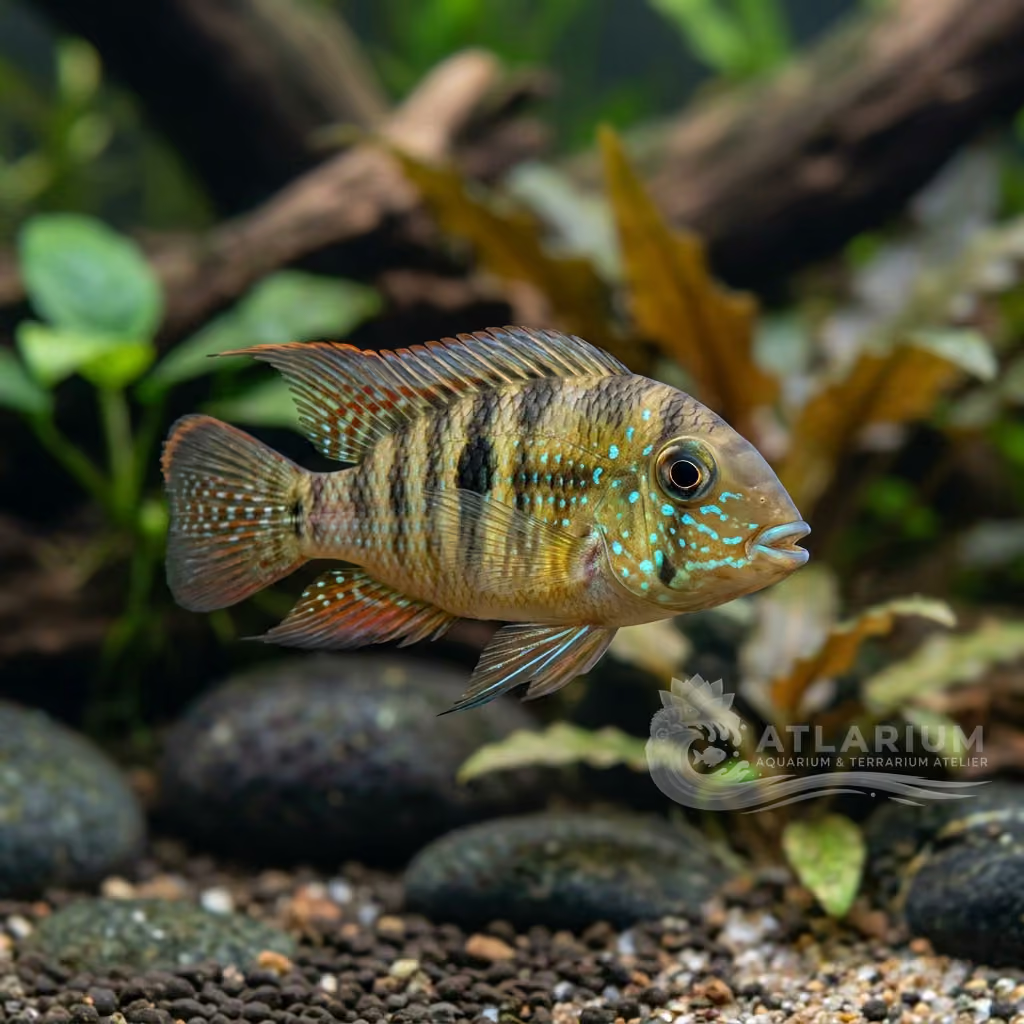
Despite the diabolical and intimidating scientific name (*Satanoperca* literally means "Demon Fish" and Jurupari is a demon from Amazonian mythology), the *Satanoperca jurupari* is actually the most inoffensive and mildest eartheater cichlid in all of South America. It features an unmistakable sloping and "horse-like" frontal profile, with a muscular and prominent lower lip for foraging in the mud. It lacks the sparkling neon colors of Geophagus, preferring a sober golden-sand livery studded with iridescent greenish and metallic blue dots on the snout and gill covers. Its delicate environmental needs make it a fish for experts only.
- Family
- Cichlidae
- Origin
- Sud America (Ampiamente distribuito nel bacino dell'Amazzonia)
- Origin
- Amazon, Orinoco, and Guianas
- Tank use
- Used in 0 tanks
Share
26 °C - 30 °C
5.5 - 7
Freshwater
Bottom
25 cm
Description
Geographic Origin and Biotope: Widely distributed throughout the entire Amazon basin (Brazil, Peru, Colombia), spanning numerous major tributaries. It strictly inhabits the "blackwater" or "clearwater" environments of sluggish rivers, oxbow lakes, and deeply flooded swamps. It is inextricably and biologically tethered to one exclusive habitat: vast, sprawling, and flat shoreline shallows composed entirely and exclusively of impossibly soft sand and mud, thickly blanketed by organic silt and deep layers of decaying fallen leaves, with a total, absolute absence of sharp rocks.
Taxonomy and Morphology: Renowned in the aquarium hobby as the "Earth-Eater Cichlid" or "Demon Fish" (The scientific genus name Satanoperca literally translates to "Satan's Perch," paying homage to local indigenous Tupí mythology regarding "Jurupari," a forest demon spirit). Its morphology is bizarre, alien, and hyper-specialized: a moderately laterally compressed body, but featuring an intensely elongated, sloping "snout" shaped remarkably like a tapir or horse's face. It possesses disproportionately massive eyes situated extremely high atop the skull—an evolutionary trait designed to watch out for aerial predators (like birds) while it thrusts its entire face deep into the sand blindly. It can rapidly achieve 15-20 cm (6-8 inches), sometimes more, in a large tank.
Social Behavior: Undeniably one of the most peaceful, tolerant, and gentle giants of all large South American cichlids. The Jurupari is a strictly, obligate gregarious schooling animal (must always be kept in a group). They spend their entire, exhaustive waking day raising massive clouds of sand, chewing it, and filtering it incessantly. Inter-specific aggression (against other species) is literally zero; they completely and utterly ignore their tankmates. Within their own school, there is only mild competition, manifested in harmless, comical "lip-locking" (mouth-wrestling) matches to gently establish the pecking order.
Coloration and Sexual Dimorphism: Extraordinarily elegant, yet incredibly subtle; this is not a "neon" glowing fish. The base canvas is a pearlescent silvery-gray or pale pastel olive-brown, which takes on warmer hues depending on the light. The belly and jugular (throat) region radiate a soft, muted yellow. But its true, breathtaking spectacle only ignites under high-quality spectrum lighting: the entire body, and specifically the upper head and cheeks, is densely studded, dusted, and sprayed with a microscopic, ultra-fine "Glitter" or vermiculated speckling of pale sea-green, ice-blue, and reflective gold iridescence. It features a tiny, barely visible dark spot on the upper edge of the caudal peduncle (tail base). **Absolute Lack of Dimorphism:** Males and females are completely identical in size, colors, and fin extensions. The only possible way to sex them is by observing the genital papilla during the very act of spawning (the male's is pointed, the female's is thick and blunt).
Care and observations
Tank Setup: Managing a required school (minimum 5-6 specimens) demands a massive footprint. Mandatory dimensions: an absolute minimum of 150 cm (5 feet) in length and extremely wide at the base (over 400-500 liters / 100-125+ Gallons). **THE SUBSTRATE IS LIFE OR DEATH:** 90% of the aquarium floor must be a gigantic, sweeping expanse of ULTRA-FINE, soft river sand (or pale pool filter sand) laid very deep (at least 5-7 cm / 2-3 inches). If you use coarse, sharp-edged gravel, or a bare-bottom tank, you will condemn the fish to hell: they will be physically unable to breathe or eat, irreversibly shredding their mouths, ripping their delicate gills, and rapidly dying of extreme stress and starvation. Decorate exclusively with smooth wood suspended from above to cast dark shadows, and scatter dried leaves (Catappa) on the floor. Almost zero rooted plants can survive their infinite, non-stop "bulldozer" uprooting.
Feeding and Diet: Benthic "Eartheater" (Filtering Micro-Predator / Detritivore). It feeds EXCLUSIVELY and physically by engulfing massive mouthfuls of the substrate, filtering out microscopic crustaceans, aquatic worms, and hidden insects with its highly specialized pharyngeal apparatus, and then violently "shooting" the cleaned sand backward out of its gills in a massive, dusty cloud. Feeding them in captivity mandates the use of micro-foods (tiny granule sizes) that sink like a stone and embed in the sand: specific sinking carnivore micro-pellets, massive amounts of frozen bloodworms, artemia, and daphnia. They will completely refuse, or be physically unable to eat, large floating flakes or food that stays at the surface.
Water Quality: Because they spend their entire lives shoving their faces into dirt and kicking up clouds of silt from the bottom, these fish are intimately exposed to, and paradoxically, terribly vulnerable to organic filter pollution, specifically nitrates. The water must be exceptionally, immaculately pristine, managed by titanic biological filtration and frequent pre-filter cleanings. Warm, South American water: pH ranging from 6.0 to 7.2 (moderately acidic to neutral), soft water (GH 2-8). Strict, steady temperature at 27-29°C (80-84°F).
Compatibility: The ultimate, perfect centerpiece schooling species for an XXL, hyper-peaceful Amazonian display tank. Their mouths are incredibly small and entirely inept at biting others, meaning they will never harm (nor swallow) slow South American Tetras (even small ones), large peaceful Tetras, or docile Loricariids (Plecos). NEVER, UNDER ANY CIRCUMSTANCES, mix them with true, robust Central American brawlers (like Jack Dempseys, Texas Cichlids, or Flowerhorns) which would brutally slaughter these defenseless fish in an hour. Also, exercise caution with massive, aggressive "Eartheaters" of the genus Geophagus (like *G. brasiliensis*), which will psychologically bully them to death by denying them access to the sand. Because they are obligate schooling fish, buying a single Jurupari and putting it in a 30-Gallon tank is animal cruelty.
Reproduction in Captivity: An exceedingly rare, legendary, and bizarre species to breed: they are one of the most delayed, specialized "Larvophilous Mouthbrooders" (Delayed Mouthbrooders) in existence. It takes years for them to mature and form a pair. They START the process identically to standard "substrate spawners". They will maniacally clean a tiny, hidden disc under the silt (a flat sunken leaf, a piece of slate, or submerged wood) and lay roughly 300 eggs. FOR THE FIRST FEW DAYS, both parents fiercely guard the eggs exactly where they lie on the leaf. ONLY when the egg casings burst and the microscopic, wriggling larvae emerge, do the mother or father suddenly inhale ALL the babies into their throat (buccal pouch) to hold and incubate them until they are free-swimming (fasting for several weeks). If an inexperienced owner startles the tank during this delicate transition, the parent will panic and swallow the babies or spit them into the abyss.
Risks and Diseases: 1. Fatal Gravel Mutilation (Snout Trauma): the improper use of sharp, coarse gravel substrates irreparably slices the fish's specialized mouth to ribbons, permanently preventing them from feeding, leading to rapid tumor formation or lethal necrosis in their highly fragile gills. 2. Fulminant Hexamita / "Hole in the Head" Disease: triggered instantly by a high load of anaerobic bacteria in poorly maintained sand beds or constantly high nitrates in tanks that owners forget to deep-siphon (a must, given how much waste they kick up). 3. Extreme Isolation Depression and Bulimia: single specimens kept without a "school" develop fearful paralysis, refuse to eat, or become blind "Jumpers," violently smashing their bodies into the glass lids if someone suddenly turns on the room lights.
Fish profile
- Temperament
- Timido e totalmente remissivo. È così pacifico che in un acquario di comunità rischia di farsi sottomettere e morire di fame anche a causa di pesci grandi un decimo di lui se aggressivi. Si sentono sicuri solo in banchi di conspecifici.
- Diet
- Micro-Bentonico / Geofago Estremo. A differenza dei grossi Geophagus, non accettano volentieri grossi pellet galleggianti. Masticano e setacciano il fondale senza sosta, ingoiando fango e sputandolo (è questo che faceva credere agli indigeni che avessero 'i poteri di un demone' della terra). Nutrire abbondantemente al buio con micropellet affondanti, tubifex e chironomus sparsi direttamente sulla sabbia.
- Tank level
- Bottom
- Minimum group
- 5
- Adult size
- 25 cm
- Minimum tank
- 500 L
- GH
- 1 dGH - 8 dGH
- KH
- n/a
- TDS
- n/a
- Conductivity
- n/a
- Sex ratio
- Gruppi misti in banco. Il sesso è quasi impossibile da determinare fuori dal momento riproduttivo (nessun dimorfismo evidente).
- Feeding frequency
- Piccole quantità 3-4 volte al giorno per simulare il micro-pascolo continuo.
- Bioload
- Alto
- Flow
- Corrente da Nulla a Lieve (preferiscono acque calme di lagune e aree inondate della giungla)
- Reproduction
- Rara in acquario. A differenza della S. leucosticta (incubatori orali puri), spesso la S. jurupari depone le uova su materiale sommerso che i genitori muovono e nascondono in buche (spostando legni interi con la bocca) e solo dopo la schiusa le larve vengono prese in bocca per la protezione finale.
- Compatibility
- Mantenimento ottimale in Species Tank (acquario specifico). Se abbinati, i compagni DEVONO essere lenti e 100% pacifici come Symphysodon (Discus), Corydoras, e grandi banchi di Tetra (Cardinali). Evitare qualsiasi altro Ciclide dominante (anche i Geophagus) che li sovrasterebbe, e scordatevi Botia o squaletti.
Image gallery
Licensed images linked to the species or, when marked, to the closest representative taxon.