Bigbelly Seahorse
Hippocampus abdominalis
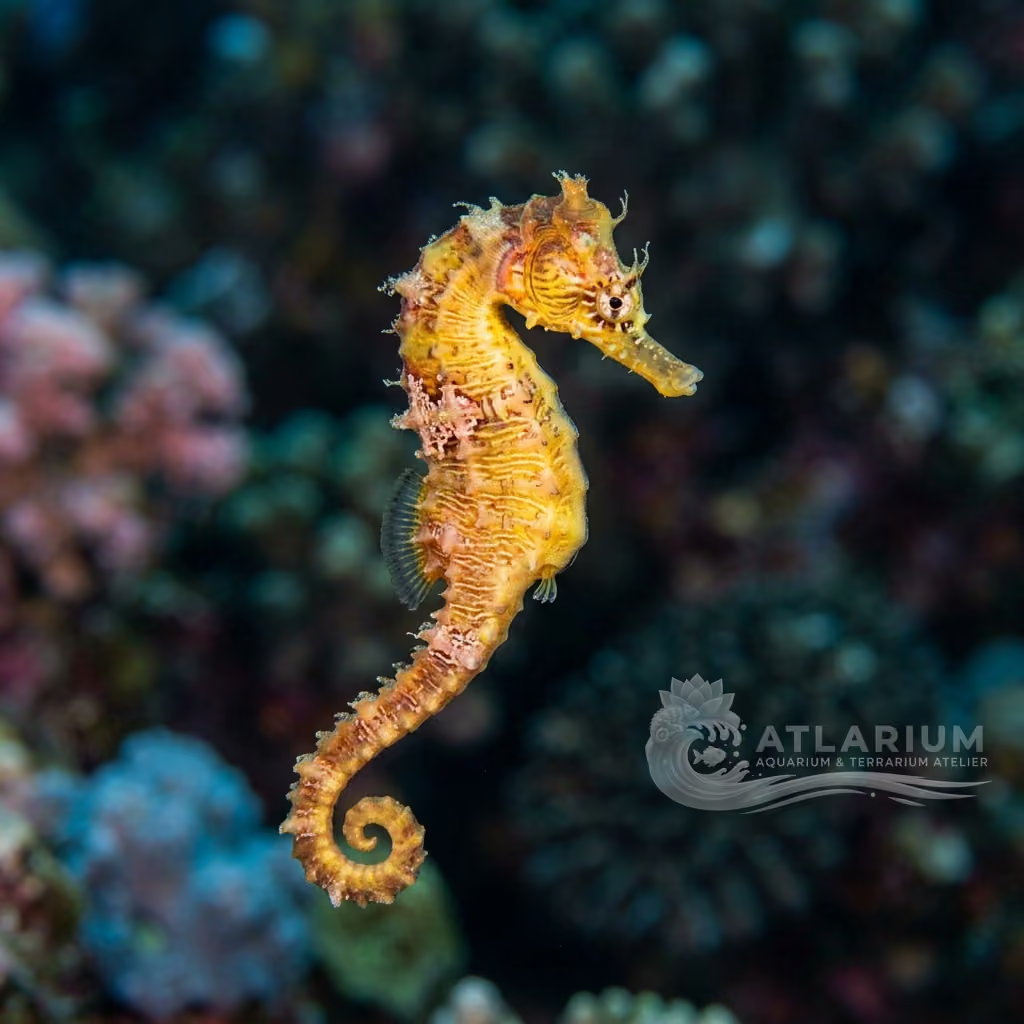
The bigbelly seahorse (Hippocampus abdominalis) is one of the largest seahorse species, distinguished by its prominent belly and its preference for cool, temperate marine waters.
Water Temperature
14 - 18 °C
pH Value
8.1 - 8.4
Water type
Marine
Tank level
Bottom and middle
Adult size
35 cm
Minimum tank volume
>= 250 L
Minimum group
>= 2

Species description
Geographical Origin and Habitat: Native to the temperate waters of the southwestern Pacific Ocean, specifically along the southern coast of Australia and all of New Zealand. Inhabits rocky reefs, large kelp forests, sheltered bays, and jetty pilings, down to depths of 100 meters, and occasionally enters brackish estuaries.
Taxonomy and Morphology: Belongs to the family Syngnathidae. It is one of the largest seahorse species in the world, capable of reaching lengths up to 35 cm. Characterized by a thick-set body, an exceptionally swollen and prominent belly, a long snout, and a high coronet.
Social Behavior: Peaceful and moderately active compared to other seahorse species. Lives in loose groups or stable pairs. Spends significant time anchored to kelp or artificial structures, displaying complex courtship behaviors during the breeding season.
Coloration and Sexual Dimorphism: Coloration ranges from yellow to grayish-brown, decorated with prominent dark spots and stripes on the body and tail. Adult males have a significantly larger, smooth belly containing the brood pouch, which turns pale or white during courtship, whereas females are more angular.

Care, breeding and tankmates
Aquarium Setup: Requires a large, tall aquarium of at least 350-400 liters (90-100 gallons) for a pair, with a minimum height of 70-80 cm to allow successful spawning. Provide tall, sturdy anchor points like thick synthetic kelp or branches. Water flow should be low to moderate with calm zones.
Diet and Feeding: Specialized carnivore with a large appetite due to its size. In captivity, it must be fed 2-3 times daily with generous portions of large frozen mysis shrimp, chopped krill, or live glass shrimp.
Water Quality: **IMPORTANT**: This is a cool-water/temperate species. Requires a constant water temperature between 15°C and 18°C (59-64°F; temperatures above 20°C/68°F are lethal long-term), making a water chiller mandatory. Keep pH 8.1-8.4, salinity 1.020-1.025 SG, and pristine filtration.
Compatibility and Cohabitation: Best housed in a species-only system or with other peaceful, cool-water species. Highly incompatible with tropical fish or fast-swimming, aggressive feeders that will starve them.
Aquarium Breeding: Successfully bred in captivity. The pair performs a vertical dance where the female transfers eggs into the male's pouch. The male incubates them for 28-30 days before giving birth to hundreds of large fry that can immediately consume enriched baby brine shrimp.
Risks and Diseases: Highly vulnerable to thermal stress if temperatures exceed 20°C, which triggers bacterial infections (Vibrio) and gas bubble disease. Requires pristine filtration. A cover is recommended to prevent accidental jumping.

Geographic origin and distribution
Native to the temperate waters of the southwestern Pacific Ocean, specifically along the southern coast of Australia and all of New Zealand. Inhabits rocky reefs, large kelp forests, sheltered bays, and jetty pilings, down to depths of 100 meters, and occasionally enters brackish estuaries.
Origin
Tropical oceans and reefsCentral America and CaribbeanAustralia, New Guinea, and Oceania

Fish profile
- Temperament
- Peaceful
- This is a docile and peaceful creature. It interacts calmly with its own kind. It never shows aggression towards other tank mates.
- Diet
- Carnivore
- It is a carnivorous predator in the wild. Its diet in captivity should consist of enriched mysis shrimp. Live foods can be offered occasionally as a treat.
- Life expectancy
- 3-6 years
- Adult size
- 35 cm
- Sex ratio
- Pair
- They can be kept in pairs or small groups. A balanced number of males and females is generally best. Males can sometimes compete for female attention during courtship.
- Feeding frequency
- 2-3 times daily
- This seahorse requires multiple feedings throughout the day. Offering food two to three times daily is recommended. A continuous supply of tiny crustaceans is highly beneficial.
- Bioload
- Low to Medium
- This species produces a high bioload for a seahorse. Its large size and frequent feeding contribute to significant waste. Strong filtration and regular water changes are essential.
- Flow
- Strong
- It appreciates moderate water movement in the tank. The flow should not be strong enough to blow it around. Hitching posts in low-flow areas must be provided.
- Jump risk
- No
- Reproduction
- Oviparous
- Breeding is possible in a dedicated setup. The male carries the eggs in his pouch until they hatch. Fry require specialized care and tiny live foods.
- Compatibility & tankmates
- Peaceful
- It should be kept with other peaceful, slow-moving species. Aggressive fish will easily outcompete it for food. It can be housed with gentle invertebrates like snails.
- Tank level
- Middle/Bottom
- They mainly inhabit the middle to lower regions. They rely heavily on tall plants or structures for hitching. Open swimming spaces are rarely utilized.

Related species
Recommendations grouped by close relatives, companion choices, and similar care.