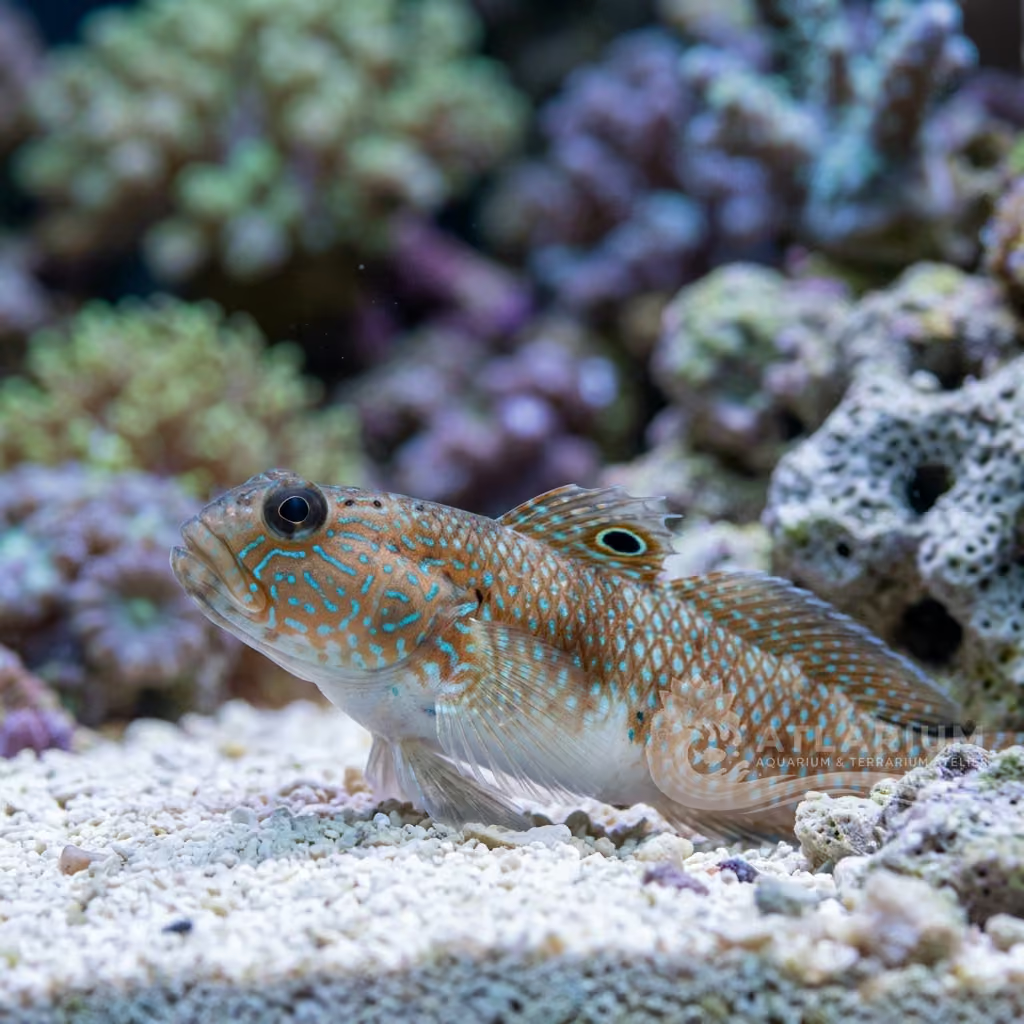
Purple Firefish
Nemateleotris decora
The Purple Firefish is a stunning marine dartfish with a striking purple gradient and elongated dorsal fin. Shy but hardy, it is a perfect addition to peaceful reef aquariums.
Water Temperature
22 - 28 °C
pH Value
8.1 - 8.4
Water type
Marine
Tank level
Bottom and middle
Adult size
9 cm
Minimum tank volume
>= 80 L
Minimum group
>= 1
KH
8 - 12 dKH

Species description
Geographical Origin and Habitat: This marine species inhabits the tropical waters of the Indo-West Pacific, ranging from Mauritius to the Samoa Islands, and north to the Ryukyu Islands down to the Great Barrier Reef. It is typically found at considerable depths, generally between 25 and 70 meters, where it frequents the outer slopes of coral reefs, hovering over sandy or patch rubble areas near small burrows or natural crevices.
Taxonomy and Morphology: It belongs to the Gobiidae family and the Nemateleotris genus. It displays a slender, cylindrical, and elongated body shape that can reach a maximum total length of approximately 8 to 9 centimeters. The anterior dorsal fin is notably elongated and serves as a dynamic signaling device, flicking back and forth to communicate with conspecifics or deter predators.
Social Behavior: It is a shy and peaceful fish that usually lives in pairs or small loose groups as juveniles. It spends most of its time hovering in the water column a few feet above the substrate, facing the current to catch zooplankton. At any sign of danger, it makes a rapid backward dart, seeking shelter inside its reef crevice or sandy burrow.
Coloration and Sexual Dimorphism: The coloration is stunning: the body features a gradient from a whitish-grey front to a deep violet-purple toward the tail. The fins are adorned with bold bands of black, red, and electric purple. There is no visible sexual dimorphism between males and females, making external gender determination impossible.

Care, breeding and tankmates
Aquarium Setup: Requires a well-established reef aquarium of at least 80 to 100 liters (approx. 20-25 gallons). It is essential to provide a fine sand substrate and plenty of live rock arranged to create cracks, caves, and secure burrows for shelter. A tight-fitting lid or fine mesh screen is absolutely mandatory, as this species is notorious for jumping out of the tank when startled.
Diet and Feeding: Feeds exclusively on suspended zooplankton. In captivity, it must be fed two to three times daily with a varied diet of frozen or live foods, such as mysis shrimp, brine shrimp, copepods, and chopped krill. High-quality dry pellets or flakes may be accepted after acclimation, provided they are small enough for its tiny mouth.
Water Quality: Requires stable marine parameters: water temperature between 23 and 26°C, pH between 8.1 and 8.4, specific gravity of 1.022 to 1.025, and minimal nitrates or phosphates. Moderate to gentle water flow is recommended, which delivers food without overpowering its delicate hovering movements.
Compatibility and Cohabitation: A peaceful species that does not harm corals or mobile invertebrates. It should be kept with other quiet tankmates such as clownfish, pipefish, small gobies, or blennies. Avoid keeping it with territorial or aggressive species (like large wrasses, dottybacks, or aggressive damselfish) that will bully it into hiding.
Aquarium Breeding: Spawning in home aquariums is extremely rare. They are monogamous spawners that lay adhesive eggs inside their burrows, which are then guarded by both parents. Raising the larvae is highly complex and requires specialized live microscopic foods (rotifers and green water) in a separate rearing tank.
Risks and Diseases: Aside from the high risk of jumping, this species is prone to stress-induced immune suppression. If bullied, it may hide constantly, leading to starvation. It is susceptible to marine ich (Cryptocaryon irritans), but responds well to standard medications if they are reef-safe and copper-free.

Geographic origin and distribution
This marine species inhabits the tropical waters of the Indo-West Pacific, ranging from Mauritius to the Samoa Islands, and north to the Ryukyu Islands down to the Great Barrier Reef. It is typically found at considerable depths, generally between 25 and 70 meters, where it frequents the outer slopes of coral reefs, hovering over sandy or patch rubble areas near small burrows or natural crevices.
Origin
Tropical oceans and reefsAfrica and MadagascarEast Asia

Fish profile
- Temperament
- Peaceful
- The Purple Firefish is incredibly timid and easily intimidated by boisterous tankmates. Once they feel secure, they will spend most of the day boldly hovering in the open. If housed with aggressive fish, they may hide constantly and eventually starve.
- Diet
- Carnivore
- They are zooplanktivores that naturally pluck small crustaceans from the water column. In captivity, they require finely chopped meaty foods like mysis shrimp and vitamin-enriched brine shrimp. High-quality marine micro-pellets and flakes are usually accepted with enthusiasm.
- Life expectancy
- 3-8 years
- Adult size
- 9 cm
- Sex ratio
- Flexible
- Sexing the Purple Firefish visually is impossible as males and females look identical. Unless a guaranteed mated pair is purchased, it is highly recommended to keep only a single specimen. Adding two unsexed individuals often results in one harassing the other to death.
- Feeding frequency
- Twice daily
- Due to their high energy levels, they require small, frequent meals to thrive. Feeding them twice a day is generally sufficient for maintaining optimal health. Care must be taken to ensure faster fish do not steal all the food before the firefish can eat.
- Bioload
- Low to Medium
- The Purple Firefish is a very small, slender fish that produces an extremely light bioload. Their minimal waste output makes them perfectly suited for nano reef setups. They will not put significant strain on standard biological filtration systems.
- Flow
- Moderate
- They prefer a moderate water flow that gently sweeps food past their hiding spots. The flow should be steady but not so turbulent that it exhausts them. They will often hover facing the current, waiting for morsels to drift by.
- Jump risk
- Yes
- Firefish possess a notoriously high risk of jumping out of the aquarium, especially when frightened. A tight-fitting mesh lid or glass canopy is absolutely essential for their survival. Even a tiny gap near a filter return is large enough for an escape.
- Reproduction
- Oviparous
- While they do form monogamous pairs in the wild, captive breeding is extremely difficult. They lay their eggs deep within a small burrow where the male aggressively guards them. Rearing the microscopic larvae requires highly specialized rotifer cultures and advanced techniques.
- Compatibility & tankmates
- Peaceful
- They are completely reef safe and entirely peaceful toward other fish and invertebrates. However, they will display severe aggression toward other firefish or dartfish. They should only be kept with very docile, non-aggressive tankmates that will not bully them.
- Tank level
- Middle/Bottom
- They generally hover in the lower to middle levels of the water column, always staying close to a bolt-hole. When threatened, they instantly dart into their chosen crevice or burrow in the substrate. Providing ample rockwork with numerous small caves is a strict requirement.

Scientific Parameters & Models
FishBase
Window to the official scientific data of the species
FishBase v25.04Data synced on: 06/15/2026
- Trophic level
- 3.1 ± 0.19 se
- Phylogenetic uniqueness (PD50)
- 0.5625
- Bayesian Length-Weight
- a = 0.00389, b = 3.12
- VulnerabilityLow vulnerability (10 / 100)

Related species
Recommendations grouped by close relatives, companion choices, and similar care.