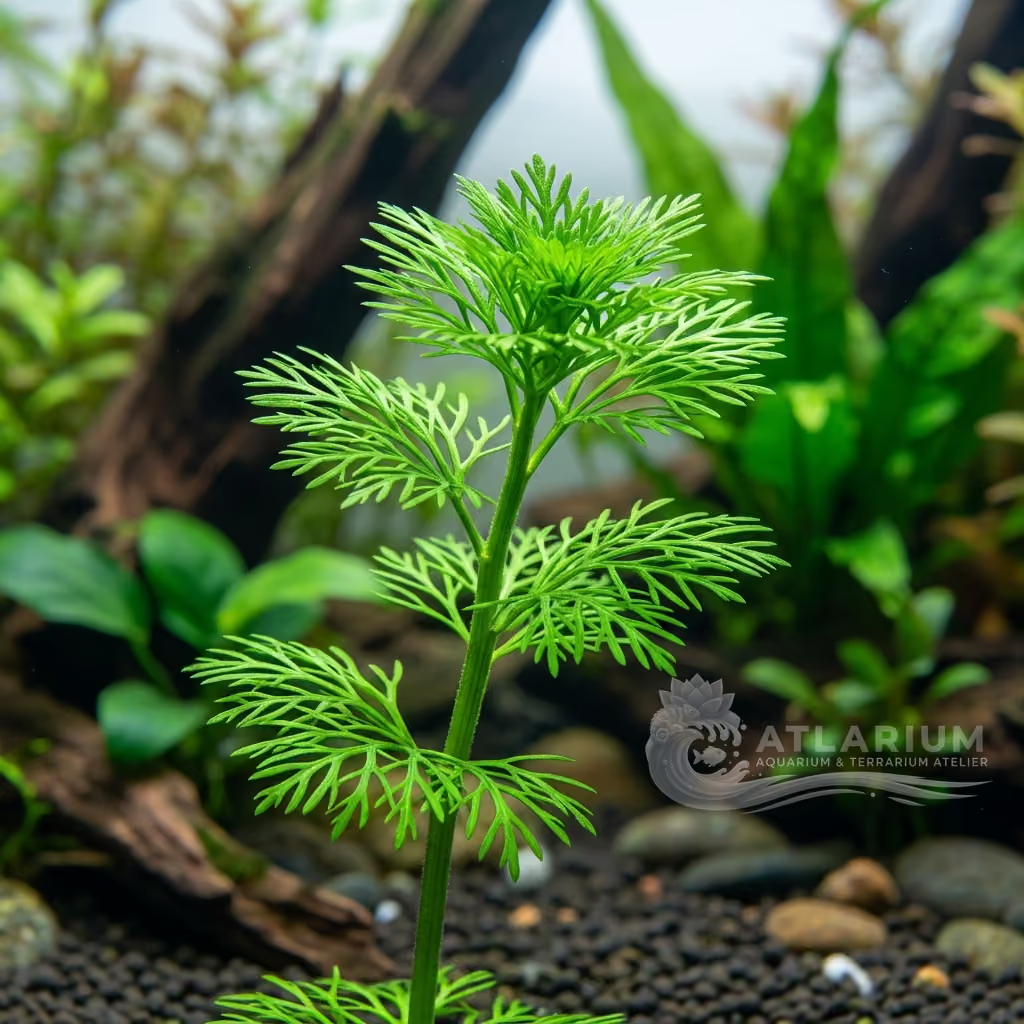
Eleocharis pusilla ("E. parvula")
Eleocharis pusilla
A versatile amphibious sedge from Australia, widely sold as Dwarf Hairgrass. It requires strong lighting and heavy root nutrition to establish a magnificent foreground.
Water Temperature
15 - 28 °C
pH Value
6 - 7.5
Water type
Freshwater
Light
High
CO2
Medium
Expected height
6 cm
Expected width
5 cm
GH
4 - 20 dGH
KH
0 - 14 dKH

Species description
Geographical Origin and Habitat: Endemic to the temperate and subtropical regions of Australia and New Zealand, Eleocharis pusilla (universally and incorrectly sold in the aquarium trade as Eleocharis parvula or "Dwarf Hairgrass") is a highly adaptable, true amphibious sedge. It naturally colonizes the extremely shallow, mud-rich margins of freshwater streams, temporary pools, and marshlands. It is a wildly aggressive, deeply rooted carpet-forming plant perfectly evolved to thrive in densely packed, submerged mats along the water's edge.
Taxonomy & Genetics: Scientifically classified within the Cyperaceae (Sedge) family, E. pusilla is the legendary "Dwarf Hairgrass" of the aquascaping world. Taxonomically, it is globally confused with E. parvula, but true E. pusilla is distinctively shorter and curves slightly downward. Genetically, it is completely hard-wired for extreme horizontal propagation. Its DNA forces the continuous deployment of an aggressive subterranean runner system, completely suppressing vertical gigantism (rarely exceeding 5 cm in height).
Physical Structure: The architectural structure of E. pusilla is gracefully fine, intensely dense, and uniquely "curly" at the leaf level. It is the ultimate foreground carpet plant, lacking broad leaves or vertical stems. The foundation is a highly aggressive, deeply burrowing, microscopic white runner system (rhizome). The "leaves" (specialized stems called culms) erupt from the runners. They are strictly needle-like, exceptionally short (3-5 cm), and naturally curve backward (recurved), creating a perfectly low, plush mat.
Color & Texture: The coloration is distinctly pure, intensely solid, and visually vibrant. Grown submerged under intense lighting, the dense thicket of curved needle-like culms is a solid, glowing bright apple-green to a rich emerald-green. Because it completely lacks any genetic mechanism for red pigments, it remains an intensely bright pure green under any light intensity. The texture is distinctly crisp, extremely flexible, and beautifully smooth, looking exactly like a flawlessly manicured, intensely low-cut miniature lawn.

Care, breeding and tankmates
Lighting & CO2: It is a highly demanding, energy-hungry foreground plant. While it will technically survive in medium-light aquariums, its spectacular miniature carpeting behavior will fail; it will refuse to send out runners and instead stretch straight upward, losing its iconic curved "dwarf" look. To force the violent horizontal spread and the tight, recurved (curly) needle growth necessary for a plush lawn, blasting, high-intensity LED lighting is absolutely mandatory. Pressurized CO2 drastically accelerates the carpet density.
Nutrition & Substrate: As an incredibly fine, dense carpeting sedge, Dwarf Hairgrass is a terrifyingly aggressive, obligate root feeder. Its microscopic runner system strictly demands a very fine-grained, heavily nutrient-dense substrate. It absolutely demands premium, fine-powder aquasoil heavily enriched with iron and macro-nutrients. It will completely fail to spread in standard gravel, as its delicate runners cannot penetrate it. If starved of root nutrients, the fine green needles will quickly turn yellow, rot, and dissolve.
Water Chemistry: Originating from temperate Australasia, it is practically invincible regarding standard water parameters. It thrives effortlessly in heated tropical aquariums (22-28°C) but is equally comfortable in unheated cold-water tanks. It is exceptionally adaptable, comfortably tolerating soft, acidic water as well as harder, moderately alkaline tap water (pH 6.0 - 7.5). The single most critical environmental requirement is absolute substrate stability and nutrient flow. It thrives in moderate to strong water currents.
Space Management & Placement: Due to its exceptionally short, curved needle-like foliage and extreme horizontal spreading nature, Eleocharis pusilla is strictly a dominant, absolute foreground carpeting plant for aquariums of all sizes (especially nano tanks). It MUST be planted initially in tiny, distinct tufts evenly spaced across bare powder aquasoil. Because it grows via aggressive subterranean runners, it will rapidly bridge the gaps, forming a breathtaking, impenetrable miniature green lawn that perfectly contours the hardscape.
Pruning: Pruning is a simple, massive, and highly necessary procedure to maintain the carpet. Never attempt to uproot the plant once established. To prune, you must use curved aquascaping scissors to literally "mow the lawn." You aggressively cut the vertical needles down to 1-2 cm above the substrate. This brutal haircut forces the plant to abandon vertical growth and immediately invest massive energy into horizontal runners, thickening the carpet. Sever stray runners that attempt to invade other plant zones.
Risks & Diseases: The absolute greatest threat to a Dwarf Hairgrass carpet is Hair Algae, Cyanobacteria, and coarse substrate. Because the fine, dense, curled needles trap detritus, they act as massive landing pads for devastating algae if water flow is poor. Once algae aggressively intertwines with the fine grass, it is impossible to separate mechanically. The second risk is planting in coarse gravel; the delicate runners will be crushed, the plant will exhaust its energy attempting to spread, and violently die.

Geographic origin and distribution
Endemic to the temperate and subtropical regions of Australia and New Zealand, Eleocharis pusilla (universally and incorrectly sold in the aquarium trade as Eleocharis parvula or "Dwarf Hairgrass") is a highly adaptable, true amphibious sedge. It naturally colonizes the extremely shallow, mud-rich margins of freshwater streams, temporary pools, and marshlands. It is a wildly aggressive, deeply rooted carpet-forming plant perfectly evolved to thrive in densely packed, submerged mats along the water's edge.
Origin
Australia, New Guinea, and Oceania

Plant profile
- Placement
- Foreground
- This plant is universally utilized in the foreground of the aquarium to create lush, grass-like carpets. It can also be planted strategically between rocks or hardscape to soften transitions. Due to its short stature, it should not be shaded by larger background plants. It works exceptionally well in nano tanks and large aquascapes alike.
- Botanical form
- Stem
- Eleocharis pusilla forms fine, hair-like blades that grow from a central basal rosette. It propagates via lateral runners beneath the substrate surface, creating interconnected networks. The blades are bright green, highly flexible, and wave gently in the water current. Its root system is delicate but dense, anchoring the plant firmly into fine-grained substrates.
- Growth
- Medium
- The growth rate is generally moderate to fast, provided optimal conditions with high light and CO2 are met. Once the plant acclimates to the aquarium environment, it sends out numerous runners. Under lower light, the growth can slow down significantly, and the blades might grow taller as they reach for light. Consistent conditions will ensure a steady and even spread.
- Substrate
- High
- Eleocharis pusilla is a highly sought-after carpeting plant that demands a nutrient-dense, fine-grained substrate for optimal spread and vitality. Its tiny, fragile roots require a soft medium like aqua soil to penetrate easily and anchor the developing runners firmly. A substrate bed of 3-5 centimeters is recommended to provide sufficient depth for its extensive root network. Providing a fertile foundation ensures that the plant has continuous access to essential macronutrients, which are crucial for maintaining its bright green, dense appearance.
- Column fertilization
- Recommended
- While heavily reliant on substrate nutrients, column fertilization still plays a crucial role in its development. Dosing liquid fertilizers containing potassium and micronutrients ensures the blades remain bright green. If the water column lacks iron, new growth may appear pale or yellowish. A comprehensive liquid fertilization routine is necessary for the best visual results.
- Root fertilization
- None
- Root feeding is the primary method Eleocharis pusilla uses to gather nutrients, making a specialized soil or root tabs highly beneficial. The fine roots easily penetrate active aquasoils, which supply long-term nutrients. If grown in inert sand or gravel, root capsules must be added to prevent nutrient deficiencies. A rich substrate promotes much faster runner development.
- Trimming
- Occasional
- Trimming is essential to maintain a neat, compact carpet and prevent the lower layers from dying off due to lack of light. Use curved spring scissors to trim the blades down to about 1-2 cm above the substrate. The plant responds very well to aggressive trimming and will grow back thicker. Be sure to net out the floating clippings, as they can quickly mess up the filter.
- Propagation
- Runners, Division
- Propagation occurs naturally through runners that branch out from the parent plant. To speed up the carpeting process, you can carefully uproot a small patch, separate it into smaller plugs, and replant them a few centimeters apart. Over time, these plugs will grow together. Healthy plants will constantly push new runners as long as space and nutrients are available.
- Sensitivity
- Moderate
- This plant is relatively hardy but can be sensitive to aggressive chemical treatments, particularly algaecides containing copper. It also struggles if detritus accumulates heavily within its dense blades, leading to suffocation and algae. Good water circulation is necessary to keep the carpet clean. It is generally resistant to most common water parameter fluctuations if kept within standard planted tank ranges.
- Layout role
- Foreground, Nano
- Its primary role is as a foreground carpeting plant, providing a scale-enhancing, meadow-like appearance. It contrasts beautifully with larger-leaved midground plants or dark hardscape materials like dragon stone. By planting it on sloped substrates, aquascapers can create an illusion of depth. It is a staple choice for Iwagumi style layouts.

Image gallery
Licensed images linked to the species or, when marked, to the closest representative taxon.

Related species
Recommendations grouped by close relatives, companion choices, and similar care.