Atipa, Brown Hoplo
Hoplosternum littorale
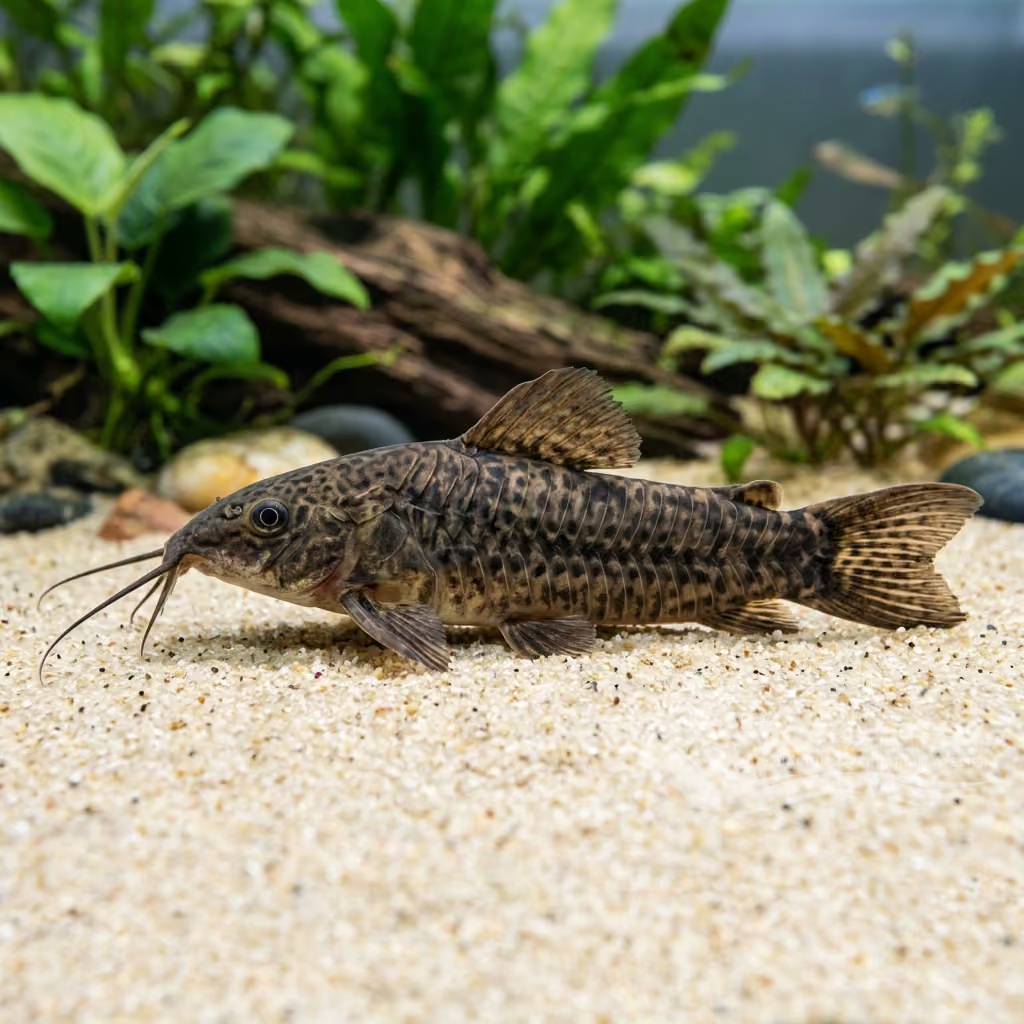
Large and rough armored South American freshwater fish, uniform gray-brown. Nocturnal, builds gigantic bubble nests mixed with leaves and plant debris on the surface.
Water Temperature
20 - 28 °C
pH Value
5.5 - 7.5
Water type
Freshwater
Tank level
Bottom
Adult size
20 cm
Minimum tank volume
>= 200 L
Minimum group
>= 6
GH
2 - 20 dGH
KH
2 - 15 dKH
TDS
50 - 450 ppm
Conductivity
78 - 703 uS/cm

Species description
Geographical Origin and Habitat: Monstrously widespread over almost all Latin America, from east of Trinidad and Tobago down to south in Argentina. King of the mud: fearlessly dominates seasonal drying pools, hypoxic swamps, and acidic blackwater trickles, moving when necessary over muddy dry land.
Taxonomy and Morphology: Absolute colossus of the Callichthyidae family. Popularly renamed "Brown Hoplo", it touches 20 cm (8 inches) in size (true "armoured beast"). Thick barrel-shaped siluriform, shielded on the flanks. Structures the absorption of gaseous oxygen directly in the hyper-vascularized viscera.
Social Behavior: Quiet nocturnal tank. Willingly coexists with conspecifics, passively stacked during the day between branches and foliage. Unleashed dragon of the seabed with the arrival of evening, where the 20-centimeter sizes will mess up the entire riverbed.
Coloration and Sexual Dimorphism: Pure utility with no frills. Monochromatic "stealth" livery: armored brown-green (often perfectly muddy). The mature male outshines the female with abnormal curved first pectoral spines and reddish fangs/villi for nuptial grip.

Care, breeding and tankmates
Aquarium Setup: Pachydermic aquariums with solidly covered panes (they attempt mass escapes by jumping high). Requires imposing carpets of fine sand and very solid and immovable furnishings (glued rocks, giant pipes, immense mopani). Any coarse substrate will fatally disfigure it.
Diet and Feeding: The greedy omnivorous fury. Extremely broad-spectrum scavenger. Never satiated, exterminates infesting snails, demands epic doses of massive granular pellets, immense earthworms and mixed bottom meal; cleans up decaying plant remains.
Water Quality: Biological ironclad in every sense. Ranges without stress in enormous thermal gaps (20-28°C / 68-82°F) and tolerates chemical swings as acidic (pH 5.5) as basic (pH 7.5). Mixed water hardness (GH 2-20). Nitrate accumulation that would intoxicate it must be stopped, always providing surface oxygen.
Compatibility and Cohabitation: Indifferent to fish swimming in mid-water. Supreme companion for large tanks of South American beasts: Oscars, Midas Cichlids, Arowanas. However, it will munch overnight on anything tiny that dares to rest on the bottom of its aquarium.
Aquarium Breeding: Surface nester in grand style. The male engineers and fiercely defends with bites large frothy castles (bubbles) under floating debris and foliage. Having fertilized the adhering eggs, the male becomes a ruthless fury: immediately remove any female and conspecific.
Risks and Diseases: Point of weakness: the very long barbels. If forced onto rough gravel, it lethally splits them, causing devastating septicemia. High mortality and intolerance towards intoxication in the tank by copper, undissolved salt or malachite green.

Geographic origin and distribution
Monstrously widespread over almost all Latin America, from east of Trinidad and Tobago down to south in Argentina. King of the mud: fearlessly dominates seasonal drying pools, hypoxic swamps, and acidic blackwater trickles, moving when necessary over muddy dry land.
Origin
Extra-Amazon South AmericaCentral America and Caribbean

Fish profile
- Temperament
- Semi-aggressive
- They exhibit a peaceful but incredibly active and boisterous temperament in the community aquarium. While they do not intentionally harm other fish, their energetic swimming can sometimes be disruptive. They are social creatures and display the most interesting behaviors when kept in small groups.
- Diet
- Omnivore
- These fish are omnivorous scavengers that will accept almost any sinking food offered to them. Their diet should consist of high-quality sinking pellets, wafers, and a variety of frozen foods like bloodworms and brine shrimp. Vegetable matter should also be provided periodically to ensure balanced nutrition.
- Life expectancy
- 4-8 years
- Adult size
- 20 cm
- Sex ratio
- Group
- Males can be distinguished by their significantly thicker, recurved pectoral fin spines, which they use during combat and breeding. Females are generally plumper, especially when conditioned with eggs, and lack the enlarged pectoral spines. A group of mixed sexes can be kept together in a sufficiently large aquarium.
- Feeding frequency
- Twice daily
- They should be fed once or twice daily with an amount they can consume within a few minutes. Because they are active mostly during twilight and night, evening feedings are often the most successful. Ensure that enough food reaches the bottom before being consumed by mid-water fish.
- Bioload
- High
- This armored catfish produces a moderate to high bioload relative to its size due to its constant foraging. They are vigorous eaters and actively sift through the substrate, which can stir up detritus into the water column. Good mechanical and biological filtration is necessary to keep the water clear.
- Flow
- Stagnant
- They are highly adaptable but generally prefer sluggish to moderate water flow environments. Coming from swamps and slow-moving rivers, they do not require torrential currents. Regular aeration is helpful, though they possess the ability to breathe atmospheric air if necessary.
- Jump risk
- Yes
- While not primarily known as escape artists, their rapid dashes to the surface for air can result in jumping. They take gulps of atmospheric air as an adaptation to oxygen-poor waters in the wild. A secure cover is recommended to ensure they do not accidentally launch themselves out.
- Reproduction
- Oviparous
- Breeding is fascinating as males build a large bubble nest at the water surface, often utilizing floating plant debris. The male becomes highly territorial during this time and will aggressively defend the nest against intruders. Once the eggs hatch, the fry require immediate access to small foods like infusoria or micro-worms.
- Compatibility & tankmates
- Community
- They are generally peaceful and make excellent additions to large community aquariums with similarly sized fish. However, their active nature may stress out very small, timid, or delicate bottom-dwelling species. They do best with robust characins, cichlids, and other medium to large peaceful fish.
- Tank level
- Bottom
- They are strict bottom dwellers that spend the vast majority of their time rooting around in the substrate. They will, however, make sudden and rapid dashes to the surface to swallow atmospheric air. Providing plenty of open sandy areas is important for their natural foraging behavior.

Scientific Parameters & Models
FishBase
Window to the official scientific data of the species
FishBase v25.04Data synced on: 06/15/2026
- Trophic level
- 2.7 ± 0 se
- Resilience
- Medium (1.4 - 4.4 years)
- Phylogenetic uniqueness (PD50)
- 0.625
- Bayesian Length-Weight
- a = 0.02089, b = 2.98
- VulnerabilityLow vulnerability (16 / 100)

Related species
Recommendations grouped by close relatives, companion choices, and similar care.