Taxiphyllum sp. "Flame Moss"
Taxiphyllum sp. "Flame Moss"
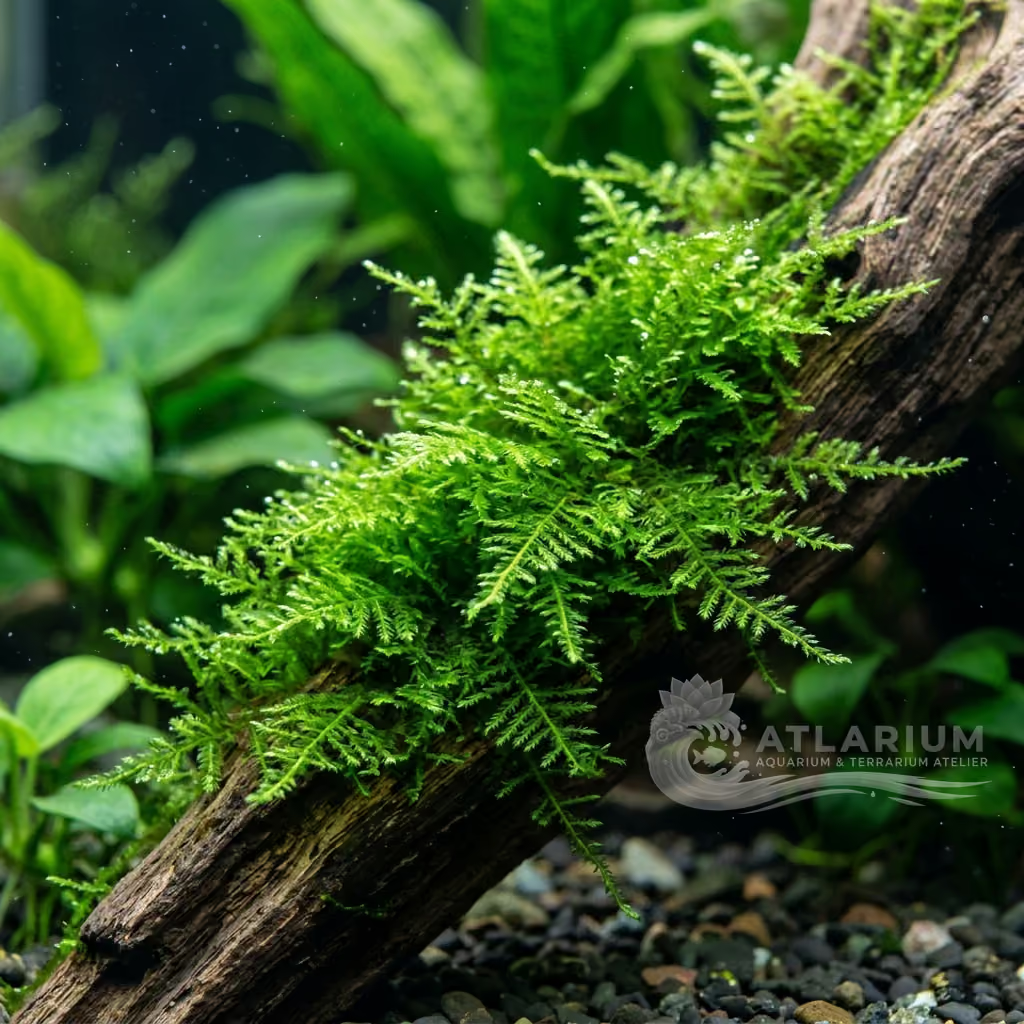
Taxiphyllum sp. "Flame Moss" is a slow-growing moss cherished for its unique upward, spiraling growth habit that resembles flickering flames, making it an excellent midground accent. It readily attaches to hardscape, adding dynamic texture and depth to any aquascape.
Water Temperature
12 - 30 °C
pH Value
5 - 8
Water type
Freshwater
Light
Low to High
CO2
Low - High
Expected height
10 cm
Expected width
10 cm
KH
0 - 14 dKH

Species description
Geographical Origin and Habitat: Taxiphyllum sp. "Flame Moss," while not having a precisely identified species with a confined natural habitat, belongs to a genus typically thriving in aquatic and riparian environments across East and Southeast Asia. In nature, *Taxiphyllum* mosses are often found clinging to submerged rocks, fallen tree trunks, or branches extending into water, benefiting from moderate currents and partial shading. This ecological origin endows Flame Moss with remarkable adaptability to stable underwater conditions, making it an ideal candidate for aquariums. Its resilience stems from its ability to colonize diverse surfaces in dynamic, often wet or semi-submerged environments.
Taxonomy & Genetics: Taxiphyllum sp. "Flame Moss" is classified within the Hypnaceae family, a large and diverse group of pleurocarpous mosses characterized by creeping stems from which lateral branches arise. The "sp." designation in its scientific name indicates that it is either an undescribed or unconfirmed species within the *Taxiphyllum* genus, or possibly a cultivated variant specifically selected for its unique growth pattern. This moss shares close genetic kinship with other popular aquarium mosses like "Java Moss" (Taxiphyllum barbieri) and "Christmas Moss" (Vesicularia dubyana, sometimes erroneously classified as Taxiphyllum), but is distinctly set apart by its unique growth morphology. Its classification within the *Taxiphyllum* genus reflects shared botanical characteristics with other members, such as leaf arrangement and sporophyte capsule structure, though the latter are rarely observed in submerged cultivation.
Physical Structure: The physical structure of Taxiphyllum sp. "Flame Moss" is its most defining characteristic, giving rise to its common name. This moss develops upright, dense fronds that grow upwards with a distinctive spiral or twisted habit, creating a visual effect reminiscent of small, flickering flames. Individual leaves are small, lanceolate or ovate, and tightly appressed to the stem, giving the moss a compact and velvety appearance. Unlike many other mosses that tend to grow more prostrately or horizontally branched, Flame Moss exhibits a decided tendency towards vertical growth. This peculiarity makes it excellent for creating three-dimensional accents and imparting a sense of movement within the aquarium, especially when attached to driftwood or rocks.
Color & Texture: The predominant color of Taxiphyllum sp. "Flame Moss" is a vibrant, deep green, which can range from a medium green to a darker hue depending on lighting conditions and nutrient availability. Under more intense light and with good fertilization, the moss tends to develop a richer, deeper, almost emerald tone. Its texture is finely velvety to the touch and visually dense, thanks to the small, tightly appressed leaves and dense branching. The overall appearance is lush and compact, offering a pleasing contrast to larger-leaved plants or dark rocks. The combination of its lively color and fine texture contributes to the "flame" effect that makes it so desirable in aquascapes.

Care, breeding and tankmates
Lighting & CO2: Taxiphyllum sp. "Flame Moss" is remarkably versatile regarding its lighting requirements, thriving in conditions ranging from low to high light, though its morphology and density benefit from higher light intensities. Under moderate to high light, the moss will develop a more compact growth and accentuate its characteristic "flame" shape, while in low light conditions, growth will be slower and potentially less dense, but still robust. CO2 supplementation is not strictly necessary for this moss's survival, but its provision can significantly accelerate growth rate and promote more vibrant coloration and a lusher habit. Good CO2 levels, coupled with adequate lighting, will maximize the aesthetic potential of "Flame Moss," allowing it to form dense, vertical masses more quickly.
Nutrition & Substrate: As an epiphytic moss, Taxiphyllum sp. "Flame Moss" does not require a nutrient-rich substrate, as it absorbs most of its nutrients directly from the water column through its small leaves. Therefore, a comprehensive liquid fertilization regimen, including both macronutrients (nitrogen, phosphorus, potassium) and micronutrients (iron, manganese, etc.), is crucial for healthy growth and optimal coloration. It is particularly susceptible to iron deficiency, which can manifest as yellowing tips or stunted growth. Although it does not root into the substrate, it is advisable to initially anchor it to rocks, driftwood, or other hard surfaces using thin fishing line or aquarium-safe cyanoacrylate glue. Once established, the moss will develop adhesive rhizoids that securely attach it to the chosen surface, not for nutrient absorption but for physical anchorage.
Water Chemistry:
Space Management & Placement: Taxiphyllum sp. "Flame Moss" is ideally placed in the midground of the aquarium, where its vertical growth and "flame" effect can be fully appreciated and utilized to create visual dynamism. It is particularly effective when anchored to mangrove wood, lava rock, or other decorative elements that benefit from a touch of lush, vertical green. To achieve the desired effect, it is advisable to attach small clumps of moss to surfaces using fishing line or cyanoacrylate glue, distributing them strategically. This technique allows for the creation of dense and natural formations, which can serve as shelter for small fish or invertebrates while also acting as a focal point. Its slow growth means it won't require frequent pruning to maintain its shape, but careful initial placement is key to maximizing its aesthetic impact within the overall layout.
Pruning: Pruning Taxiphyllum sp. "Flame Moss" is an important operation to maintain its desired shape, encourage denser growth, and prevent the accumulation of debris or algae within its structure. Because it grows slowly, pruning is not required as frequently as with faster-growing plants, but it should be performed regularly once the moss has reached the desired density. Use sharp, precise scissors to trim the upper fronds or overly dense areas, preferably with a motion that creates a uniform surface or follows the desired shape. Pruned fragments must be carefully removed from the aquarium to prevent them from settling on the substrate and decaying, or taking root in undesirable areas. Regular pruning encourages the moss to branch more, leading to a more robust and compact structure, and enhances its overall health.
Risks & Diseases: Taxiphyllum sp. "Flame Moss" is generally robust, but can be susceptible to common issues if aquarium conditions are not optimal. The primary risk is algae infestation, particularly filamentous algae or BBA (Black Brush Algae), which can become trapped within the dense fronds of the moss and suffocate it, compromising photosynthesis and its aesthetic. This problem is often related to nutrient imbalances, excessive lighting, or poor water circulation. Another risk is "melting," which can occur due to drastic changes in water parameters, poor water quality, or severe nutrient deficiencies, manifesting as the moss becoming translucent and disintegrating. To prevent these issues, it is crucial to maintain a strict maintenance routine, including regular water changes, adequate fertilization, and careful light management, while ensuring good oxygenation and circulation around the moss.

Geographic origin and distribution
Taxiphyllum sp. "Flame Moss," while not having a precisely identified species with a confined natural habitat, belongs to a genus typically thriving in aquatic and riparian environments across East and Southeast Asia. In nature, *Taxiphyllum* mosses are often found clinging to submerged rocks, fallen tree trunks, or branches extending into water, benefiting from moderate currents and partial shading. This ecological origin endows Flame Moss with remarkable adaptability to stable underwater conditions, making it an ideal candidate for aquariums. Its resilience stems from its ability to colonize diverse surfaces in dynamic, often wet or semi-submerged environments.
Origin
South and Southeast AsiaEast Asia

Plant profile
- Placement
- Midground
- Best attached to horizontal pieces of driftwood or flat rocks to highlight its vertical growth pattern. When placed in the foreground or midground, it creates the illusion of small green flames reaching upwards. It should be placed in areas with moderate water flow to keep it clean. Avoid burying it in the substrate.
- Botanical form
- epiphyte or epilith
- Highly distinctive due to its strictly vertical growth habit, with shoots that twist and spiral slightly as they grow upwards. This gives the appearance of a green campfire, hence the name 'Flame Moss'. The fronds are relatively thick and robust compared to other Taxiphyllum species. It maintains this unique shape even under varying light intensities.
- Growth
- Slow
- Grows at a slow to moderate pace, depending largely on lighting and CO2 availability. It takes some time to establish and begin its characteristic upward spiraling growth. Once settled, it steadily increases in height and density. It requires less frequent trimming than faster-growing mosses like Java moss.
- Substrate
- None
- Like other mosses, this distinct, vertical-growing variety does not produce roots and requires no planted substrate. It easily secures itself to rough surfaces like driftwood and lava rock using small, gripping rhizoids. Nutrient uptake occurs entirely across the surface area of its twisted fronds, making the aquarium's soil type inconsequential.
- Column fertilization
- Recommended
- Relies completely on the water column for its nutritional needs. A standard dosing regime of trace elements and macronutrients is sufficient to keep it healthy. It is not a heavy feeder, so lean dosing is often adequate. Maintaining stable water parameters helps ensure consistent, upward growth.
- Root fertilization
- None
- Lacks true roots and attaches itself using rhizoids. Consequently, substrate fertilizers are of no use to this plant. All feeding occurs directly through the leaf surfaces. It must be tied or glued to hardscape to establish itself properly.
- Trimming
- Occasional
- Trimming should be done carefully to maintain its vertical 'flame' appearance. Simply cut across the top of the moss horizontally to reduce its height and encourage denser growth from the base. The lower layers rarely die off if the moss is kept at a reasonable height. Siphon away any loose trimmings to prevent unwanted spreading.
- Propagation
- Cuttings
- Propagated easily by dividing the main clump or using the trimmings. Cut sections can be tied down to a new piece of hardscape using cotton thread or fishing line. Ensure the moss is spread thinly when attaching it, to allow light to reach all parts. It will slowly anchor itself and begin growing upwards again.
- Sensitivity
- Moderate
- Susceptible to algae growth if exposed to intense light without sufficient CO2 and nutrients. It can trap detritus easily due to its dense, upright structure, so adequate flow is important. It may melt if exposed to high doses of liquid carbon or certain medications. Generally, it is quite hardy once established.
- Layout role
- Epiphyte, Nano, Midground, accent
- Offers a unique structural element in aquascaping due to its verticality. It is often used to create the appearance of tall grass or miniature pine forests on hardscape. It provides excellent contrast when placed next to plants with broad leaves or horizontal growth patterns. It is also highly favored in shrimp tanks for grazing.

Related species
Recommendations grouped by close relatives, companion choices, and similar care.