Taxiphyllum alternans "Taiwan Moss"
Taxiphyllum alternans "Taiwan Moss"
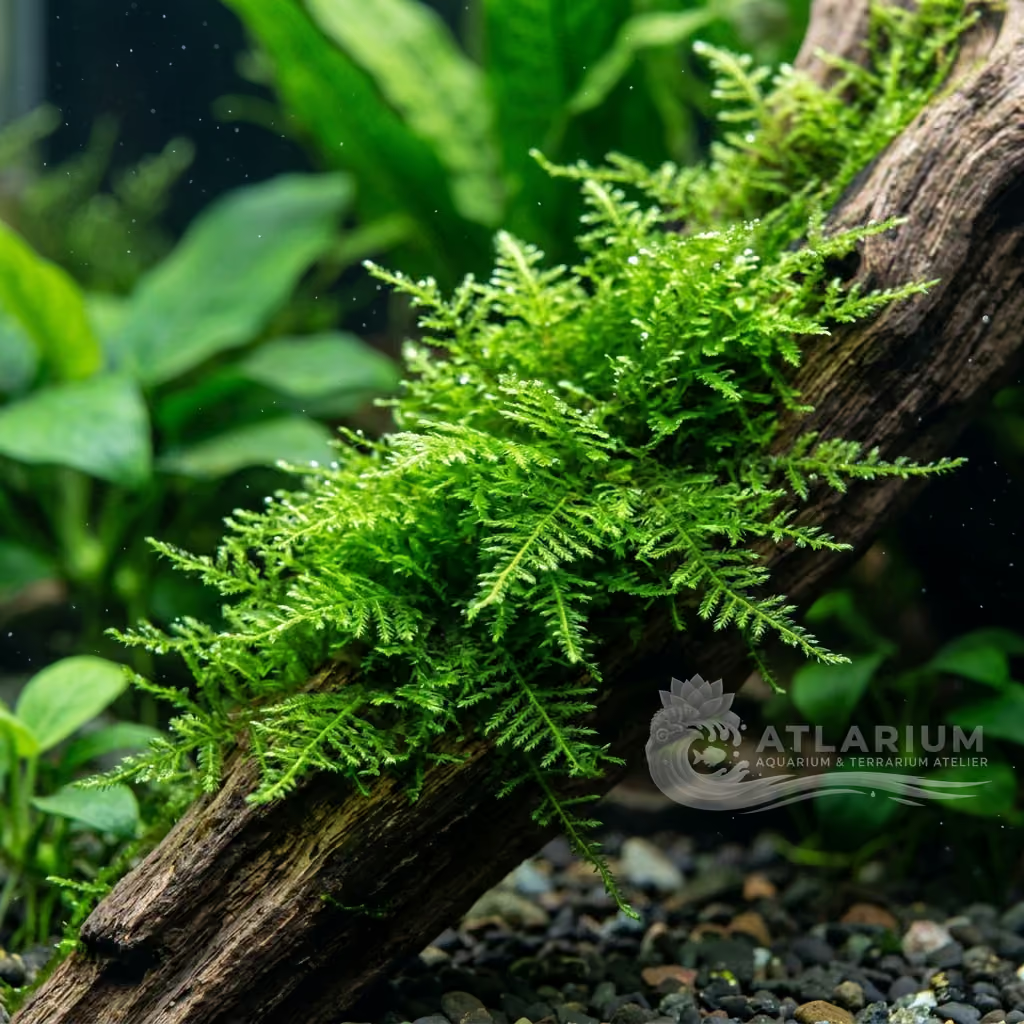
Taxiphyllum alternans "Taiwan Moss" is a versatile, slow-growing moss, ideal for the midground, adapting to various conditions. This moss forms dense, natural coverings by attaching to wood or rocks, enriching the aquarium layout with its fine texture.
Water Temperature
12 - 30 °C
pH Value
5 - 8
Water type
Freshwater
Light
Low to High
CO2
Low - High
Expected height
5 cm
Expected width
10 cm
KH
0 - 14 dKH

Species description
Geographical Origin and Habitat: Believed to originate from the Southeast Asian regions, particularly Taiwan, Taxiphyllum alternans "Taiwan Moss" is commonly found in aquatic and semi-aquatic habitats. It prefers shaded, humid areas along stream banks, where it clings to submerged or semi-submerged rocks and wood. This species thrives in clear, flowing water, demonstrating a remarkable ability to adapt to diverse environmental conditions.
Taxonomy & Genetics: Belonging to the Hypnaceae family, Taxiphyllum alternans is often identified in the aquarium trade as "Taiwan Moss." It is distinguishable from other related mosses, such as the more common Taxiphyllum barbieri (Java Moss), by a more delicate structure and a slightly pendulous or triangular growth pattern. Although its precise botanical identification can be complex, its specific morphology makes it a valued specimen.
Physical Structure: Taxiphyllum alternans "Taiwan Moss" exhibits a compact, densely branched growth habit, forming intricate and thick mats or cushions. Its delicate fronds are typically small, branching repeatedly to create a fine, feathery texture. It attaches to surfaces using inconspicuous rhizoids, allowing it to cling securely to rocks, wood, or mesh, without requiring a rooted substrate.
Color & Texture: This moss displays a vibrant, rich green coloration under optimal conditions, which deepens slightly with higher light and nutrient availability. Its texture is notably fine and soft to the touch, contributing to a lush, natural appearance within the aquarium. The dense growth and intricate branching create a visual depth that enhances foreground or midground compositions.

Care, breeding and tankmates
Lighting & CO2: Taxiphyllum alternans "Taiwan Moss" is adaptable to a wide range of lighting, from low to high; however, moderate light promotes healthier, denser growth without excessive algal issues. While CO2 injection is not strictly necessary, it significantly accelerates its slow growth rate and encourages a more robust, vibrant appearance. In low light conditions, growth will be minimal but sustained, while high light without CO2 can increase the risk of algal proliferation.
Nutrition & Substrate: This moss primarily absorbs nutrients from the
Water Chemistry: Taxiphyllum alternans "Taiwan Moss" is extremely tolerant of various water parameters, thriving in temperatures between 12.0 and 30.0 °C, demonstrating remarkable adaptability. It flourishes across a broad pH range of 5.0 to 8.0 and with a carbonate hardness (KH) of 0.0 to 14.0, indicating its resilience to both soft, acidic, and harder, more alkaline conditions. Maintaining stable parameters within these ranges is more crucial than hitting a specific optimal value.
Space Management & Placement: Ideally placed in the midground of an aquascape, where its dense growth can create lush green carpets or cover hardscape elements. It is an excellent choice for tying to driftwood or rocks, providing shelter for small fish and invertebrates, or softening harsh lines in the composition. Its slow growth rate means it requires less frequent intervention to maintain its desired shape.
Pruning: Regular pruning is essential to prevent the moss from becoming too dense, which could lead to light blockage and eventual decay of the inner layers. Trimming also helps maintain its aesthetic shape and promotes healthier, more compact new growth. Use sharp scissors to snip off overgrown sections, ensuring good water circulation throughout the moss.
Risks & Diseases: Generally robust, Taxiphyllum alternans "Taiwan Moss" primarily faces challenges related to excessive algae growth, especially when nutrient levels are imbalanced or light is too intense without adequate CO2. Melting can occur due to sudden drastic changes in water parameters or insufficient light, leading to browning and decay. Ensure stable conditions and appropriate nutrient balance to mitigate these risks.

Geographic origin and distribution
Believed to originate from the Southeast Asian regions, particularly Taiwan, Taxiphyllum alternans "Taiwan Moss" is commonly found in aquatic and semi-aquatic habitats. It prefers shaded, humid areas along stream banks, where it clings to submerged or semi-submerged rocks and wood. This species thrives in clear, flowing water, demonstrating a remarkable ability to adapt to diverse environmental conditions.
Origin
South and Southeast Asia

Plant profile
- Placement
- Epiphyte
- Ideal for attaching to hardscape elements such as driftwood and rocks to create a natural, aged look. It can also be used to create moss walls or placed in the foreground as a low-lying carpet if tied to mesh. Ensure it is placed in an area with good water flow. It thrives best when it is not buried in the substrate.
- Botanical form
- Moss
- Features delicate, fine fronds that branch out regularly, giving it a somewhat triangular, fern-like appearance. It closely resembles weeping moss but tends to grow outward and slightly upward rather than strictly drooping. The foliage is a lush, vibrant green when healthy. Its texture is softer and finer than Java moss.
- Growth
- Slow
- Exhibits a moderate to fast growth rate compared to other mosses, quickly covering surfaces it is attached to. Under optimal conditions with good lighting and CO2, its growth can be quite vigorous. Regular maintenance is required to prevent it from becoming too thick and detaching. It grows faster when attached to wood than when left free-floating.
- Substrate
- None
- As an aquatic moss, Taiwan Moss lacks true roots and does not require any substrate for its growth. Instead, it utilizes specialized rhizoids to anchor itself firmly to hardscape materials such as driftwood or rocks. All essential nutrients are absorbed directly from the water column through its delicate fronds, making the underlying substrate type entirely irrelevant.
- Column fertilization
- Recommended
- Relies entirely on column fertilization as it lacks a true root system. Occasional dosing of trace elements and macronutrients helps maintain its bright color and dense growth structure. It is relatively efficient at scavenging nutrients from the water. Avoid heavy fertilization, which can lead to algae blooms that quickly choke the moss.
- Root fertilization
- None
- Does not require root fertilization because it attaches to surfaces using rhizoids rather than true roots. Substrate nutrients are entirely inaccessible to this plant. All feeding must be done via the water column. Planting it directly into soil or gravel can actually cause the lower sections to rot.
- Trimming
- Occasional
- Should be trimmed regularly to prevent the lower layers from dying off due to lack of light and water flow. Trimming can be done easily with curved scissors, cutting it close to the hardscape. The trimmings must be siphoned out carefully, as any loose piece will attach and grow elsewhere. Regular haircuts encourage a much denser, more appealing growth form.
- Propagation
- Cuttings
- Extremely simple to propagate by manual division. A clump can be pulled apart or cut into smaller pieces and attached to new surfaces using cotton thread, fishing line, or cyanoacrylate glue. Every small fragment has the potential to grow into a new colony. Tying it tightly to hardscape ensures a neat and tidy initial growth pattern.
- Sensitivity
- LOW
- Sensitive to heavy algae growth, which can quickly smother the delicate fronds. Liquid carbon supplements should be used with caution, as overdosing can melt the moss. It prefers cooler water temperatures and may suffer in excessively warm tanks. Debris accumulation in the moss can lead to localized rot and should be prevented with good flow.
- Layout role
- Epiphyte, Nano, Midground
- Frequently used to soften the harsh edges of hardscape and provide a natural, established feel to the aquascape. It offers excellent hiding places for shrimp and small fish fry. Its branching structure makes it a popular choice for creating realistic miniature trees on driftwood. It adds a lush, textured detail to the foreground and midground.

Related species
Recommendations grouped by close relatives, companion choices, and similar care.