Banded Archerfish
Toxotes jaculatrix
The Banded Archerfish is the quintessential mangrove sniper. Adapting to brackish waters, it requires aerial clearance above the tank to exhibit its extraordinary ability to shoot water at live prey.
Water Temperature
25 - 30 °C
pH Value
7 - 8
Water type
Freshwater
Tank level
Surface
Adult size
25 cm
Minimum tank volume
>= 300 L
Minimum group
>= 1
GH
10 - 30 dGH
KH
5 - 15 dKH
TDS
200 - 600 ppm
Conductivity
313 - 938 uS/cm

Species description
Geographical Origin and Habitat: Indian and western Pacific Ocean (from India to the Philippines and Australia). Typical inhabitant of estuaries, brackish lagoons and intricate mangrove forests, rarely venturing into freshwater areas.
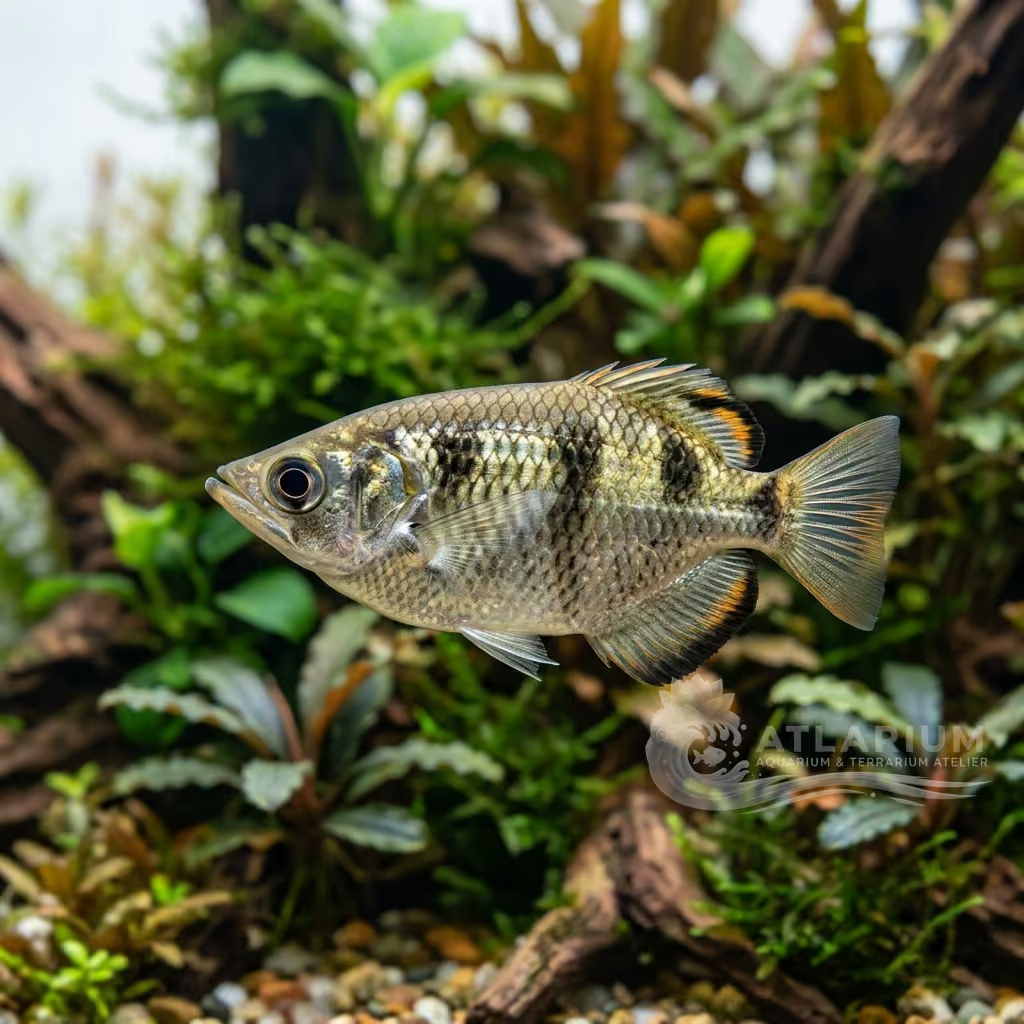
Taxonomy and Morphology: Banded Archerfish (Toxotes jaculatrix). The most common "banded" archerfish in the aquarium trade. Laterally compressed body, flat back to navigate close to the surface. It features the same "water cannon" mouth structure as the chatareus.
Social Behavior: Gregarious Sharpshooter. Unlike the giant chatareus, the jaculatrix prefers to live in medium schools. They are intelligent fish that learn to recognize the faces of their owners (scientific studies prove this). They shoot concentrated water jets, taking down spiders and locusts.
Coloration and Sexual Dimorphism: Black Bands. The back varies from pale golden to green, the belly is silvery. The absolute distinguishing mark are 4 or 5 clear and spaced coal-black vertical bands on the upper half of the flank (not merged into spots like in the chatareus).

Care, breeding and tankmates
Aquarium Setup: Extensive Brackish Paludarium (Minimum 120 cm / 48 inches). It is strictly necessary to create a half-empty tank: 30 cm (12 inches) of brackish water, topped by 40 cm (16 inches) of open airspace covered by a net to prevent escapes (they jump a lot). Emerged woods are fundamental.
Diet and Feeding: Aerial hunter. The owner must turn the meal into environmental enrichment: dropping crickets in the water will bore it; place or temporarily glue them on suspended pothos leaves and watch them snipe the prey with jets up to 1.5 meters (5 feet) away.
Water Quality: Strictly Brackish fish. It does not live well and does not thrive in purely freshwater. Requires a saline specific gravity of 1.005-1.015. Excellent filtration required to compensate for the diet based on large polluting insects.
Compatibility and Cohabitation: Perfect in schools (5-6 individuals) in a dedicated brackish paludarium. Very tolerant with peaceful Monodactylus or Scatophagus. NEVER keep them with fish more aggressive at mealtime, nor with tiny fish they would swallow.
Aquarium Breeding: Impossible in a home aquarium. They release millions of microscopic eggs in conjunction with tidal factors, rainy season and oceanic tropical photoperiod in reproduction.
Risks and Diseases: Ceiling stress. The most serious mistake for a Toxotes is to block its instinct: mirrored closed tanks or illuminated so strongly as to cause photophobia (blinding reflections on the surface) will deprive it of orientation, wearing out its nervous system in a short time.

Geographic origin and distribution
Indian and western Pacific Ocean (from India to the Philippines and Australia). Typical inhabitant of estuaries, brackish lagoons and intricate mangrove forests, rarely venturing into freshwater areas.
Origin
Tropical oceans and reefsSouth and Southeast AsiaAustralia, New Guinea, and Oceania

Fish profile
- Temperament
- Semi-aggressive
- While generally well-behaved, The Banded archerfish possesses a semi-aggressive streak that requires careful tank mate selection. They will fiercely defend their chosen territory, especially during feeding or breeding times, but usually ignore fish that stay out of their way. Providing a large enough aquarium with distinct visual boundaries helps mitigate most aggressive tendencies.
- Diet
- Omnivore
- The Banded archerfish is a specialized insectivore, naturally feeding on insects that fall onto the water surface or live among aquatic vegetation. Their diet in the aquarium should heavily feature live or frozen insects, such as fruit flies, bloodworms, and mosquito larvae. While they can be trained to accept floating pellets, natural insect prey remains crucial for their digestion and vitality.
- Life expectancy
- 5-10 years
- Adult size
- 25 cm
- Sex ratio
- Pair
- Males and females of The Banded archerfish are nearly identical in appearance, making visual sexing extremely challenging outside of the breeding season. During spawning, females may appear slightly plumper, while males might develop slightly more intense coloration or specific breeding tubes. When keeping a group, a balanced mix is natural, though purchasing a larger group and letting pairs form organically is the best approach.
- Feeding frequency
- Twice daily
- Since The Banded archerfish feeds primarily at the surface, offering food in small, frequent amounts throughout the day mimics their natural foraging behavior. They should be fed two to three times daily, focusing on floating items that stay at the surface. Care must be taken to remove any uneaten food quickly to prevent water spoilage.
- Bioload
- High
- The Banded archerfish is known for producing a significant amount of waste, placing a high demand on the aquarium's filtration system. Heavy mechanical and biological filtration is absolutely critical to process the ammonia output safely and efficiently. Frequent and substantial water changes are an unavoidable part of keeping this species healthy in the long term.
- Flow
- Stagnant
- Originating from moderately flowing streams and rivers, The Banded archerfish appreciates a steady but not overpowering water current. The flow should be sufficient to ensure good oxygenation and even temperature distribution throughout the tank. Providing areas of both moderate flow and resting zones with lower flow will allow the fish to choose their preferred environment.
- Jump risk
- Yes
- The Banded archerfish is an excellent jumper and is well known for leaping out of the water to catch prey or escape predators in the wild. Even the smallest gap in the aquarium canopy can be exploited, leading to a tragic outcome. A completely secure, heavy, and tightly fitting lid or mesh screen is an absolute necessity for this species.
- Reproduction
- Oviparous
- Reproduction in The Banded archerfish involves the scattering of pelagic eggs directly into the water column, usually during the rainy season in their natural habitat. They do not exhibit any parental care, and the eggs are left to drift with the current until they hatch. Breeding them in captivity is incredibly difficult and rarely achieved without specialized hormonal treatments and massive breeding vats.
- Compatibility & tankmates
- Semi-aggressive
- This species can be somewhat territorial, especially towards conspecifics or similar-looking fish. They should be kept with robust fish that occupy different water levels to minimize aggressive encounters. Providing plenty of visual barriers like plants and driftwood will help reduce tension within the aquarium.
- Tank level
- Top
- The Banded archerfish spends the vast majority of its time patrolling the upper levels of the water column, often just below the surface. They rely on their upward-facing mouths to snatch food from the water's edge or even above it. Floating plants can provide them with a sense of security while they hunt and rest in this specific zone.

Scientific Parameters & Models
FishBase
Window to the official scientific data of the species
FishBase v25.04Data synced on: 06/15/2026
- Trophic level
- 2.6 ± 0.27 se
- Resilience
- Medium (1.4 - 4.4 years)
- Phylogenetic uniqueness (PD50)
- 0.5156
- Bayesian Length-Weight
- a = 0.0166, b = 3
- VulnerabilityLow vulnerability (20 / 100)

Related species
Recommendations grouped by close relatives, companion choices, and similar care.