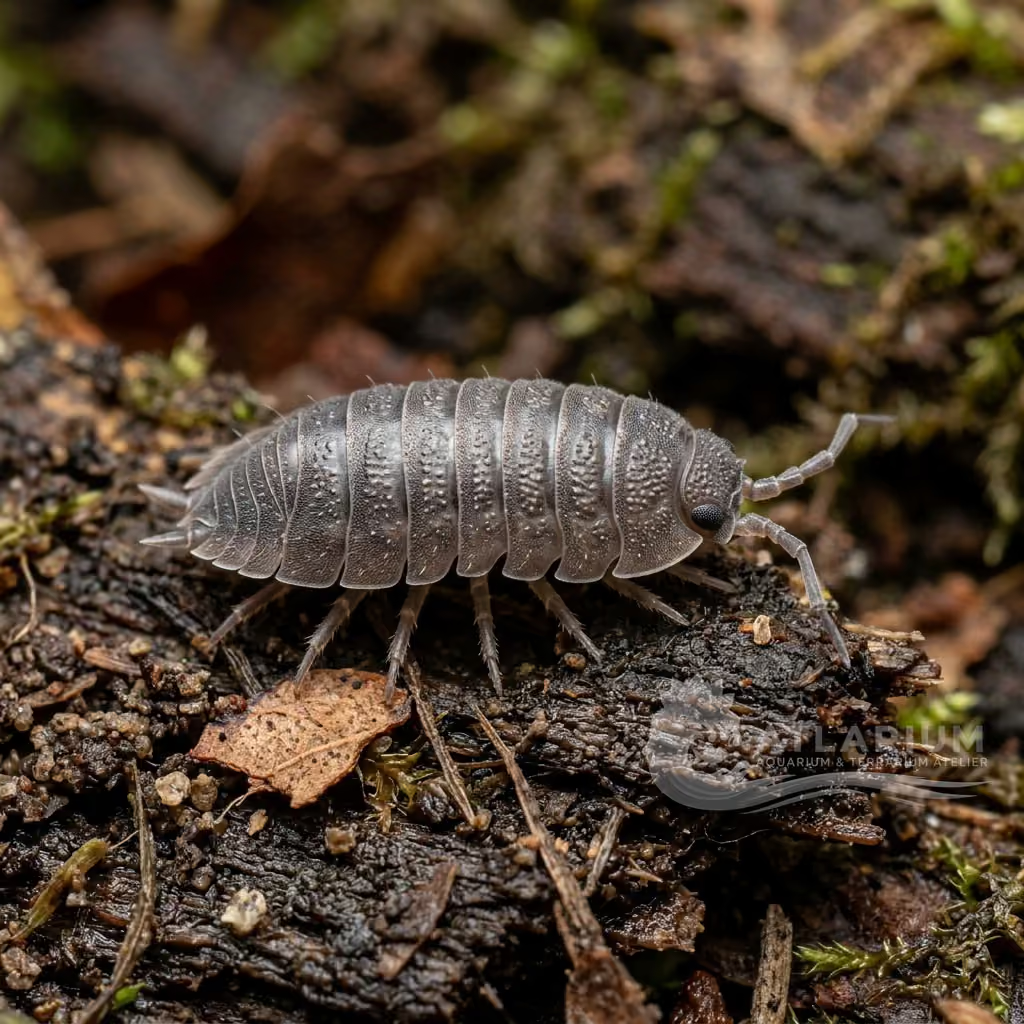
High Yellow Isopod (Haasi)
Porcellio haasi
The Spanish Yellow Isopod (Porcellio haasi). A mastodontic, precious isopod (up to 1.4 inches) renowned worldwide for its very rare and splendid 'High Yellow morph'. It is one of the most sensitive and sought-after Iberian gems: very black or charcoal colored body embellished with three dazzling bright sulfur/lemon yellow parallel central bands and very extensive epimera (skirts). Difficult to stabilize in a colony and very fragile to thermal changes, dies easily from environmental stress.
Environment
Terrestrial
Humidity
40 - 60 %
Day temperature
20 - 26 °C
Night temperature
18 - 22 °C

Species description
Geographical Origin and Habitat: Arid undergrowths on asphyxiating calcareous slopes and Spanish Mediterranean scrub with freezing winters and fiery summers.
Taxonomy and Genetics: Family Porcellionidae. Another thoroughbred of the Iberian giants group ('Flaring skirts isopods'). The mutations on the market have concentrated on making the acid yellow (High Yellow) shine, almost completely removing the black. Very slow reproduction with broods that rarely exceed 20 babies in whole months of stasis.
Behavior and Habits: gold medals. In nature and in terrarium, the Haasi spend most of their time in total immobility (slower and more motionless even than the titanic Hoffmannseggii). If bothered or touched with tweezers, they do not play dead or run away, but run for a few seconds to violently glue themselves to a corner of the cork flattening the skirt and making themselves untargetable.
Morphology: Flattened into a perfect lozenge (1.4 inches / 3.5 cm). Very extensive, smooth and flat shell (flatter and similar to expansus). Majestic colors: steel gray or petroleum black armor gutted by three luminous yellow central lanes ('Light morph') and often milky white edges (White skirt). Exaggeratedly long alien insect antennae.

Care, breeding and tankmates
Terrarium Setup: GIANT BINS, ARID WITH SUPREME VENTILATION (Pure exclusive setup). Porcellio haasi CANNOT BE WITH ANYTHING: only dedicated plexiglass tanks heavily modified with steel mesh that acts as the entire lid and cross lateral air intakes to zero the vapor. Deep calcareous arid soil. Stack infinite flat cork barks to create thin layers of 'squashed' refuge.
Lighting and Heating: ABSENCE OF DIRECT LIGHT. Cool and still heat 72-75°F (22-24°C). Very sensitive to the muggy summer climate: they die in the grip of convulsions (hyperthermia) if kept in houses without air conditioning above 82°F (28°C) for two weeks, unable to escape into deep underground tunnels.
Humidity and Hydration: EXTREME STONY GROUND VENTILATION (30-50% MAX). CRITICAL: 85% DUSTY AND ARID SOIL. Provide a tiny (1.5 inches) pad of moss dripping with water injected with a syringe, buried in a deep corner, which serves as a lethal watering hole against dehydration (isopods will dive in to absorb with their abdomen to start again for the arid).
Feeding and Supplementation: Slow Elite Calcareous Detritivores. Impressive need for clean dead leaves (Dried Oak, Chestnut and Walnut washed by dew). They will eat very few animal proteins (Microscopic Krill twice a month). NECESSARY an enormous exposure of calcium (turtle blocks, cuttlefish bones scattered everywhere) or they will die in the lethal failed molt ('Molt failure').
Compatibility: Hyper-Rare, Untouchable for Collectors. Handle as little as possible. They do not tolerate gatherings. Colonies of P. haasi will block reproductively and fatally collapse in stasis if raised in narrow boxes, triggering silent fights and cannibalism on the babies. No roommates tolerated except springtails.
Health and Common Diseases: Fungal decay from damp armor (White Mold Asphyxia ). Like all giants with enormous Iberian skirts, the enormous external plates of the shell prevent natural ventilation of the belly if sprayed from above: condensation penetrates into the trapped gills (pleopods) that begin to rot alive with fluffy fungi (death in 36 hours).

Geographic origin and distribution
Arid undergrowths on asphyxiating calcareous slopes and Spanish Mediterranean scrub with freezing winters and fiery summers.
Origin
Selective breeding and cultivarsEurope, Mediterranean, and West AsiaCosmopolitan or introduced

Terrestrial invertebrate profile
- Diet
- Detritivore
- The diet of Porcellio haasi consists of specific nutrients. It forages for a variety of food sources. A well-balanced feeding regimen is essential.
- Adult size
- 2.5 cm
- Lifestyle/Microhabitat
- Terrestrial
- Porcellio haasi leads a lifestyle adapted to its niche. It utilizes various elements of its habitat. Providing a complex enclosure is crucial for its enrichment.
- Activity cycle
- Nocturnal
- The activity pattern of Porcellio haasi dictates when it is most active. It exhibits periods of rest aligned with light cycles. Understanding these rhythms helps create a suitable schedule.
- Sociality
- Solitary
- They are highly social and thrive in colony settings. They are peaceful amongst themselves and display fascinating group dynamics when feeding, often congregating in large numbers around high-value food items.
- Reproduction
- Marsupial
- Reproduction for Porcellio haasi involves specific mating behaviors. Females seek out appropriate nesting sites. Successful breeding requires mimicking natural conditions.
- Venomous
- No
- Handling tolerance
- Tolerant
- Handling Porcellio haasi should be done with care. It is recommended to allow the animal to adjust first. Gentle movements are key when handling is necessary.
- Brumation
- Not required
- Brumation for Porcellio haasi is triggered by temperature changes. During this period, its metabolism slows down. Proper preparation is essential to ensure a healthy emergence.
- Molting
- Periodic
- The molting process of Porcellio haasi allows it to shed old layers. Adequate humidity is vital for facilitating a smooth shed. Caretakers must regularly check for retained pieces.

Related species
Recommendations grouped by close relatives, companion choices, and similar care.