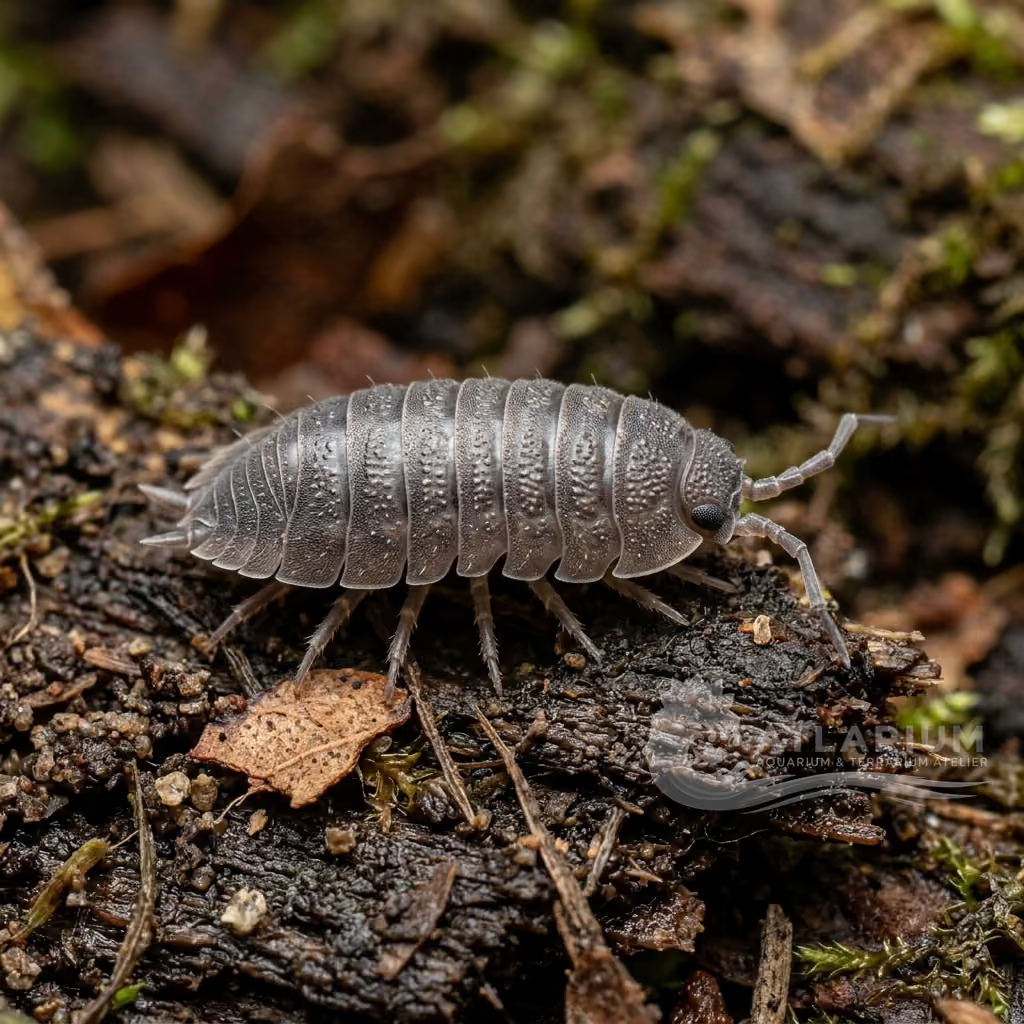
Greek Isopod (Pancake Isopod)
Porcellio werneri
The Greek Isopod or 'Pancake Isopod' (Porcellio werneri). A Mediterranean biological masterpiece (1 inch). It is perhaps the most flattened and 'leaf-like' isopod that exists in terrarium keeping. Its shape is an almost perfect elliptical disk (totally flattened), of a beautiful opaque silver gray adorned with a very wide and white 'skirt' (white fringing). It is an extremely dry, species and highly vulnerable to humidity errors.
Environment
Terrestrial
Humidity
30 - 50 %
Day temperature
20 - 26 °C
Night temperature
18 - 22 °C

Species description
Geographical Origin and Habitat: Arid undergrowths of pines, dry olive groves and crevices between stony dry stone walls baked by the sun of the Greek islands.
Taxonomy and Genetics: Family Porcellionidae. (Isopods of the extreme Mediterranean group). It shares the extended lateral skirts with the Iberian giants, but takes the concept of 'flattening' to the extreme: seen from above they are perfect and very smooth ovals, fused to the ground like ancient silver coins.
Behavior and Habits: Paralyzed silver medals. Incredibly. P. werneri move very little, especially if disturbed. If discovered under a stone, they totally immobilize themselves adhering to the rock in a desperate attempt to simulate a flat lichen. Their reproduction is atrociously slow: they hatch very few manchae and the young grow at a snail's pace.
Morphology: Saucer / medal shaped (Up to 1 - 1.1 inches / 2.5 - 2.8 cm). They are so squashed (Pancake shape) that they have no curve on their back. Breathtaking color: the center is dark slate gray/dull silver (Frosted silver), fading sharply into an oval outline ('skirt' and head) of dazzling pearly white or butter yellow. Short legs hidden entirely by the umbrella carapace.

Care, breeding and tankmates
Terrarium Setup: ARID BINS WITH VENTILATED 'STRATIFICATION' (Dedicated and clean set-ups). Werneri require large horizontal boxes. Very dry clay/calcareous based substrate. Instead of peat (which retains deadly moisture), use a mixture of holm oak leaves and sand. Place very flat cork bark: they love to squeeze under millimetric thicknesses.
Lighting and Heating: ABSENCE OF DIRECT LIGHT. Medium-cool Greek heat: 72-75°F (22-24°C). Very sensitive to temperatures above 79°F (26°C). The air must be fresh and moving.
Humidity and Hydration: SEA WIND TYPE VENTILATION AND ARIDITY (30-50% MAX). MANDATORY: Box for 80% completely dry. Keep only a tiny tuft of wet moss in a very distant pipette or the box will go into condensation killing them atrociously of asphyxia in 2 days. They have huge shell wings that do not let anything evaporate from the belly (they avoid drying out in Greece but rot in inexpert captivity).
Feeding and Supplementation: Low-Need Shy Detritivores. They will eat minimal portions of ultra-dry oak leaves (they eat at a very slow pace), thin rounds of dried carrot and protein fish flakes but in surgical doses (otherwise the protein will rot in the box causing deadly mold). Calcium (cuttlefish bone) crumbled over the entire tank in large doses.
Compatibility: Hyper-Rare, Untouchable (Absolute Isolation). Very fragile to manual pressure. The white 'skirts' can be crushed or torn if lifted brutally with the fingers. Pregnancies (females with inflated marsupial pouch) are very fragile: the female can literally abort and die if the box is moved too much.
Health and Common Diseases: Decay from invisible humidity (Wet-Molt Misfire ). If the substrate feels barely damp to the touch and ventilation is weak, the werneri cannot expand the new 'flat' exoskeleton during molting. They remain trapped halfway out the shell, their legs glue together and they die frozen in a rotten water bubble.

Geographic origin and distribution
Arid undergrowths of pines, dry olive groves and crevices between stony dry stone walls baked by the sun of the Greek islands.
Origin
Europe, Mediterranean, and West Asia

Terrestrial invertebrate profile
- Diet
- Detritivore
- The diet of Porcellio werneri consists of specific nutrients. It forages for a variety of food sources. A well-balanced feeding regimen is essential.
- Adult size
- 2.6 cm
- Lifestyle/Microhabitat
- Terrestrial
- Porcellio werneri leads a lifestyle adapted to its niche. It utilizes various elements of its habitat. Providing a complex enclosure is crucial for its enrichment.
- Activity cycle
- Nocturnal
- The activity pattern of Porcellio werneri dictates when it is most active. It exhibits periods of rest aligned with light cycles. Understanding these rhythms helps create a suitable schedule.
- Sociality
- Solitary
- Social creatures that thrive when housed in a colony. They interact peacefully with one another and a group setting often seems to encourage more natural foraging behaviors and better overall colony health.
- Reproduction
- Marsupial
- Reproduction for Porcellio werneri involves specific mating behaviors. Females seek out appropriate nesting sites. Successful breeding requires mimicking natural conditions.
- Venomous
- No
- Handling tolerance
- Tolerant
- Handling Porcellio werneri should be done with care. It is recommended to allow the animal to adjust first. Gentle movements are key when handling is necessary.
- Brumation
- Not required
- Brumation for Porcellio werneri is triggered by temperature changes. During this period, its metabolism slows down. Proper preparation is essential to ensure a healthy emergence.
- Molting
- Periodic
- The molting process of Porcellio werneri allows it to shed old layers. Adequate humidity is vital for facilitating a smooth shed. Caretakers must regularly check for retained pieces.

Related species
Recommendations grouped by close relatives, companion choices, and similar care.