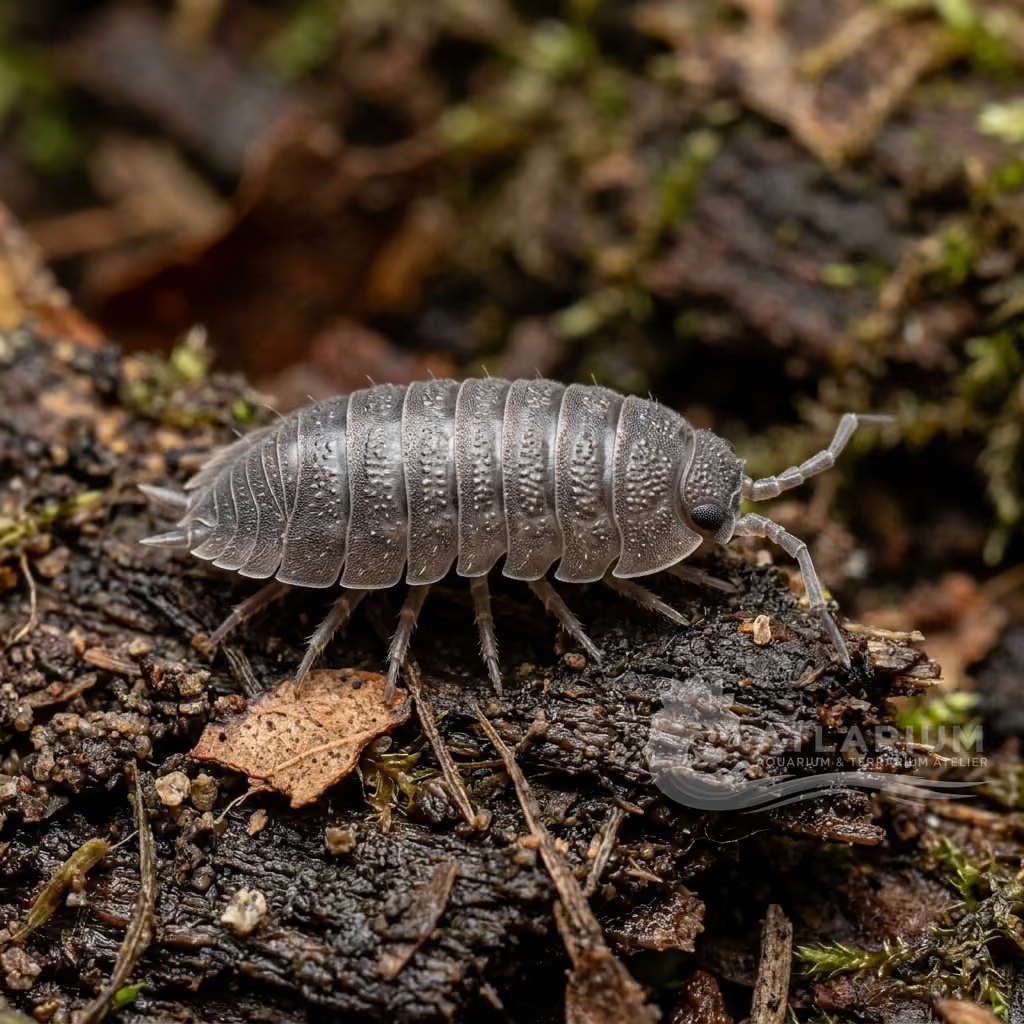
Bolivar's Isopod (Bolivari)
Porcellio bolivari
Bolivar's Sulfur Yellow Isopod (Porcellio bolivari). Perhaps the most visually alien and exaggerated terrestrial isopod of the entire European continent (1.4 inches). Characterized by the incredible (and very long) reddish posterior uropods shaped like sharp lances, and by an aerodynamic opaque yellow carapace shaded with ghost gray. Very expensive, very slow to reproduce and lethal to breed due to its intolerance to ANY minimum percentage of stagnant humidity in the terrarium (dies almost instantly of 'wet-molt').
Environment
Terrestrial
Humidity
20 - 40 %
Ambient temperature
21 °C
Day temperature
22 - 26 °C
Night temperature
18 - 20 °C
Substrate depth
>= 7 cm

Species description
Geographical Origin and Habitat: Exclusive to sunny crevices, dry caves and boiling rocks of the arid plateaus of central continental Spain.
Taxonomy and Genetics: Family Porcellionidae. One of the members of the extreme giant Iberian trinity (Along with haasi and hoffmannseggii). If Hoff is stubby and massive and Haasi is flattened and neon yellow, Bolivari is the 'aerodynamic ghost' with the most bizarre proportions of the entire isopod order (the posterior uropodial tails are the absolute longest, constituting 1/3 of the body length).
Behavior and Habits: Silent prey with lethal lances. Clumsy and awkward in walking, these giants use the monstrous posterior tails (uropods) as real fixed lances behind them to prevent predators (centipedes or Iberian scorpions) from piercing them from behind in a narrow ravine. They spend days motionless clinging under oak barks, barely tolerating the presence of conspecifics and not reproducing in minimally congested spaces.
Morphology: Long, huge ghost yellow/gray lancers (Over 1.4 - 1.6 inches / 3.5 - 4 cm tails included). The 'skirt' (epimeron) is angular and less wide than P. expansus. Males show off exaggeratedly long uropods (red/orange lances on the rear). The armor is of a very elegant washed-out opalescent yellow (Ghost Yellow) mixed with a crazy dull steel gray, with thin and monstrous antennae to scan the dark.

Care, breeding and tankmates
Terrarium Setup: Guidance about terrarium setup for Porcellio bolivari must rely exclusively on the parameters and sources listed on this record.
Lighting and Heating: Guidance about lighting and heating for Porcellio bolivari must rely exclusively on the parameters and sources listed on this record.
Humidity and Hydration: Guidance about humidity and hydration for Porcellio bolivari must rely exclusively on the parameters and sources listed on this record.
Feeding and Supplementation: Guidance about feeding and supplementation for Porcellio bolivari must rely exclusively on the parameters and sources listed on this record.
Compatibility and Coexistence: Guidance about compatibility and coexistence for Porcellio bolivari must rely exclusively on the parameters and sources listed on this record.
Health and Common Diseases: Guidance about health and common diseases for Porcellio bolivari must rely exclusively on the parameters and sources listed on this record.

Geographic origin and distribution
Exclusive to sunny crevices, dry caves and boiling rocks of the arid plateaus of central continental Spain.
Origin
North AmericaEurope, Mediterranean, and West Asia

Terrestrial invertebrate profile
- Diet
- Detritivore
- The diet of Porcellio bolivari consists of specific nutrients. It forages for a variety of food sources. A well-balanced feeding regimen is essential.
- Adult size
- 3 cm
- Lifestyle/Microhabitat
- Terrestrial
- Porcellio bolivari leads a lifestyle adapted to its niche. It utilizes various elements of its habitat. Providing a complex enclosure is crucial for its enrichment.
- Activity cycle
- Nocturnal
- The activity pattern of Porcellio bolivari dictates when it is most active. It exhibits periods of rest aligned with light cycles. Understanding these rhythms helps create a suitable schedule.
- Sociality
- Solitary
- Bolivar's Isopods are fascinating terrestrial crustaceans that display a highly active and somewhat bold demeanor in the terrarium. They tend to prefer a strong humidity gradient, often congregating in the drier areas of the enclosure while still needing access to moisture. This species is quite gregarious and establishes peaceful colonies, often seen foraging together in small groups. When disturbed, they may attempt to quickly scurry away rather than completely conglobate (roll into a ball).
- Reproduction
- Oviparous
- Reproduction for Porcellio bolivari involves specific mating behaviors. Females seek out appropriate nesting sites. Successful breeding requires mimicking natural conditions.
- Venomous
- No
- Handling tolerance
- Tolerant
- Handling Porcellio bolivari should be done with care. It is recommended to allow the animal to adjust first. Gentle movements are key when handling is necessary.
- Brumation
- Brumation for Porcellio bolivari is triggered by temperature changes. During this period, its metabolism slows down. Proper preparation is essential to ensure a healthy emergence.
- Molting
- Periodic
- The molting process of Porcellio bolivari allows it to shed old layers. Adequate humidity is vital for facilitating a smooth shed. Caretakers must regularly check for retained pieces.

Related species
Recommendations grouped by close relatives, companion choices, and similar care.