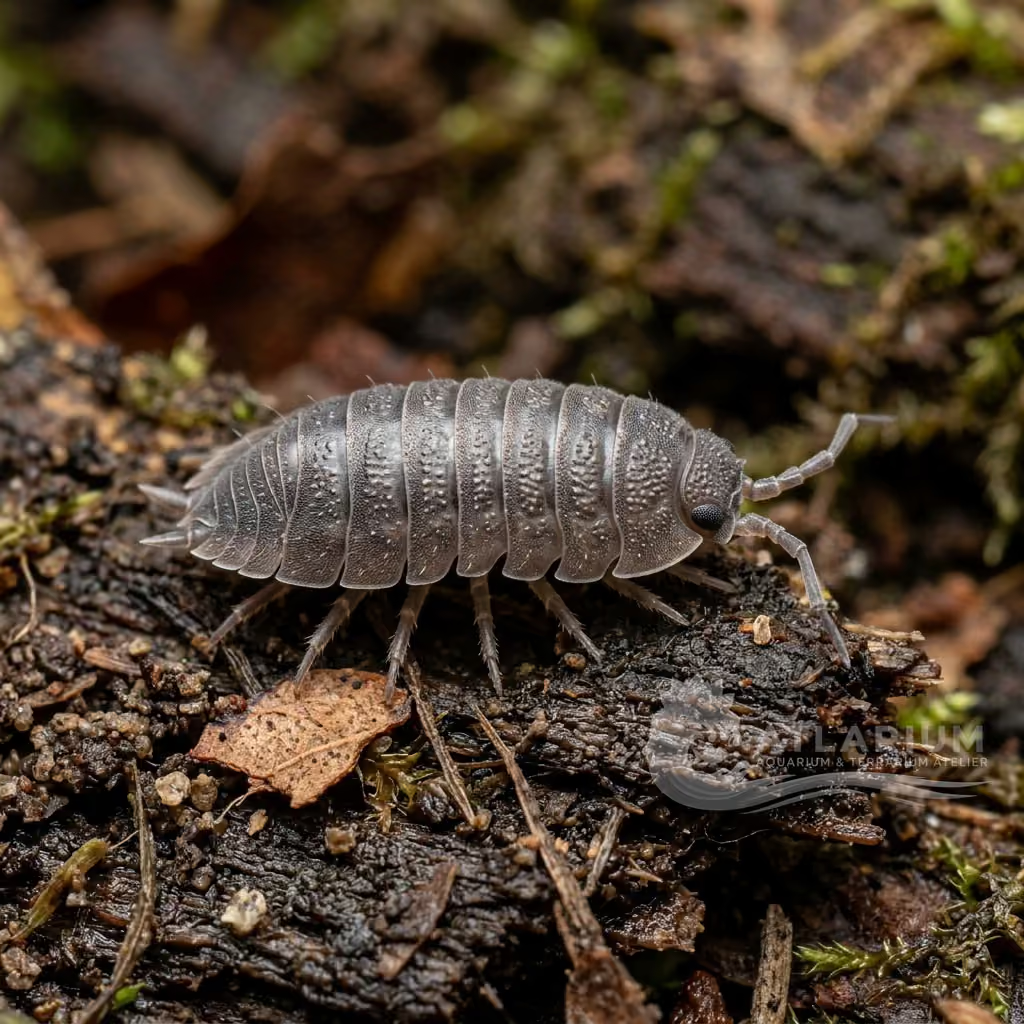
Nosy Pillbug (A. nasatum)
Armadillidium nasatum
The Nosy Pillbug Isopod (Armadillidium nasatum). A particular Armadillidium (0.6 inches) widespread throughout the northern world. Its unmistakable trait is the pronounced 'Nose': a frontal lobe of the shell highly protruding above the head. Unlike its cousin 'vulgare', it cannot close into a perfectly hermetic ball (leaves a gap). Very prolific, famous for the very well known 'Peach' morph (totally pastel orange/peach), excellent for cool terrariums.
Environment
Terrestrial
Humidity
50 - 70 %
Day temperature
20 - 26 °C
Night temperature
18 - 22 °C

Species description
Geographical Origin and Habitat: Widespread in Northern Europe, British Isles and introduced in North America. Inhabits lowland forests, damp gardens, greenhouses (famous scourge of Victorian English greenhouses) and woodpiles.
Taxonomy and Genetics: Family Armadillidiidae. (The Imperfect Conglobator). Although belonging to the family of pillbugs, its defensive closure is 'dirty': the presence of the frontal rostrum (the 'nose') prevents the head from fitting perfectly with the rear, leaving a visible slit if rolled up.
Behavior and Habits: Imperfect sprinters. The nasatum is slightly more slender, fast and bold than the vulgare, preferring to climb on barks and stems rather than spending life buried 4 inches in the dark. Very prolific: in a stable environment without sudden changes (they are damp greenhouse beasts) they explode demographically devouring moss and shoots.
Morphology: Total dome but elongated (0.6 inches / 1.5 cm). The head bears a pointed and upward turned 'nose' (scutellum), highly visible to the naked eye looking them in the face. The wild color is a pale gray/brown with spotted longitudinal bands. The 'Peach' morph transforms them into wonderful smooth bright tangerine orange candies without any dark spots.

Care, breeding and tankmates
Terrarium Setup: In Ganter's caged-population experiment, increased density reduced growth rate, survivorship, and size at first reproduction in the tested isopods, including Armadillidium nasatum. This is an experimental population result, not a prescriptive enclosure protocol; the source provides no enclosure-design, substrate, or space-allocation parameters.
Lighting and Heating: This source provides no lighting or heating guidance for Armadillidium nasatum.
Humidity and Hydration: This source provides no humidity or hydration guidance for Armadillidium nasatum.
Feeding and Supplementation: This source provides no feeding or supplementation protocol for Armadillidium nasatum.
Compatibility and Coexistence: This source provides no compatibility or cohabitation guidance for Armadillidium nasatum.
Health and Common Diseases: This source provides no health or disease guidance for Armadillidium nasatum.

Geographic origin and distribution
Widespread in Northern Europe, British Isles and introduced in North America. Inhabits lowland forests, damp gardens, greenhouses (famous scourge of Victorian English greenhouses) and woodpiles.
Origin
Selective breeding and cultivarsNorth AmericaEurope, Mediterranean, and West AsiaCosmopolitan or introduced

Terrestrial invertebrate profile
- Diet
- Detritivore
- The diet of Armadillidium nasatum consists of specific nutrients. It forages for a variety of food sources. A well-balanced feeding regimen is essential.
- Adult size
- 1.2 cm
- Lifestyle/Microhabitat
- Terrestrial
- Armadillidium nasatum leads a lifestyle adapted to its niche. It utilizes various elements of its habitat. Providing a complex enclosure is crucial for its enrichment.
- Activity cycle
- Nocturnal
- The activity pattern of Armadillidium nasatum dictates when it is most active. It exhibits periods of rest aligned with light cycles. Understanding these rhythms helps create a suitable schedule.
- Sociality
- Gregarious
- Very social creatures that do exceptionally well in colony setups. They cluster together naturally and feed cooperatively without any signs of cannibalism or aggression.
- Reproduction
- Marsupial
- Reproduction for Armadillidium nasatum involves specific mating behaviors. Females seek out appropriate nesting sites. Successful breeding requires mimicking natural conditions.
- Venomous
- No
- Handling tolerance
- Tolerant
- Handling Armadillidium nasatum should be done with care. It is recommended to allow the animal to adjust first. Gentle movements are key when handling is necessary.
- Brumation
- Not required
- Brumation for Armadillidium nasatum is triggered by temperature changes. During this period, its metabolism slows down. Proper preparation is essential to ensure a healthy emergence.
- Molting
- Periodic
- The molting process of Armadillidium nasatum allows it to shed old layers. Adequate humidity is vital for facilitating a smooth shed. Caretakers must regularly check for retained pieces.

Related species
Recommendations grouped by close relatives, companion choices, and similar care.