Rummy-nose Rasbora
Sawbwa resplendens
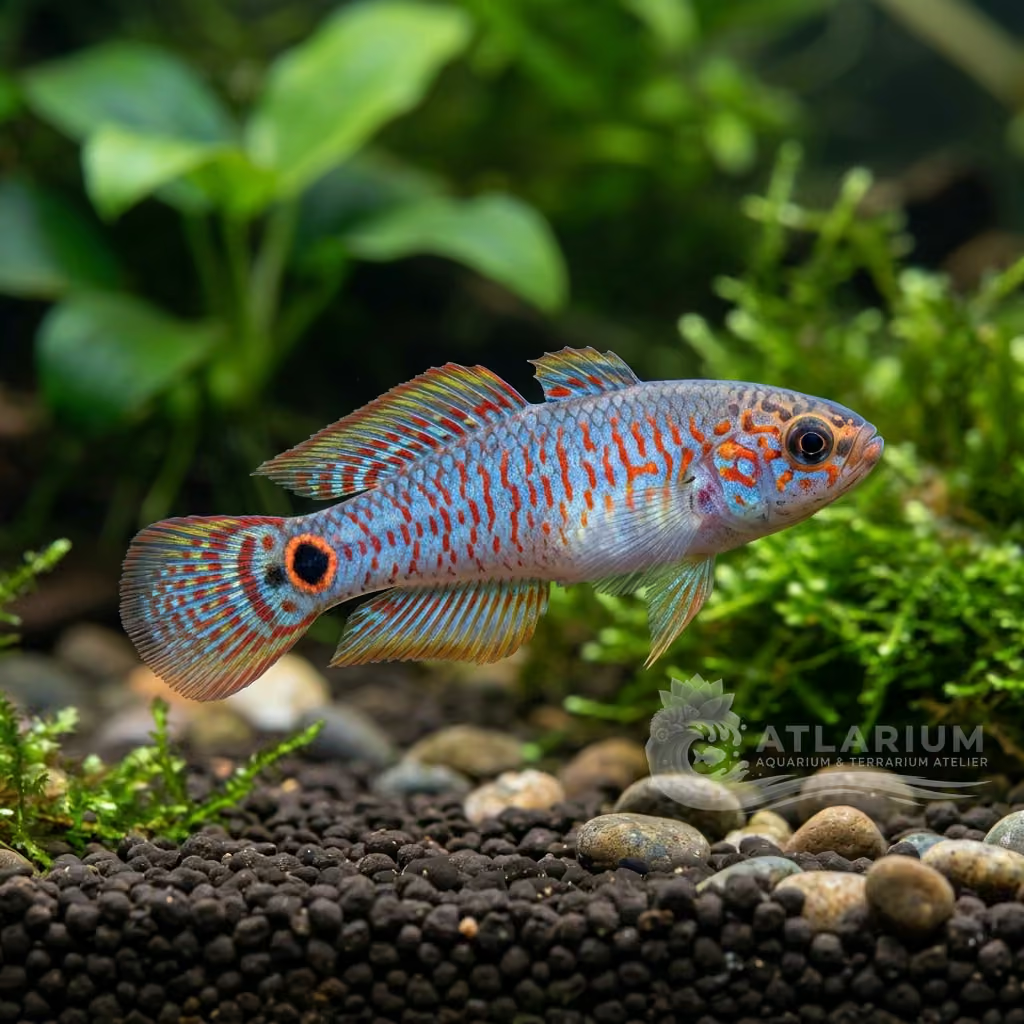
An absolute evolutionary bizarre. A completely scaleless cyprinid endemic to a single calcareous Burmese lake. The male boasts a blinding sky-blue body and blood-red tips on the snout and tail.
Water Temperature
18 - 24 °C
pH Value
7 - 8
Water type
Freshwater
Tank level
Surface and middle
Adult size
3.5 cm
Minimum tank volume
>= 30 L
Minimum group
>= 1
GH
10 - 20 dGH
KH
5 - 10 dKH
TDS
200 - 400 ppm
Conductivity
313 - 625 uS/cm

Species description
Geographical Origin and Habitat: Micro-endemic: exists solely in the crystal-clear waters of the Inle Lake basin in the Shan State (Myanmar). A highly peculiar high-altitude habitat: calcareous bottom, very hard, alkaline water, choked with massive meadows of hornwort, and cool temperatures.
Taxonomy and Morphology: Cyprinidae. The only member of the genus Sawbwa. Its most striking feature, visible to the naked eye, is the TOTAL ABSENCE OF SCALES. The body (3.5 cm / 1.4 inches) is as smooth as a catfish, making it extremely vulnerable to aquarium medications.
Social Behavior: The quintessential schooling fish, highly hierarchical. Must be placed in very large groups (minimum 15-20 specimens). Dominant males are hyperactive, flash neon colors, and incessantly chase each other to show who the 'Sawbwa' is (a term that in the Shan language literally means 'King' or 'Prince').
Coloration and Sexual Dimorphism: The most astounding dimorphism in the family. The breeding male turns a solid, milky metallic sky-blue (because it lacks scales), with the tip of its snout and tail lobes dipped in deep scarlet red. Females are the exact opposite: completely drab, pale olive/silver or transparent, without a hint of red or blue.

Care, breeding and tankmates
Aquarium Setup: Demands an aquarium specifically set up for Inle Lake (minimum 60-80 cm / 24-32 inches). The substrate must contain calcareous material (crushed coral or limestone rocks). Extreme planting of fast-growing cosmopolitan or Asian plants (Hornwort, Vallisneria). Very slow water current, mimicking a lake.
Diet and Feeding: Micro-omnivore. Heavily prefers zooplankton in the wild. In the tank, it accepts crushed flakes, but requires regular feedings of live baby brine shrimp, daphnia, and micro-bloodworms to trigger the red explosions on the male's snout.
Water Quality: THE REAL HURDLE (Advanced Difficulty): Keeping this fish in a classic 'soft tropical' aquarium is a death sentence. It requires very hard (GH 10-20), alkaline (pH 7.0 - 8.0) water and cool temperatures (18-24°C / 64-75°F). Driftwood or leaves that acidify the water are absolutely forbidden.
Compatibility and Cohabitation: Very difficult to find tankmates due to its extreme chemical requirements. Ideal partners are other Inle Lake endemics: Celestichthys choprae (Glowlight Danio) or Microrasbora rubescens. They tolerate chaotic or large fish very poorly. Safe with most hard-water snails and shrimp.
Aquarium Breeding: Egg-scatterer on fine leaves. Males are very tiring to condition. The female spawns on Hornwort leaves. Parents are hardened cannibals.
Risks and Diseases: 1. Instantly killed by standard medications (malachite green, copper) due to the lack of scales. 2. Lethal fungal infections if placed in acidic (peaty) waters or in 28°C (82°F) tropical tanks.

Geographic origin and distribution
Micro-endemic: exists solely in the crystal-clear waters of the Inle Lake basin in the Shan State (Myanmar). A highly peculiar high-altitude habitat: calcareous bottom, very hard, alkaline water, choked with massive meadows of hornwort, and cool temperatures.
Origin
South and Southeast Asia

Fish profile
- Temperament
- Semi-aggressive
- They are a very peaceful, active, and schooling fish. Males display stunning colors when showing off to females. They can be slightly shy if not kept in a large enough school.
- Diet
- Omnivore
- They are micropredators that eat zooplankton and small insects. Offer them high-quality micro-pellets and crushed flakes. Live baby brine shrimp or microworms are excellent supplements.
- Life expectancy
- 3-5 years
- Adult size
- 3.5 cm
- Sex ratio
- School
- Keep them in a large school of at least 10 individuals. A higher ratio of females to males helps reduce male harassment. Males will spar harmlessly to establish dominance.
- Feeding frequency
- Twice daily
- Feed them very small amounts once or twice a day. Their stomachs are tiny, so they can only eat a little at a time. Remove any uneaten food to prevent water fouling.
- Bioload
- Medium to High
- This tiny cyprinid has a very small bioload. A standard sponge filter or small HOB filter is perfectly adequate. They do require clean water to thrive and show their best colors.
- Flow
- Stagnant
- They prefer sluggish to moderate water movement, similar to their native lake habitat. Strong currents will exhaust them quickly. A gentle sponge filter provides ideal flow and filtration.
- Jump risk
- Yes
- They have a low jump risk but can jump if chased. A well-fitting lid is advisable for any nano tank. Floating plants can also help them feel secure.
- Reproduction
- Oviparous
- They are continuous egg scatterers in heavily planted setups. They will eat their own eggs if not separated. Providing a spawning mop or dense moss increases fry survival.
- Compatibility & tankmates
- Peaceful
- They are completely peaceful and ideal for a nano community tank. Keep them with other nano fish like micro rasboras or small shrimp. Larger fish will easily view them as a snack.
- Tank level
- Top/Middle
- They spend most of their time in the middle and upper levels of the tank. They are active swimmers that dart around the plants. They rarely venture down to the substrate.

Scientific Parameters & Models
FishBase
Window to the official scientific data of the species
Data synced on: 06/15/2026
- Trophic level
- 2.9 ± 0.3 se
- Resilience
- Medium (1.4 - 4.4 years)
- Phylogenetic uniqueness (PD50)
- 1
- Bayesian Length-Weight
- a = 0.01122, b = 3.02
- VulnerabilityLow vulnerability (15 / 100)

Related species
Recommendations grouped by close relatives, companion choices, and similar care.