Yellowbar angelfish
Pomacanthus maculosus
A magnificent and large-growing marine angelfish, dark blue with a bright yellow patch, suitable only for very large fish-only systems.
Water Temperature
22 - 28 °C
pH Value
8 - 8.5
Water type
Marine
Tank level
All levels
Adult size
50 cm
Minimum tank volume
>= 800 L
Minimum group
>= 1
KH
8 - 12 dKH

Species description
Geographical Origin and Habitat: Pomacanthus maculosus, the yellowbar angelfish or half-moon angelfish, is native to the Western Indo-Pacific, with dense populations in the Red Sea, the Persian Gulf, and south along the East African coast to Kenya. They inhabit coral reefs, silty harbors, and rocky walls at depths of 1 to 50 meters, often near caves.
Taxonomy and Morphology: A member of the family Pomacanthidae. This large angelfish has a deep, laterally compressed body typical of the Pomacanthus genus. It can reach an impressive maximum length of 50 centimeters (20 inches) in the wild, though it rarely exceeds 35 cm in captivity. It possesses a sharp opercular spine.
Social Behavior: Highly territorial and solitary. It is aggressive towards other large angelfish, especially those of the same genus or similar coloration. It is a bold, dominant swimmer that constantly patrols its territory and requires ample open water for movement.
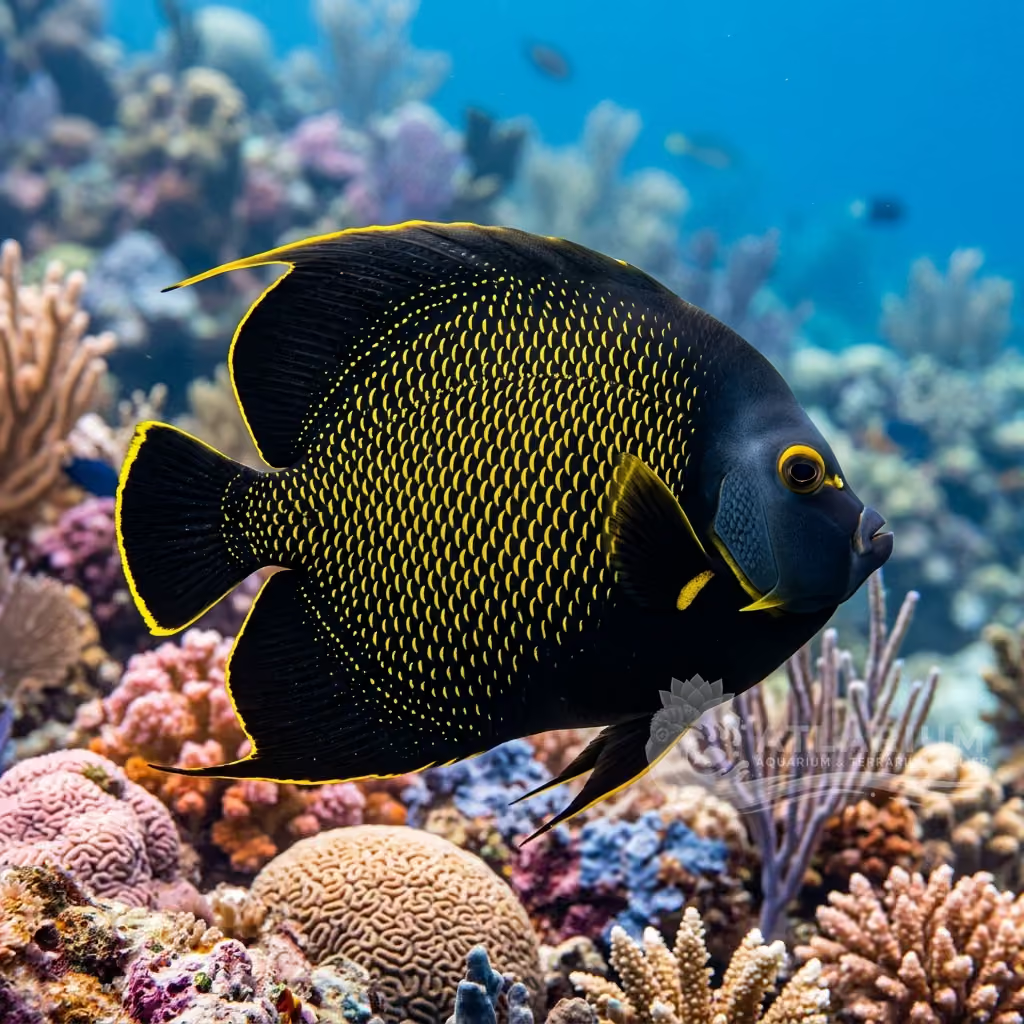
Coloration and Sexual Dimorphism: Adults display a beautiful brownish-blue to electric blue body with a large, irregular vertical yellow bar on the mid-section. The tail is pale blue-grey with fine markings. Juveniles look completely different, featuring alternating blue, black, and white vertical bands. No external sexual dimorphism is visible.

Care, breeding and tankmates
Aquarium Setup: Requires a massive aquarium. A minimum of 130 gallons (500 liters) is needed for a juvenile, while a fully grown adult requires at least 210 gallons (800 liters). Arrange live rock to form large caves, tunnels, and overhangs for shelter, while keeping the front of the tank clear for swimming.
Diet and Feeding: In the wild, they feed primarily on sponges and tunicates. In captivity, they must be fed a specialized diet containing sponge matter, spirulina, and high-quality angelfish preparations, supplemented with frozen mysis, brine shrimp, and dried seaweed (nori) sheets.
Water Quality: High-quality water and strong filtration are critical. An oversized protein skimmer, active carbon filtration, and good water movement are required. Maintain stable parameters: temperature 23 to 27 °C (73 to 81 °F), pH 8.1 to 8.4, and specific gravity 1.020 to 1.025.
Compatibility and Cohabitation: Not reef-safe. They will nip at and consume large polyp stony (LPS) corals, small polyp stony (SPS) corals, soft corals, and clam mantles. Best kept with other large, robust fish like tangs, wrasses, triggerfish, and groupers. House only one large angel per tank.
Aquarium Breeding: Breeding in home aquariums is not viable. They are pelagic spawners that release their gametes into the water column at dusk. The pelagic larvae drift for weeks and require highly specialized live diets that are difficult to cultivate on a hobbyist scale.
Risks and Diseases: Prone to marine ich (Cryptocaryon) and marine velvet under stress. They are also susceptible to Head and Lateral Line Erosion (HLLE) and Lymphocystis. A nutritious diet and low-stress environment are essential. Quarantine new fish before introduction.

Geographic origin and distribution
Pomacanthus maculosus, the yellowbar angelfish or half-moon angelfish, is native to the Western Indo-Pacific, with dense populations in the Red Sea, the Persian Gulf, and south along the East African coast to Kenya. They inhabit coral reefs, silty harbors, and rocky walls at depths of 1 to 50 meters, often near caves.
Origin
Tropical oceans and reefsAfrica and Madagascar

Fish profile
- Temperament
- Semi-aggressive
- The Yellowbar Angelfish is a highly bold, curious, and frequently dominant fish that quickly establishes a strong presence in the tank. It will readily display aggression towards similarly shaped or colored fish and actively assert its dominance over newcomers. It is highly advised to introduce this powerful angelfish as one of the last inhabitants of the aquarium.
- Diet
- Omnivore
- In the wild, the Yellowbar Angelfish predominantly consumes marine sponges and various tunicates along the reef. In an aquarium, its diet must strictly include high-quality, sponge-based commercial angelfish foods to prevent severe nutritional deficiencies. This should be generously supplemented with frozen mysis, enriched brine shrimp, and sheets of marine nori.
- Life expectancy
- 15-20 years
- Adult size
- 50 cm
- Sex ratio
- Group
- There are no visually distinct markers to reliably differentiate between male and female Yellowbar Angelfish. Because of their fierce intraspecific aggression, keeping more than one specimen per tank is strongly prohibited unless the system holds over a thousand gallons. Attempting to force a pair often results in relentless aggression and the death of the weaker individual.
- Feeding frequency
- Twice daily
- Due to their highly active nature and constant need to forage, feeding two to three times daily is considered optimal. Frequent feeding reduces their tendency to aggressively harass tank mates and keeps them well-nourished. Providing an algae clip allows them to engage in natural grazing behaviors throughout the light cycle.
- Bioload
- Extreme
- The Yellowbar Angelfish is a large, vigorously eating species that demands an exceptionally powerful filtration system. Its massive bioload quickly compromises water quality if the protein skimmer and biological media are not adequately sized. Strict adherence to a schedule of large, frequent water changes is heavily required to ensure a healthy environment.
- Flow
- Strong
- Originating from the turbulent environments of the Red Sea and Persian Gulf, they thrive in strong, erratic water currents. Robust water flow closely simulates their natural habitat and provides essential resistance for healthy muscle development. Wavemakers should be employed to ensure the entire water column is thoroughly circulated and well-oxygenated.
- Jump risk
- No
- Reproduction
- Rare / not documented
- Captive breeding of this pelagic spawner is virtually unheard of in home aquaria due to their complex reproductive strategy. Pairs release massive quantities of eggs into the water column, relying on ocean currents for dispersal. The microscopic larvae demand an expertly managed, specialized live food regimen that only advanced commercial facilities can successfully provide.
- Compatibility & tankmates
- Territorial
- Known to be quite territorial, this angelfish should be housed with other large, robust species capable of holding their own. Good companions include large tangs, durable wrasses, and non-timid groupers. It is notoriously destructive in a reef setting and will eagerly decimate stony corals, soft corals, and ornamental clams.
- Tank level
- All levels
- They are exceptionally active swimmers that will confidently utilize the entire water column, constantly patrolling their established territory. They require a very large aquarium with expansive, open swimming areas combined with substantial rockwork. Appropriately sized, cavernous hiding spots are strictly necessary for them to retreat and rest securely.

Scientific Parameters & Models
FishBase
Window to the official scientific data of the species
FishBase v25.04Data synced on: 06/15/2026
- Trophic level
- 2.8 ± 0.23 se
- Resilience
- Very low (more than 14 years)
- Phylogenetic uniqueness (PD50)
- 0.5001
- Bayesian Length-Weight
- a = 0.02951, b = 2.89
- VulnerabilityModerate vulnerability (44 / 100)

Related species
Recommendations grouped by close relatives, companion choices, and similar care.