Encyclopaedia

FishBrackishMarineIntermediate
©AI Generated·Proprietary

African Mono

Monodactylus sebae

This remarkably tall, diamond-shaped silver fish originates from West African estuaries. It is a fast, active schooling species that requires a large aquarium transitioning to full marine conditions.

Taxonomy
Class:Actinopteri
Order:Perciformes
Family:Monodactylidae
Genus:Monodactylus
Species:Monodactylus sebae

Share

Check out African Mono on Atlarium

PracticeRecognition quizzesPhotos, names, origins, and puzzles to review Atlas species.Open quizzes
Water Temperature

24 - 28 °C

pH Value

7.5 - 8.5

Water type

Brackish / Marine

Tank level

Middle

Adult size

25 cm

Minimum tank volume

>= 300 L

Minimum group

>= 6

Species description

Geographical Origin and Habitat: This species is widely distributed along the coast of tropical West Africa, from Senegal southward to Angola. It primarily inhabits river estuaries, brackish lagoons, mangrove swamps, and coastal harbors. Juveniles spend most of their time in freshwater or low-salinity brackish habitats, migrating to full marine conditions as they reach adulthood.
Taxonomy and Morphology: Belonging to the family Monodactylidae. It features an exceptionally deep, laterally compressed body, giving it a diamond-like or triangular silhouette due to the high profile of the dorsal and anal fins. Adults can reach up to 20-25 centimeters in vertical height, often exceeding their overall body length.
Social Behavior: An extremely active, fast-swimming schooling species that needs to be kept in groups of at least 5-6 individuals. Solitary specimens or pairs often experience chronic stress, leading to extreme shyness, refusal to feed, or heightened aggression toward other peaceful tankmates.
Coloration and Sexual Dimorphism: The base body coloration is a brilliant, reflective silver, accented by four dark vertical bands (black or dark brown) that cross the head and anterior body. These bands are prominent in juveniles and fade slightly as the fish ages. The anal and dorsal fin tips are yellowish-gold. There is no visible external sexual dimorphism.

Care, breeding and tankmates

Aquarium Setup: Requires a very large aquarium, with a minimum capacity of 90-100 gallons (approx. 350-400 liters) for a small school. Ample open swimming space is critical. The aquascape should feature sturdy structures like large rocks and driftwood roots along the perimeter. Live plants should be avoided as they will likely be eaten.
Diet and Feeding: Voracious, opportunistic omnivores. In the aquarium, they require a varied diet containing high-quality frozen foods like mysis shrimp, krill, and chopped seafood, along with an essential plant component such as spirulina flakes, nori seaweed, and blanched spinach. They will readily eat high-quality pellets and flakes.
Water Quality: While young specimens can adapt to hard freshwater, long-term health and adult survival require brackish (SG 1.005-1.015) or full marine conditions (SG 1.020-1.024). Keep the temperature between 24 and 28°C and pH at 7.8-8.4. Powerful mechanical and biological filtration is necessary to manage their waste production.
Compatibility and Cohabitation: Excellent tankmates include active, robust brackish species of similar size, such as Archerfish (Toxotes), Scats (Scatophagus), and large gobies. Do not house them with small, delicate, or slow-moving fish that could be stressed by the monos' rapid swimming habits or eaten. Generally reef-safe but may eat tiny shrimp.
Aquarium Breeding: Spontaneous spawning in home aquaria has not been successfully documented. In the wild, they are pelagic spawners, releasing eggs in full marine coastal waters. Commercial breeding is achieved in large facilities using hormonal stimulation and specialized salinity-shifting regimes.
Risks and Diseases: Quite hardy if kept in appropriate salinity. However, keeping them in freshwater long-term weakens their immune system, making them susceptible to skin parasites like Oodinium and Marine Ich. They are sensitive to high nitrate levels, so weekly water changes of 20-30% are highly recommended.

Geographic Origin and Distribution

This species is widely distributed along the coast of tropical West Africa, from Senegal southward to Angola. It primarily inhabits river estuaries, brackish lagoons, mangrove swamps, and coastal harbors. Juveniles spend most of their time in freshwater or low-salinity brackish habitats, migrating to full marine conditions as they reach adulthood.

Origin

Tropical oceans and reefsNorth AmericaAfrica and Madagascar

Fish profile

Temperament
Aggressive
They are generally peaceful but highly energetic. Their fast swimming can stress shy tank mates. They may occasionally nip at trailing fins.
Diet
Omnivore
It is an omnivore that eats aggressively. Flakes, pellets, and frozen meaty foods are greedily accepted. Vegetable matter should also be included in its diet.
Sex ratio
School
They are schooling fish that need a group of at least five. No specific sex ratio is needed. A larger school minimizes stress and aggression.
Feeding frequency
TWO_THREE_DAILY
Feed them two to three times a day. They have large appetites and grow quickly. Ensure enough food is provided for the whole school.
Bioload
This fish produces a high bioload. It grows large and is very active. Excellent filtration and regular water changes are a must.
Flow
Strong
They thrive in high water flow environments. Strong currents mimic their natural coastal habitats. Powerheads can be used to provide extra water movement.
Jump risk
No
Reproduction
Hermaphrodite
Breeding this species in home aquariums is exceptionally rare. They likely spawn in the ocean and juveniles migrate to estuaries. Specific captive breeding protocols are not established.
Compatibility & tankmates
Community
Best kept with other large, active brackish or marine fish. Scats and archerfish make excellent companions. Small fish will likely be harassed or eaten.
Tank level
Middle
They are active swimmers in the middle water column. They will occasionally venture to the top during feeding. Ample open swimming space is required.

Window to the official scientific data of the species

Data synced on: 06/15/2026

Scientific Parameters & Models

Trophic level
3.9 ± 0.64 se
Phylogenetic uniqueness (PD50)
0.625
Bayesian Length-Weight
a = 0.02188, b = 3.02
VulnerabilityLow vulnerability (15 / 100)

Image gallery

Licensed images linked to the species or, when marked, to the closest representative taxon.

Related species

Recommendations grouped by close relatives, companion choices, and similar care.

Variants and close relatives

Same atlas type, nearby scientific identity, genus, or family.

Recommended companions

Compatible cards from coherent ecosystems with matching parameters.

Caulerpa prolifera
Plant

Caulerpa prolifera

Caulerpa prolifera
View details->
Caulerpa taxifolia
Plant

Caulerpa taxifolia

Caulerpa taxifolia
View details->
Chaetomorpha macroalgae
Plant

Chaetomorpha macroalgae

Chaetomorpha linum

View details->
Dead man fingers algae
Plant

Dead man fingers algae

Codium fragile

View details->
Grape caulerpa
Plant

Grape caulerpa

Caulerpa racemosa

View details->
Halimeda macroalgae
Plant

Halimeda macroalgae

Halimeda opuntia

View details->
Peacock tail algae
Plant

Peacock tail algae

Padina pavonica

View details->
Red gracilaria
Plant

Red gracilaria

Gracilaria parvispora

View details->
Red grape algae
Plant

Red grape algae

Botryocladia uvaria

View details->
Sea lettuce
Plant

Sea lettuce

Ulva lactuca

View details->
Red Mangrove
Plant

Red Mangrove

Rhizophora mangle

View details->
Ciliated Cryptocoryne
Plant

Ciliated Cryptocoryne

Cryptocoryne ciliata

View details->

Similar care

Cards with similar requirements, difficulty, habitat, and husbandry profile.

Blue-spot Dascyllus

Blue-spot Dascyllus

Dascyllus carneus

View details->
Blackside Hawkfish

Blackside Hawkfish

Paracirrhites forsteri

View details->
Bullseye Damselfish

Bullseye Damselfish

Abudefduf taurus

View details->
Black Bow Damselfish

Black Bow Damselfish

Neoglyphidodon melas

View details->
Black-and-gold Chromis

Black-and-gold Chromis

Neoglyphidodon nigroris

View details->
Neon damselfish

Neon damselfish

Neoglyphidodon oxyodon

View details->
Blue Damselfish

Blue Damselfish

Chrysiptera cyanea

View details->
Four-stripe Damselfish / Blacktail Humbug

Four-stripe Damselfish / Blacktail Humbug

Dascyllus melanurus
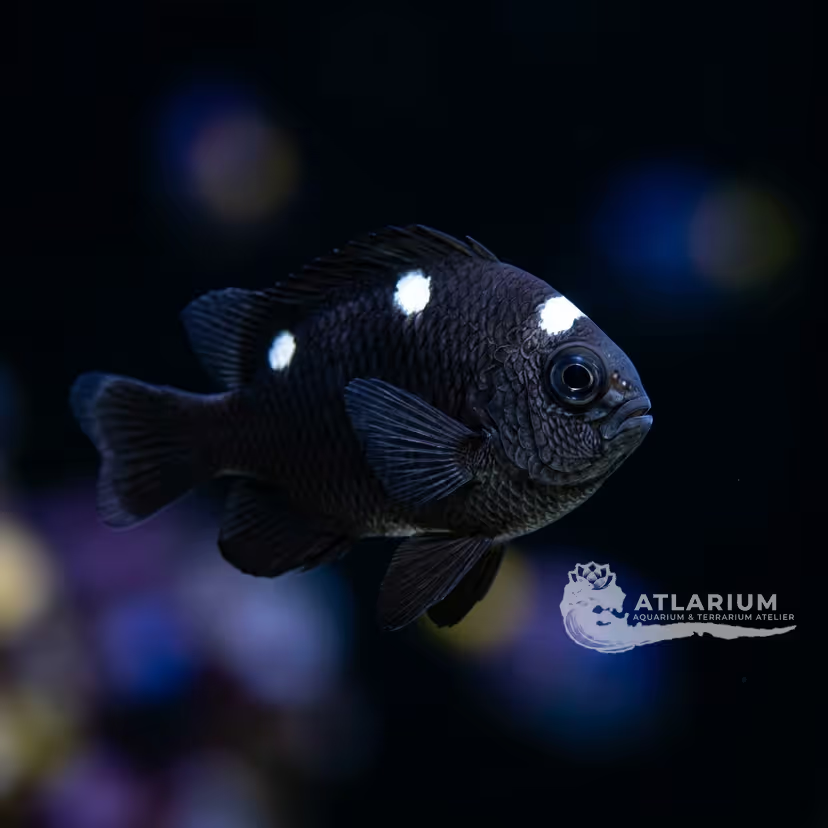
View details->
Threespot dascyllus

Threespot dascyllus

Dascyllus trimaculatus
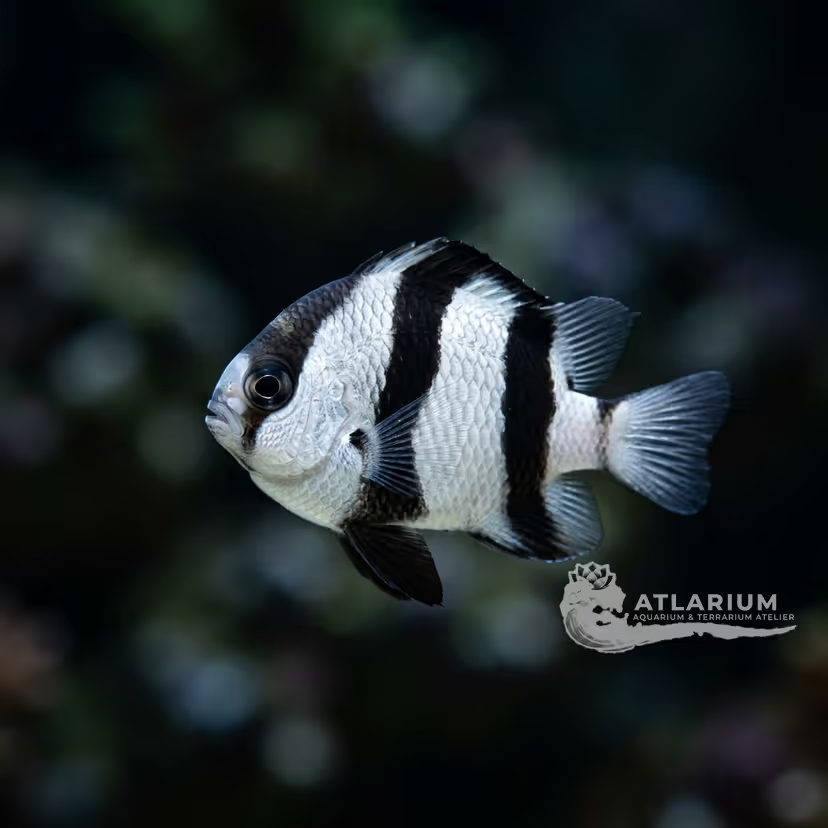
View details->
Whitetail Dascyllus

Whitetail Dascyllus

Dascyllus aruanus

View details->
Forktail blenny

Forktail blenny

Meiacanthus atrodorsalis

View details->
Striped fangblenny

Striped fangblenny

Meiacanthus grammistes

View details->
Allen's Damselfish

Allen's Damselfish

Pomacentrus alleni

View details->
Ambon Chromis

Ambon Chromis

Chromis amboinensis

View details->
Black-bar chromis

Black-bar chromis

Chromis retrofasciata
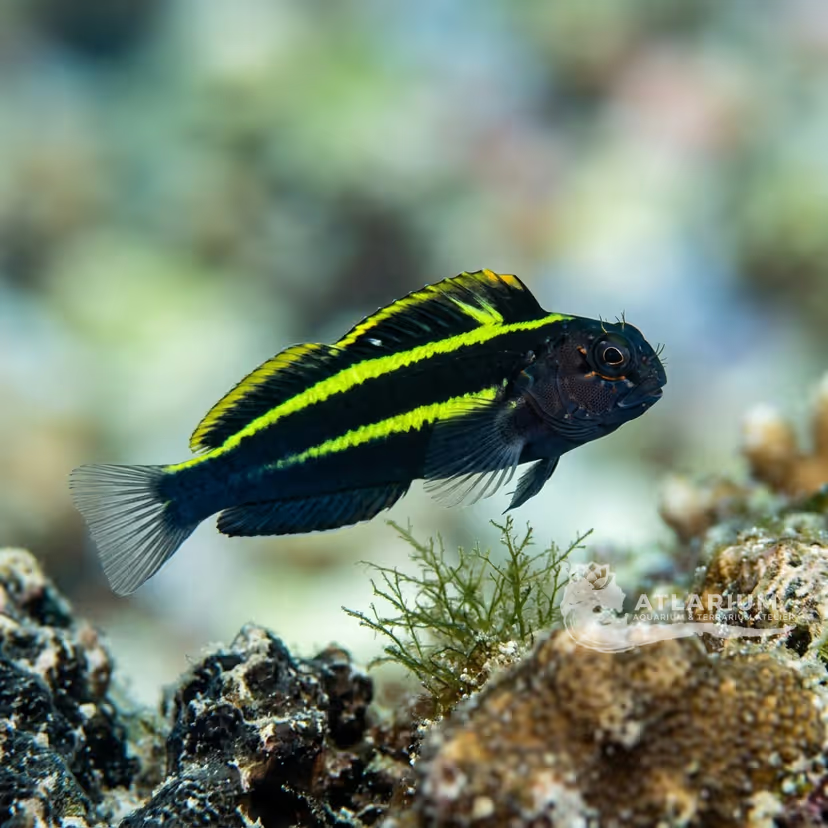
View details->
Bundoon blenny

Bundoon blenny

Meiacanthus bundoon

View details->
Last updated: 06/30/2026
African Mono (Monodactylus sebae) Care Guide & Tank Setup | Atlarium