Riccia fluitans
Riccia fluitans
Riccia fluitans is a fast-growing aquatic liverwort, highly versatile, primarily used as a floating plant or anchored to hardscape to create a bright green carpet in the foreground or midground of an aquarium.
Water Temperature
4 - 30 °C
pH Value
5 - 7.5
Water type
Freshwater
Light
Medium - High
CO2
High
KH
0 - 21 dKH

Species description
Geographical Origin and Habitat: Riccia fluitans boasts a cosmopolitan distribution, found across nearly all continents. It thrives in still or slow-moving freshwaters, where it can either float freely on the surface or attach itself to submerged substrates like rocks or driftwood along riverbanks. In its natural habitat, it plays a vital role in nutrient absorption and provides shelter for small aquatic organisms, contributing significantly to the ecosystem's health and biodiversity.
Taxonomy & Genetics: Belonging to the family Ricciaceae, the genus Riccia is classified among the liverworts (Marchantiophyta), a group of primitive non-vascular plants distinct from true mosses or higher plants. Riccia fluitans, specifically, is characterized by a simplified thallus structure, lacking differentiated roots, stems, and leaves, representing a classic example of basic and ancient plant organization within the aquatic plant kingdom. Its reproduction primarily occurs through fragmentation of the thallus, allowing for rapid colonization.
Physical Structure: The physical structure of Riccia fluitans consists of small, dichotomously branched, translucent, and bright green thalli. This aquatic plant does not develop true roots, stems, or leaves; instead, it features slender rhizoids that primarily serve for anchoring to submerged substrates rather than for nutrient absorption, which occurs directly from the water through the thallus surface. Under optimal conditions, the thalli intertwine to form dense and complex mat-like formations, capable of reaching considerable thickness. This characteristic allows it to be employed both as a floating plant and as a submerged carpet.
Color & Texture: Riccia fluitans is distinguished by its vibrant green color, which can range from a light, luminous green to a deeper, more intense tone depending on light conditions and available nutrients. Its texture is delicate and almost feathery, especially when submerged and forming intricate colonies. Under intense lighting and with adequate CO2, the thalli can trap small air bubbles, creating a captivating "pearling" effect that adds an appealing visual element to the aquascape, lending it a lively and dynamic appearance. This pearling is a clear indicator of vigorous photosynthesis.

Care, breeding and tankmates
Lighting & CO2: Lighting is a critical factor for Riccia fluitans; it demands medium to high light to fully thrive and maintain compact, healthy growth. Insufficient light can lead to leggy, less dense thalli, compromising its aesthetic appeal and vitality. CO2 injection is highly recommended, particularly if aiming to use it as a submerged carpet, as it stimulates robust growth, prevents thallus disintegration, and enhances the impressive pearling effect, where tiny oxygen bubbles form on the plant's surface during photosynthesis. This combination creates a truly stunning display.
Nutrition & Substrate: Riccia fluitans absorbs nutrients predominantly from the
Water Chemistry: This liverwort exhibits remarkable tolerance to a wide range of water parameters, making it adaptable to various aquatic setups. It prefers temperatures between 4.0 and 30.0 °C, although an interval of 20-26 °C is generally considered optimal for vigorous growth. The ideal pH ranges from 5.0 to 7.5, favoring slightly acidic to neutral waters. Carbonate hardness (KH) can vary from 0.0 to 21.0, indicating great flexibility. Nevertheless, maintaining stable parameters and avoiding drastic fluctuations is always advisable to ensure its health and vitality in the long term.
Space Management & Placement: Riccia fluitans offers significant flexibility in aquascape placement. Traditionally, it is used as a floating plant, providing shade and shelter for fry and small invertebrates. To achieve a carpeting effect or to adorn hardscape, it must be anchored to rocks or driftwood using fine netting or fishing line, typically positioned in the midground or foreground. Its fast growth necessitates regular management to prevent it from outcompeting other plants or becoming too thick and detaching. Consistent trimming is essential to maintain the desired shape and prevent excessive accumulation.
Pruning: Pruning is a crucial aspect of Riccia fluitans care, especially when utilized as a submerged carpet. Due to its rapid growth, the plant mass can become excessively dense, leading to the detachment of lower sections due to lack of light and nutrients, or simply because buoyancy overcomes anchoring strength. Regular pruning, approximately every 1-2 weeks, is recommended using sharp scissors to remove excess growth, thereby maintaining a thin and compact layer. This not only preserves the aesthetic appeal but also promotes denser and healthier growth in the remaining parts, ensuring a lush, vibrant carpet.
Risks & Diseases: Riccia fluitans is a relatively hardy plant but presents some specific risks. The most common issue is the detachment of submerged carpets, which can fragment and float, causing disorder in the aquarium. This can be caused by excessive growth without pruning or insufficient anchoring. Furthermore, its fine structure can easily trap detritus and filamentous algae, necessitating periodic cleaning. Insufficient light, CO2, or nutrient conditions can lead to stunted growth, yellowing, or disintegration of the thalli, but it is not typically prone to pathogenic diseases like vascular plants.

Geographic origin and distribution
Riccia fluitans boasts a cosmopolitan distribution, found across nearly all continents. It thrives in still or slow-moving freshwaters, where it can either float freely on the surface or attach itself to submerged substrates like rocks or driftwood along riverbanks. In its natural habitat, it plays a vital role in nutrient absorption and provides shelter for small aquatic organisms, contributing significantly to the ecosystem's health and biodiversity.
Origin
Cosmopolitan or introduced

Plant profile
- Placement
- Midground
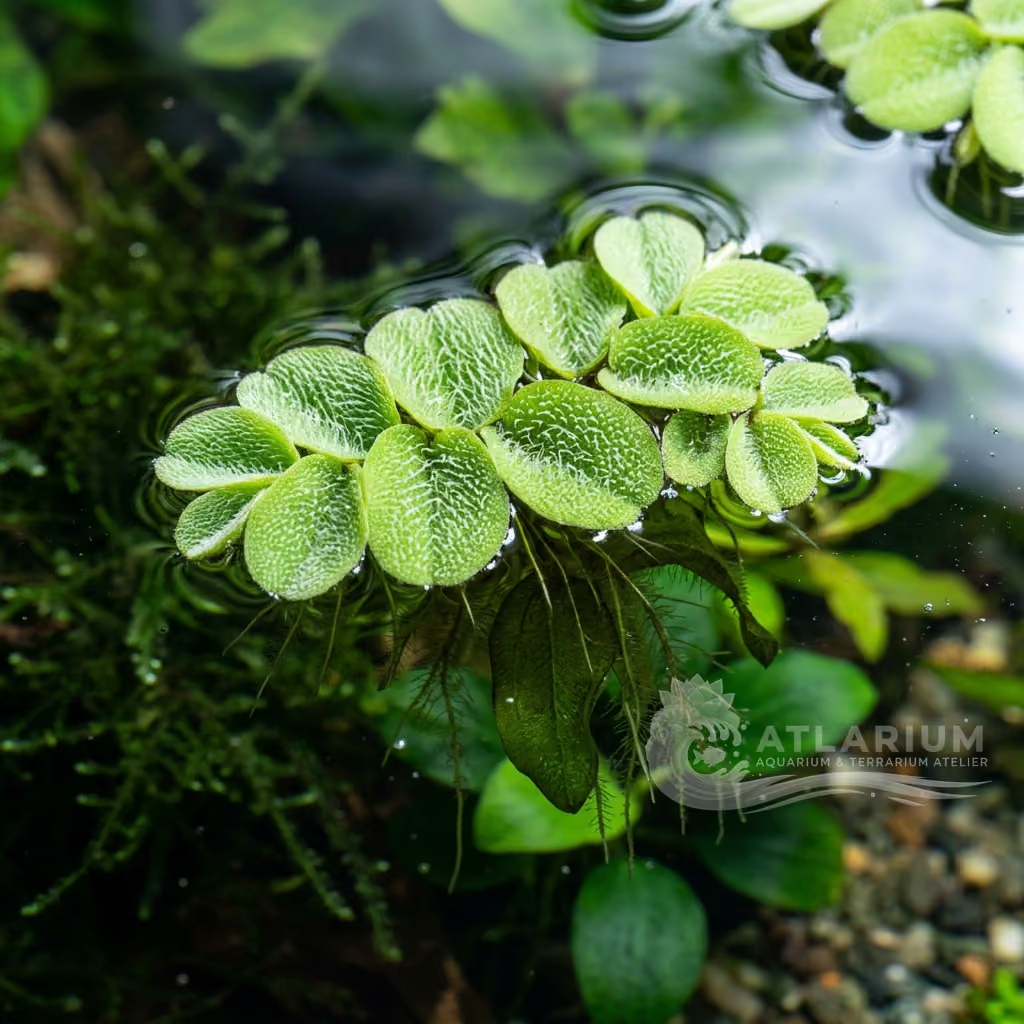
- It can be left to float freely at the water surface, where it provides excellent cover for fry. More commonly in aquascaping, it is tied down to rocks or meshes to form a bright green foreground carpet. If tied down, it requires intense lighting to reach the bottom of the tank.
- Botanical form
- free-floating submerged plant
- Crystalwort is a floating liverwort consisting of bright green, dichotomously branching thalli. It completely lacks roots and true leaves, forming a dense, tangled mass of branching filaments. When submerged and pearling heavily with oxygen bubbles, it resembles a sparkling green jewel.
- Growth
- Fast
- When provided with high light and CO2, its growth rate is explosive. It quickly multiplies, forming thick mats that double in size within a week or two. As a floating plant, it grows rapidly even without CO2 injection.
- Substrate
- None
- Riccia fluitans is naturally a floating liverwort that lacks true roots and does not draw nutrients from an aquatic substrate. It absorbs necessary light and dissolved nutrients directly from the water column through its branching, crystalline structure. Although it can be cultivated as a foreground carpet, it must be mechanically weighed down with mesh or tied to flat rocks, as it cannot root itself into soil or sand. Without these physical restraints, pieces of the plant will detach and naturally rise to float at the water's surface.
- Column fertilization
- Recommended
- Column fertilization is absolutely essential, as it relies 100% on the water column for its nutrition. Dosing a comprehensive fertilizer rich in iron and macronutrients will sustain its rapid growth. Insufficient nutrients will lead to pale, yellowish growth and eventual melting.
- Root fertilization
- None
- Root fertilization is completely useless for this plant, as it has no roots. Even when tied to the substrate, it cannot access nutrients in the soil. All feeding must be done through liquid dosing.
- Trimming
- Regular
- When grown submerged, it requires frequent, aggressive trimming to prevent the lower layers from rotting and causing the entire mat to float away. Use scissors to give it a close 'haircut' regularly. Be prepared to net out the thousands of tiny floating clippings after a trim.
- Propagation
- Cuttings
- Propagation is incredibly easy and occurs naturally as the plant grows and breaks apart. To propagate manually, simply tear a clump in half and place it elsewhere. Every tiny fragment is capable of growing into a large mat.
- Sensitivity
- Moderate
- It is quite sensitive to shading and requires direct, intense light to thrive underwater. It is also highly susceptible to liquid carbon (glutaraldehyde) overdoses, which will cause it to melt rapidly. Algae can easily entangle in its fine structure if nutrient balances are lost.
- Layout role
- Nano
- Submerged, it is famous for creating bright, pearling foreground carpets or striking accents on midground stones, a style popularized by Takashi Amano. Floating, it serves well in breeding tanks or biotope setups to dim the light and shelter fish. Its vibrant, light green color is a standout feature in any layout.

Related species
Recommendations grouped by close relatives, companion choices, and similar care.