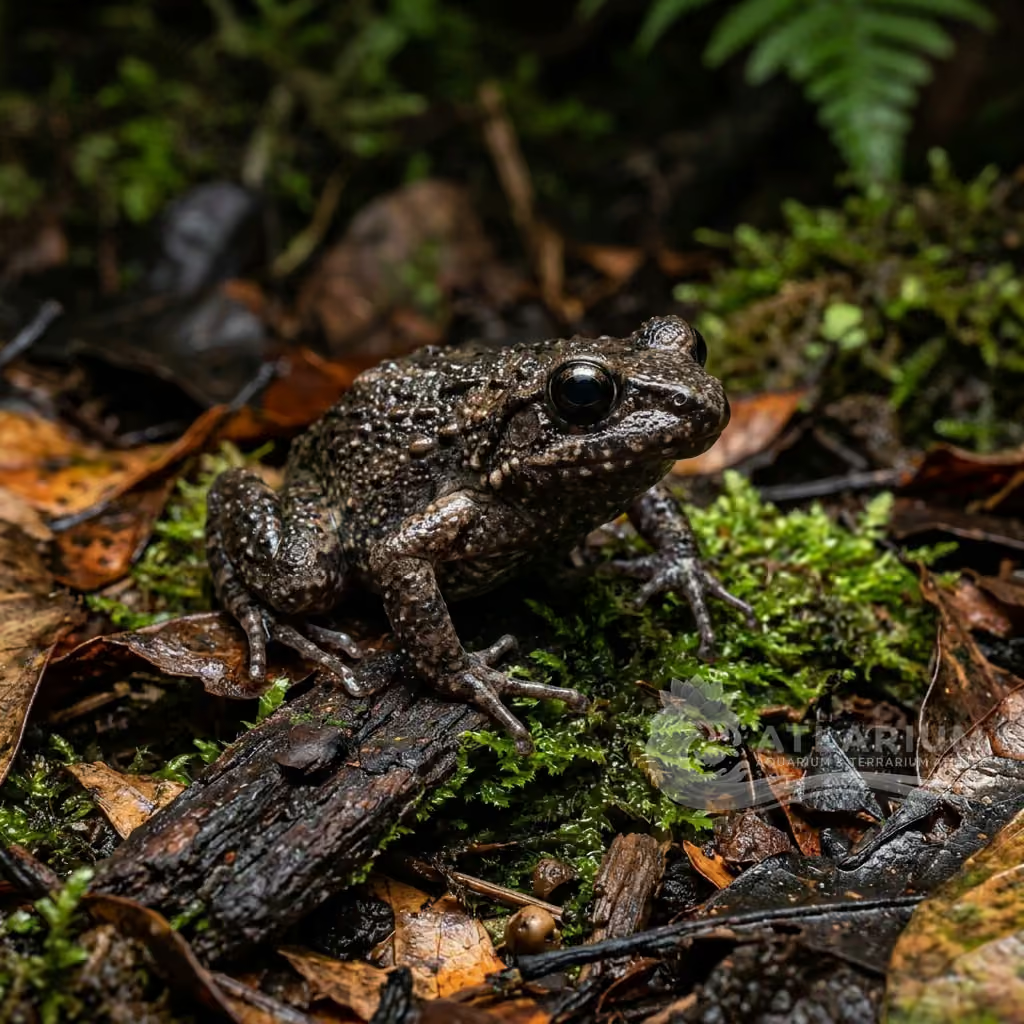
Dagua chocolate frog
Synapturanus rabus
Recently discovered in the Colombian Pacific lowlands, this small, highly fossorial frog is characterized by its stout brown body, pointed snout, and elusive subterranean habits.
Environment
Terrestrial
Humidity
80 - 95 %
Day temperature
22 - 25 °C
Night temperature
21 °C
Ambient temperature
22 - 25 °C
Minimum enclosure
>= 45 L

Species description
Geographical Origin and Habitat: Synapturanus rabus is a small microhylid frog endemic to the Pacific lowlands of Colombia, specifically recorded in the Dagua River basin within the Valle del Cauca department. It inhabits the damp leaf litter and topsoil of primary lowland tropical rainforests. This species leads a highly secretive, subterranean lifestyle, relying on pristine, undisturbed forest environments with high rainfall and thick organic forest floor layers.
Taxonomy and Genetics: Belongs to the class Amphibia, order Anura, family Microhylidae, subfamily Otophryninae, and genus Synapturanus. It was scientifically described in 2021 as part of a systematic revision of the genus. Cryptic diversity within Synapturanus is extremely high; genetic analyses have revealed multiple distinct evolutionary lineages across South America that are morphologically near-identical but genetically distinct, adapting to specific micro-basins.
Behavior and Habits: Exhibits strictly fossorial and nocturnal habits. They spend almost their entire lives buried under moist soil and decomposing leaves, rarely emerging onto the surface. Their presence is primarily detected during intense tropical rainstorms, when males produce short, high-pitched whistling calls from within their underground chambers to attract females. They are highly sensitive to soil vibrations.
Morphology: Features a stout, robust, and tear-drop shaped body adapted for burrowing. The snout is sharply pointed and prominent, extending well past the lower jaw, with small, forward-facing eyes. The mouth is narrow and the limbs are short and highly muscular, suited for backward digging. Dorsal coloration is uniform dark chocolate brown, sometimes with fine, scattered light flecks on the flanks. Adults measure between 2 and 3 cm.

Care, breeding and tankmates
Terrarium Setup: Requires a specialized fossorial terrarium with a minimum floor space of 50x40 cm for a pair. The substrate is the absolute key: provide a deep layer of at least 10-15 cm consisting of moist sphagnum peat moss, coconut coir, and pesticide-free forest soil. Top the substrate with a thick layer of dried oak or catappa leaves to replicate the natural rainforest leaf litter and provide vital hiding spots.
Lighting and Heating: Because they are subterranean and nocturnal, UVB lighting is not mandatory, but a low-intensity LED light on a 12-hour cycle is recommended to simulate day and night. Heating should be provided from above using a low-wattage heat lamp or a heating pad attached to the side wall of the terrarium. Never place a heat mat under the tank, as it will dry out the soil. Temperature: 22-25 °C.
Humidity and Hydration: Humidity must be kept exceptionally high, between 85% and 95% at all times. The substrate should feel consistently damp to the touch but never saturated or muddy, which can lead to bacterial or fungal infections. Mist the terrarium daily with dechlorinated or reverse osmosis water. A very shallow water dish can be provided, but is not strictly necessary as they absorb moisture through their skin.
Feeding and Supplementation: A specialized micro-insectivore. In the wild, they feed on ants, termites, and small soil mites. In captivity, feed them small live prey such as springtails, dwarf isopods, fruit flies (Drosophila melanogaster), and pinhead crickets. Dust the prey items with a high-quality calcium and vitamin D3 supplement twice a week to prevent nutritional deficiencies.
Compatibility: Best kept in a species-only setup, either individually or in small pairs. They are extremely shy and delicate, making them completely incompatible with other amphibian or reptile species that could outcompete them for food or transmit pathogens. Handling must be avoided entirely to prevent skin damage from oils and chemicals on human hands.
Health and Common Diseases: Amphibians are highly vulnerable to environmental toxins and pathogens. Primary risks include chytridiomycosis (a deadly fungal disease) and bacterial skin infections if the terrarium lacks proper air exchange or if the substrate becomes stagnant. Ensure the tank has mesh ventilation panels. Always dechlorinate tap water used for misting.

Geographic origin and distribution
Synapturanus rabus is a small microhylid frog endemic to the Pacific lowlands of Colombia, specifically recorded in the Dagua River basin within the Valle del Cauca department. It inhabits the damp leaf litter and topsoil of primary lowland tropical rainforests. This species leads a highly secretive, subterranean lifestyle, relying on pristine, undisturbed forest environments with high rainfall and thick organic forest floor layers.
Origin
Tropical oceans and reefsAmazon, Orinoco, and Guianas

Amphibian profile
- Diet
- Insectivore
- Synapturanus rabus has a specialized diet consisting primarily of small insects and invertebrates found in its natural habitat. It actively hunts for prey during its peak activity hours, utilizing its agile movements to capture food. Nutritional supplementation is often required in captivity to maintain its health and vitality. Caretakers should ensure a varied diet to prevent nutritional deficiencies and promote natural feeding behaviors.
- Life expectancy
- 3-5 years
- Adult size
- 1.9 cm
- Lifestyle/Microhabitat
- Fossorial
- Synapturanus rabus leads a specialized lifestyle adapted to the unique challenges of its native ecosystem. Its daily routine revolves around securing adequate nutrition, avoiding natural predators, and maintaining optimal body temperature. The species has evolved specific morphological traits that aid in its distinct way of living, whether arboreal, terrestrial, or aquatic. Understanding its lifestyle is fundamental to providing a suitable and enriching captive environment.
- Activity cycle
- Nocturnal
- The activity pattern of Synapturanus rabus is distinctly regulated by its circadian rhythm and the ambient temperature of its environment. It may exhibit nocturnal, diurnal, or crepuscular habits depending on its specific evolutionary adaptations. These patterns are essential for thermoregulation, predator avoidance, and efficient foraging within its habitat. Caretakers should carefully provide appropriate lighting and heating cycles to match these natural rhythms.
- Sociality
- Solitary
- Synapturanus rabus exhibits a fascinating array of behaviors that are closely tied to its ecological niche and survival strategies. It is known to display territorial behaviors, especially during the breeding season or when competing for limited resources. Social interactions can vary significantly, ranging from solitary habits to complex group dynamics depending on the context. Observing these behaviors provides valuable insights into its overall well-being and environmental suitability.
- Reproduction
- Oviparous
- The reproductive cycle of Synapturanus rabus is highly dependent on environmental cues such as temperature and humidity changes. Mating typically occurs during specific seasons when environmental conditions are optimal for the survival of offspring. Courtship behaviors are distinct and play a crucial role in successful mating and fertilization. Breeders must replicate these natural conditions carefully to encourage reproduction in a captive setting.
- Toxicity
- Toxic
- This species is not known to possess potent lethal toxins. However, it can secrete a mild, unpalatable mucus when threatened by predators. This defense mechanism is usually enough to deter small snakes and arthropods.
- Life stage
- Metamorphosis
- Development progresses rapidly from egg to froglet within the hidden underground nests. The tadpoles are specially adapted to survive in small, muddy pools or moist soil. Adult frogs maintain a fully terrestrial and fossorial existence in the tropical forest.
- Handling tolerance
- Display only
- They are entirely a display-only species that should not be handled. Interaction removes them from their subterranean comfort zone, causing severe stress and potentially compromising their delicate protective slime coat.
- Brumation
- Not required
- They do not brumate, as they inhabit stable, warm, and humid tropical environments year-round. Their subterranean lifestyle further buffers them against any minor surface temperature variations.
- Molting
- Periodic
- Shedding happens entirely within their burrows in the soil. High humidity from the surrounding earth is essential for a clean shed, which they then ingest to avoid wasting energy and nutrients.

Related species
Recommendations grouped by close relatives, companion choices, and similar care.