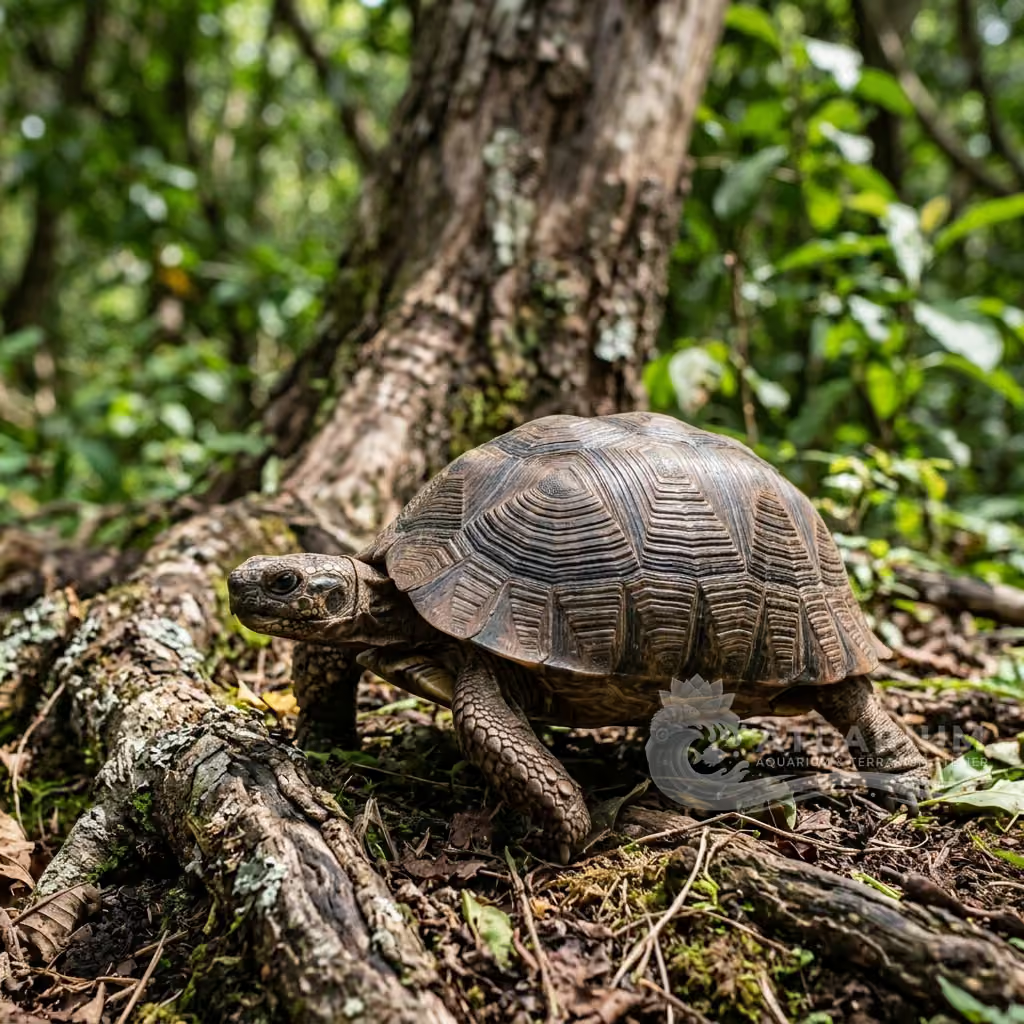
Home's Hinge-back Tortoise
Kinixys homeana
A critically endangered tropical tortoise from African rainforests. Exceptionally shy, it needs very high humidity, deep substrate, and an omnivorous diet with animal protein.
Environment
Terrestrial
Humidity
70 - 90 %
Day temperature
20 - 30 °C
Ambient temperature
20 - 30 °C
Night temperature
20 - 22 °C
Basking spot
30 - 31 °C
Adult size
20 cm
Minimum enclosure
>= 300 L
UVB
Ferguson 1-2
UVI
0 - 1 UVI

Species description
Geographical Origin and Habitat: Home's hinge-back tortoise (Kinixys homeana) is a tropical terrestrial species native to West and Central Africa. Its range spans from Liberia and Ivory Coast through Ghana, Togo, Nigeria, to Cameroon, Equatorial Guinea, and the Democratic Republic of the Congo. It exclusively inhabits warm, high-humidity primary lowland rainforests, forest swamps, and dense forest undergrowth.
Taxonomy and Genetics: Formally described by Bell in 1827, it belongs to the Testudinidae family and the Kinixys genus. It exhibits low genetic diversity and is highly threatened. It is currently listed as Critically Endangered on the IUCN Red List due to heavy rainforest logging, agricultural expansion, and hunting for food and the international pet trade.
Behavior and Habits: It is a shy, secretive, and primarily crepuscular species. It shows increased activity during rainy days and twilight hours, while spending the daytime hidden under wet leaves or decaying logs. It has a unique hinged carapace, allowing it to close the posterior shell to protect its hind legs and tail from predators.
Morphology: The carapace features an unusual, angular shape with a prominent drop-off or steep slope at the back behind the hinge. Adults reach a maximum carapace length of about 20 to 22 cm. Carapace color ranges from dull brown to dark chocolate brown, sometimes with subtle yellowish or olive highlights that provide excellent camouflage on the forest floor.

Care, breeding and tankmates
Terrarium Setup: Requires a closed-chamber style enclosure to retain humidity, with minimum dimensions of 150x80 cm for a single adult. The substrate must be at least 15 cm deep, consisting of coconut coir, peat moss, and cypress mulch topped with damp sphagnum moss and oak leaf litter. Include multiple cork bark hides and sturdy live or artificial plants to offer security.
Lighting and Heating: This species lives in shaded undergrowth and dislikes bright, glaring lights. Maintain ambient daytime temperatures of 26-28°C on the cool end, with a warm spot of 30-31°C using a ceramic heat emitter. Night temperatures must not drop below 21-22°C. Provide low-output 5% UVB lighting positioned over plant cover to ensure indirect exposure.
Humidity and Hydration: Extremely high humidity is the most critical care factor, requiring stable levels between 80% and 90%. Mist the enclosure several times daily and keep the substrate damp but not saturated. Provide a shallow, heavy water dish large enough for the tortoise to soak in daily, which is essential for proper hydration and shedding.
Feeding and Supplementation: Requires an omnivorous diet. Feed a mix of 50% leafy greens, weeds, mushrooms, and vegetables, along with fruits (papaya, melon, banana), and 50% animal protein. Meaty items should include earthworms, gut-loaded snails, insects, and high-quality commercial omnivorous reptile pellets. Dust food with calcium and D3 supplements.
Compatibility: Highly sensitive to stress. Adult males are territorial and should not be housed together. Keeping a small group is only possible in very large, well-structured enclosures containing multiple hiding spaces so submissive individuals can remain hidden and avoid food competition or harassment.
Health and Common Diseases: Keeping this species in dry conditions will quickly trigger fatal respiratory infections and chronic renal dehydration. They are highly susceptible to internal parasites; newly acquired specimens must undergo veterinary screening and deworming. Diet imbalances can lead to severe shell pyramiding.

Geographic origin and distribution
Home's hinge-back tortoise (Kinixys homeana) is a tropical terrestrial species native to West and Central Africa. Its range spans from Liberia and Ivory Coast through Ghana, Togo, Nigeria, to Cameroon, Equatorial Guinea, and the Democratic Republic of the Congo. It exclusively inhabits warm, high-humidity primary lowland rainforests, forest swamps, and dense forest undergrowth.
Origin
Africa and Madagascar

Reptile profile
- Diet
- Herbivore
- This highly specialized omnivore is uniquely adapted to a forest floor diet heavily enriched with animal protein and fungi. In the wild, they actively scavenge for dead animals, hunt large insects, and consume a significant amount of snails. Plant matter forms a smaller portion of their diet, primarily consisting of fallen forest fruits and soft foliage. Replicating their specialized dietary needs in captivity requires providing earthworms, formulated tortoise diets, and diverse mushrooms.
- Adult size
- 20 cm
- Lifestyle/Microhabitat
- Terrestrial
- This is a terrestrial forest dweller native to West African rainforests. It requires a well-planted environment with deep, moist substrates like cypress mulch or sphagnum moss to burrow into. It thrives in high-humidity microhabitats with dense canopy cover.
- Activity cycle
- Crepuscular
- It is largely crepuscular, emerging to forage during the low light of dawn and dusk. It is highly sensitive to bright light and extreme heat, preferring the dim, dappled lighting of the forest floor. Activity significantly increases during rain showers.
- Sociality
- Solitary
- Endemic to the dense, equatorial rainforests of West Africa, this tortoise is highly secretive and largely terrestrial. It possesses a steeply sloping shell and a posterior hinge, allowing it to move easily through thick underbrush and close itself off from danger. They do not bask in direct sunlight; instead, they rely on the warm ambient temperatures of the jungle to maintain their metabolism. High humidity is strictly required for their survival, and they will quickly decline in dry, open setups.
- Reproduction
- Oviparous
- Nesting occurs year-round in their stable tropical environment, though it peaks during localized rainy seasons. Females lay small clutches of 2 to 4 eggs in carefully concealed nests built within rotting logs or dense leaf litter. The eggs require constant high humidity and warm temperatures to incubate successfully over roughly four to five months. Hatchlings are extremely delicate and require immediate access to dense, humid microclimates to survive.
- Handling tolerance
- Expert only
- This species is extremely prone to stress and requires a specialized keeper. They are generally shy and will tightly close their hinge when picked up. Frequent handling can lead to refusal to eat and a decline in health, so they are best treated as observation-only pets.
- Brumation
- Not required
- Originating from equatorial rainforests, this species does not brumate or aestivate. It requires stable, warm temperatures and consistently high humidity year-round. Any significant drop in temperature can be severely detrimental to its health.
- Molting
- Periodic
- They require extremely high humidity (70-90%) to maintain proper skin and shell health. Low humidity will lead to dry, flaky skin, retained scutes, and respiratory issues. Constant access to a large, shallow water pan and daily misting are essential.

Related species
Recommendations grouped by close relatives, companion choices, and similar care.