Encyclopaedia

FishBrackishMarineAdvanced
©AI Generated·Proprietary

Pictus Brackish Catfish

Leiarius pictus

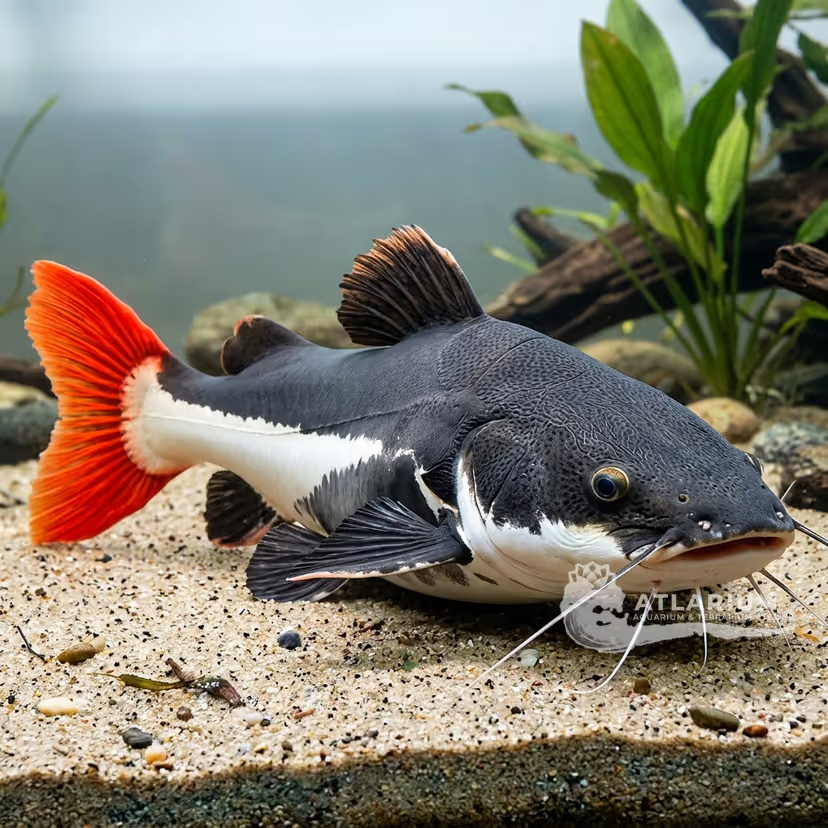
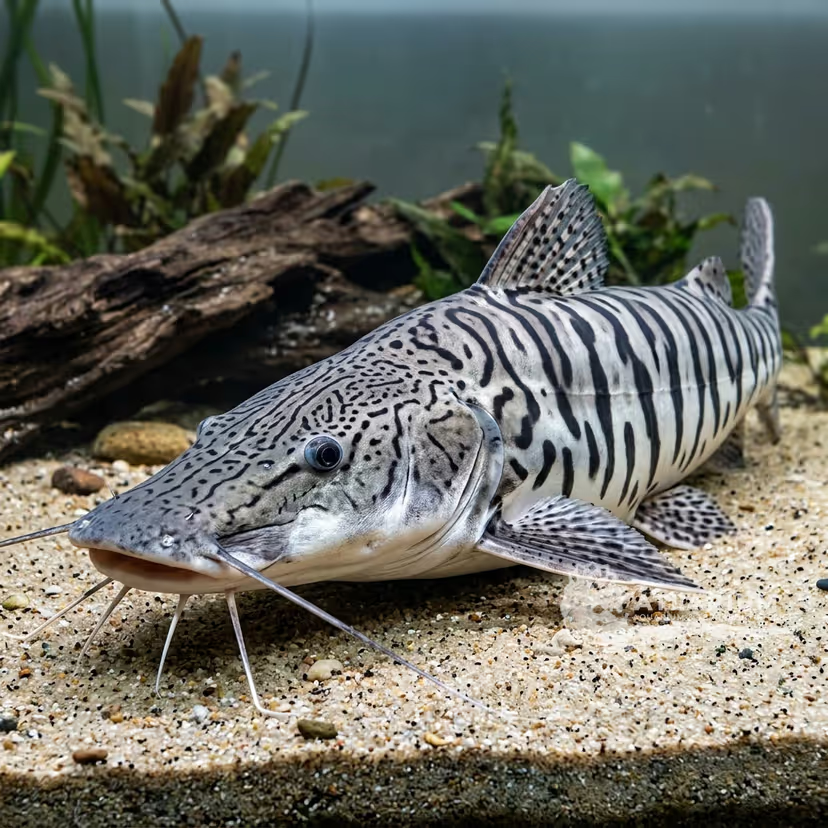
A large and striking brackish-water catfish native to northern South America, featuring a marbled gray-black pattern and venomous dorsal and pectoral spines.

Taxonomy
Class:Actinopteri
Order:Siluriformes
Family:Pimelodidae
Genus:Leiarius
Species:Leiarius pictus
Formerly known as:Sciades pictus

Share

Check out Pictus Brackish Catfish on Atlarium

PracticeRecognition quizzesPhotos, names, origins, and puzzles to review Atlas species.Open quizzes
Water Temperature

22 - 28 °C

pH Value

7.2 - 8.2

Water type

Brackish / Marine

Tank level

Bottom

Adult size

35 cm

Minimum tank volume

>= 400 L

Minimum group

>= 3

Species description

Geographical Origin and Habitat: Sciades pictus (also referred to as Arius pictus) is native to the tropical coastal waters, estuaries, and brackish lagoons of northern South America, spanning from Colombia and Venezuela through the Guianas to northern Brazil. It lives over muddy and sandy substrates near river mouths, adapting to fluctuating salinities.
Taxonomy and Morphology: Belonging to the family Ariidae (marine catfishes), the Pictus Brackish Catfish features a robust, scaleless body covered in a protective mucus layer. It has a broad, flattened head with three pairs of sensory barbels around its mouth. The dorsal and pectoral fins possess sharp, venomous bony spines. It can exceed 40-50 centimeters in adult length.
Social Behavior: It is a bottom-dwelling predator, primarily active during twilight and nighttime. While it will readily consume smaller fish and crustaceans, it is relatively peaceful and gregarious toward fish of similar or larger size, preferring to live in small groups. It swims actively close to the substrate.
Coloration and Sexual Dimorphism: The color pattern is highly attractive, featuring a marbled or reticulated dark gray to black pattern over a lighter gray or silvery base. The belly is white or cream. There are no obvious external sexual dimorphism markers; mature females are generally larger and broader than males.

Care, breeding and tankmates

Aquarium Setup: Requires an extremely large tank of at least 600-800 liters for subadults, and larger for fully grown specimens. The substrate must consist of smooth, fine sand to prevent damage to the delicate sensory barbels. Provide large driftwood roots and secure, stable rocks, leaving extensive open space for swimming.
Diet and Feeding: Strictly carnivorous. In captivity, feed a variety of meaty foods such as krill, whole shrimp, fish fillets, mussels, earthworms, and high-quality large sinking carnivore pellets. Young fish can be fed daily, while adults should be fed 3 to 4 times a week to prevent obesity.
Water Quality: Requires brackish water conditions for long-term health. Keep specific gravity stable between 1.005 and 1.015. The temperature should be maintained between 24°C and 28°C, with pH stable between 7.5 and 8.2. Powerful filtration (canister filters or a sump) is mandatory to manage the high organic waste production.
Compatibility and Cohabitation: Can be housed with other large brackish-water fish such as Scats (Scatophagus argus), Archerfish (Toxotes), Monos (Monodactylus), or other large Ariid catfishes. Any fish, shrimp, or crab small enough to fit into its mouth will be consumed. Do not keep with aggressive fin-nippers.
Aquarium Breeding: Breeding in home aquariums is undocumented and highly unlikely. They are paternal mouthbrooders; after fertilization of the large eggs, the male carries them in his mouth for several weeks, refusing food until the fry hatch and absorb their yolk sacs.
Risks and Diseases: The primary risk is the venomous spines on the dorsal and pectoral fins, which can cause severe, painful wounds; handle with extreme caution using thick gloves or containers. High nitrate levels or freshwater-only housing will cause skin infections, barbel erosion, and general decline.

Geographic Origin and Distribution

Sciades pictus (also referred to as Arius pictus) is native to the tropical coastal waters, estuaries, and brackish lagoons of northern South America, spanning from Colombia and Venezuela through the Guianas to northern Brazil. It lives over muddy and sandy substrates near river mouths, adapting to fluctuating salinities.

Origin

Tropical oceans and reefsAmazon, Orinoco, and Guianas

Fish profile

Temperament
Peaceful
Leiarius pictus is a relatively docile and peaceful giant, provided its tank mates are large enough to not be eaten. They are active mostly during twilight and nocturnal hours, but can adapt to daytime feeding. They may become skittish if adequate hiding spaces for their massive size are not provided.
Diet
Carnivore
They are omnivorous scavengers with a strong preference for meaty foods. A varied diet of high-quality sinking pellets, earthworms, pieces of fish, and crustaceans should be provided. They will readily accept prepared foods but appreciate the addition of fresh or frozen meaty treats.
Sex ratio
Group
Sexual dimorphism is not readily apparent in this species, making sexing nearly impossible outside of spawning condition. They can be kept solitarily or in groups if the aquarium is extraordinarily large. If keeping a group, ensure adequate space to minimize territorial squabbles.
Feeding frequency
Twice daily
Juveniles should be fed daily to ensure proper development and robust growth. As they mature, feeding can be reduced to three or four times a week to prevent obesity. Careful monitoring of their body condition is required to adjust portion sizes accordingly.
Bioload
Leiarius pictus, or the Painted Pimelodid, produces a massive bioload as it grows into a very large and heavy-bodied catfish. Their substantial dietary intake results in a huge amount of physical waste. Enormous aquariums with commercial-grade filtration systems are mandatory to keep the water safe.
Flow
Strong
They prefer a moderate to strong water flow that mimics the large rivers of their natural South American habitat. Strong currents help to oxygenate the water and simulate a natural environment. Ensure there are also areas of lower flow where the fish can rest easily.
Jump risk
No
Reproduction
Mouthbrooder
Captive breeding of the Painted Pimelodid has not been successfully documented in the home aquarium. Their large adult size and complex hormonal triggers make natural spawning unfeasible in captivity. Commercial breeding is likely achieved through hormone injections in massive pond setups.
Compatibility & tankmates
Verify
This catfish is generally peaceful but is a highly capable predator that will swallow any fish that fits in its capacious mouth. They are best kept with other large, robust species such as big characins, large cichlids, or other big catfish. They should not be trusted with small or slender tank mates.
Tank level
Bottom
They are predominantly bottom-dwelling fish that constantly patrol the substrate in search of food. While they stick to the bottom, their large size means they will occupy a significant portion of the lower water column. Large pieces of smooth driftwood can provide welcome cover.

Window to the official scientific data of the species

Data synced on: 06/15/2026

Scientific Parameters & Models

Trophic level
4.1 ± 0.7 se
Resilience
Medium (1.4 - 4.4 years)
Phylogenetic uniqueness (PD50)
0.5625
Bayesian Length-Weight
a = 0.00589, b = 3.09
VulnerabilityModerate vulnerability (44 / 100)

Image gallery

Licensed images linked to the species or, when marked, to the closest representative taxon.

Related species

Recommendations grouped by close relatives, companion choices, and similar care.

Recommended companions

Compatible cards from coherent ecosystems with matching parameters.

Ciliated Cryptocoryne
Plant

Ciliated Cryptocoryne

Cryptocoryne ciliata

View details->
Daggerblade Grass Shrimp
Invertebrate

Daggerblade Grass Shrimp

Palaemon pugio

View details->
West African hermit crab
Invertebrate

West African hermit crab

Clibanarius africanus

View details->
Red Mangrove
Plant

Red Mangrove

Rhizophora mangle

View details->
Feeble shrimp
Invertebrate

Feeble shrimp

Palaemon debilis

View details->
Mangrove Hermit Crab
Invertebrate

Mangrove Hermit Crab

Clibanarius longitarsus

View details->
Acorn dog whelk
Invertebrate

Acorn dog whelk

Nassarius glans

View details->
Ambon Hermit Crab
Invertebrate

Ambon Hermit Crab

Clibanarius ambonensis

View details->
Anchisteus Cleaner Shrimp
Invertebrate

Anchisteus Cleaner Shrimp

Lysmata anchisteus

View details->
Areola babylon snail
Invertebrate

Areola babylon snail

Babylonia areolata

View details->
Blue-eyed Hermit Crab
Invertebrate

Blue-eyed Hermit Crab

Clibanarius corallinus

View details->
Blue-legged Boxer Shrimp
Invertebrate

Blue-legged Boxer Shrimp

Stenopus cyanoscelis

View details->
Blueish Hermit Crab
Invertebrate

Blueish Hermit Crab

Clibanarius englaucus

View details->
Bluntclaw snapping shrimp
Invertebrate

Bluntclaw snapping shrimp

Alpheus amblyonyx
View details->
Brown Turbo Snail
Invertebrate

Brown Turbo Snail

Turbo bruneus

View details->
Carnifex Hermit Crab
Invertebrate

Carnifex Hermit Crab

Clibanarius carnifex

View details->

Similar care

Cards with similar requirements, difficulty, habitat, and husbandry profile.

Girdled goby

Girdled goby

Priolepis cincta

View details->
Convict Blenny

Convict Blenny

Pholidichthys leucotaenia
View details->
Two-spot bimaculatus blenny

Two-spot bimaculatus blenny

Ecsenius bimaculatus

View details->
Blackhead Shrimpgoby

Blackhead Shrimpgoby

Amblyeleotris melanocephala

View details->
Butterfly wrasse

Butterfly wrasse

Halichoeres papilionaceus
View details->
Allen's blenny

Allen's blenny

Ecsenius alleni

View details->
Black combtooth blenny

Black combtooth blenny

Ecsenius namiyei

View details->
Bleeker's Shrimpgoby

Bleeker's Shrimpgoby

Amblyeleotris bleekeri

View details->
Blue assessor

Blue assessor

Assessor macneilli

View details->
Starry blenny

Starry blenny

Salarias ramosus

View details->
Aurora Goby

Aurora Goby

Amblyeleotris aurora

View details->
Tailspot blenny

Tailspot blenny

Ecsenius stigmatura

View details->
Arch-fin shrimpgoby

Arch-fin shrimpgoby

Amblyeleotris arcupinna

View details->
Banded-head Shrimpgoby

Banded-head Shrimpgoby

Amblyeleotris cephalotaenius

View details->
Barsnout goby

Barsnout goby

Elacatinus illecebrosus
View details->
Beau's Fairy Wrasse

Beau's Fairy Wrasse

Cirrhilabrus beauperryi

View details->
Last updated: 06/30/2026