Threadfin anthias
Nemanthias carberryi
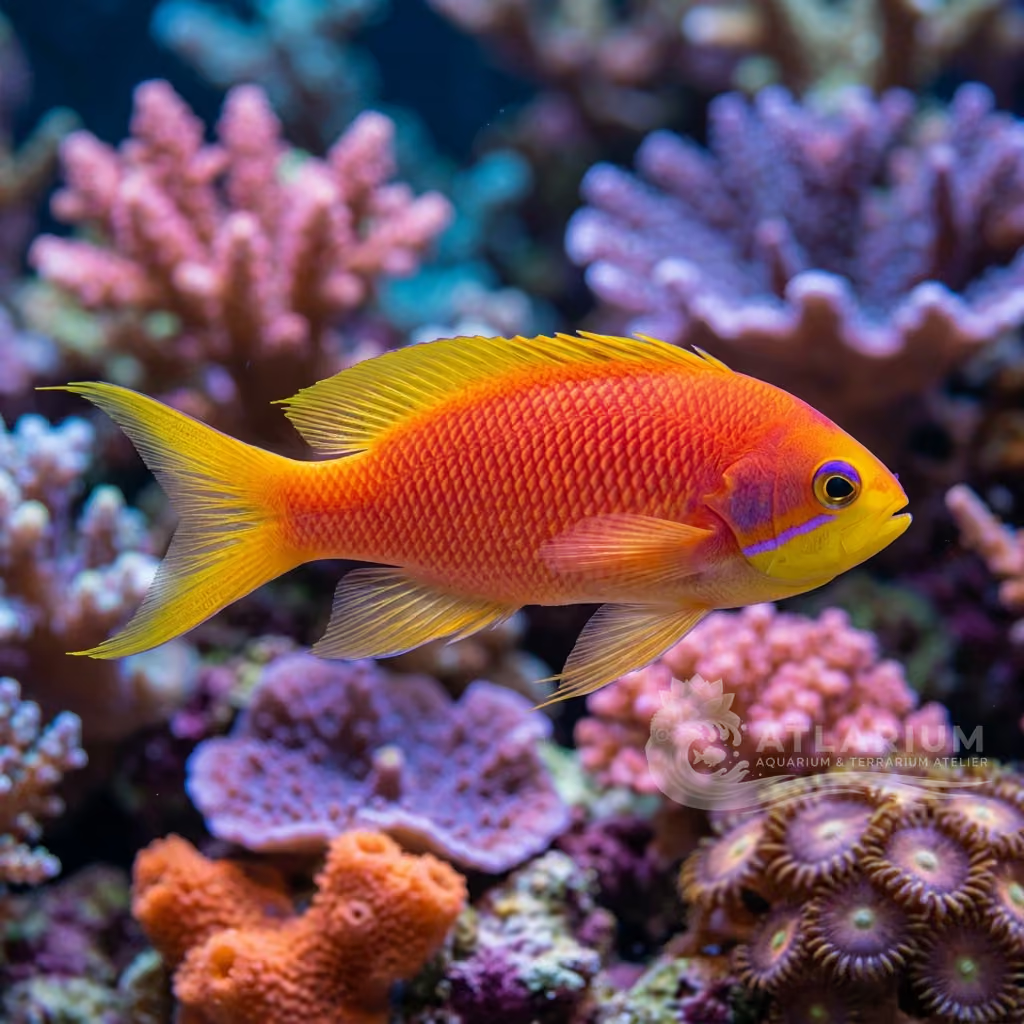
A stunning marine reef fish from the Western Indian Ocean, known for its vibrant pink-orange coloration and long thread-like filaments on the dorsal fin.
Water Temperature
22 - 27 °C
pH Value
8.1 - 8.4
Water type
Marine
Tank level
Bottom and middle
Adult size
13 cm
Minimum tank volume
>= 250 L
Minimum group
>= 4
KH
8 - 12 dKH

Species description
Geographical Origin and Habitat: Nemanthias carberryi is native to the warm tropical waters of the Western Indian Ocean, with dense populations around the Maldives, Seychelles, Madagascar, and along the East African coast. It primarily inhabits outer reef slopes, steep drop-offs, and passes exposed to strong currents, at depths ranging from 10 to 30 meters. They live in large schools that hover above colonies of hard corals such as Acropora and Pocillopora, which serve as protective shelters.
Taxonomy and Morphology: This species belongs to the family Serranidae and the subfamily Anthiadinae. It features a slender, elongated, and laterally compressed body, which is highly characteristic of zooplanktivorous reef fish. The most distinctive morphological feature is the first few rays of the dorsal fin, which extend into long, flexible filaments, particularly in adult males. The eyes are large and set forward, allowing for sharp detection of drifting microzooplankton.
Social Behavior: It is a highly gregarious species that lives in large, structured shoals governed by a strict social hierarchy. Each group is dominated by a single territorial male that guards a harem of several females and sub-adults. Nemanthias carberryi is a protogynous hermaphrodite: if the dominant male dies, the largest and most dominant female in the group undergoes a hormonal transition to transform into a functional male within a few weeks.
Coloration and Sexual Dimorphism: The coloration is remarkably bright, featuring a pinkish-orange or magenta body that transitions to golden yellow on the flanks and abdomen. Sexual dimorphism is distinct: males possess much more intense colors with violet streaks on the cheeks, larger dorsal and anal fins, and significantly longer thread-like filaments on the dorsal fin. Females are smaller and exhibit a more uniform pinkish-yellow coloration.

Care, breeding and tankmates
Aquarium Setup: Requires a mature marine aquarium of at least 300 liters to house a small group. The aquarium must offer plenty of open swimming space in the middle and upper levels, combined with a rockwork structure (reefscape) that provides numerous caves, crevices, and hiding spots where they can escape when threatened. High-power wavemakers are essential to simulate the strong ocean currents of their natural habitat.
Diet and Feeding: It is an obligate zooplanktivore with an exceptionally high metabolic rate. In captivity, it must be fed multiple times a day (at least 3-4 times) with small portions of high-quality frozen foods, such as mysis shrimp, brine shrimp, copepods, and rotifers. While they may eventually accept high-quality vitamin-enriched dry pellets or flakes, their primary diet must consist of frozen or live foods to prevent wasting disease.
Water Quality: Being a sensitive species, water parameters must be kept stable and checked regularly: temperature 22-26 °C, pH 8.1-8.4, specific gravity 1.020-1.025, and KH 8-12. Nitrate and phosphate levels must be kept close to zero through efficient protein skimming, carbon filtration, and regular partial water changes.
Compatibility and Cohabitation: This species is completely reef safe and will not harm corals, clams, or other sessile invertebrates. To minimize stress, they should be introduced to the aquarium as a group containing one male and 4-6 females. They coexist peacefully with other docile reef fish like gobies, clownfish, and small wrasses. Avoid housing them with aggressive or large predatory fish.
Aquarium Breeding: Breeding in home aquariums is extremely challenging and rarely successful. During courtship, the male performs elaborate swimming rituals around the females with fully extended fins. Spawning occurs in the open water column where eggs and sperm are released simultaneously. The eggs are pelagic and float; raising the larvae requires dedicated breeding setups and a constant supply of live phytoplankton and rotifers.
Risks and Diseases: The primary risk is starvation due to inadequate feeding frequency. Additionally, due to shipping and acclimation stress, they are highly susceptible to marine parasites such as marine ich (Cryptocaryon irritans) and marine velvet (Amyloodinium ocellatum). A quarantine period is strongly recommended to monitor health and ensure they are feeding well before reef introduction.

Geographic origin and distribution
Nemanthias carberryi is native to the warm tropical waters of the Western Indian Ocean, with dense populations around the Maldives, Seychelles, Madagascar, and along the East African coast. It primarily inhabits outer reef slopes, steep drop-offs, and passes exposed to strong currents, at depths ranging from 10 to 30 meters. They live in large schools that hover above colonies of hard corals such as Acropora and Pocillopora, which serve as protective shelters.
Origin
Tropical oceans and reefsAfrica and MadagascarSouth and Southeast Asia

Fish profile
- Temperament
- Peaceful
- While highly peaceful with other species, they maintain a strict social hierarchy within their own group. The dominant male will frequently display and mildly chase the females to assert dominance. They are a schooling fish that must be kept in groups to prevent severe stress.
- Diet
- Carnivore
- They are strict zooplanktivores that require a rich, varied meaty diet. Finely chopped mysis shrimp, copepods, and high-quality frozen mixtures are mandatory. Getting them to accept dry pellets can be extremely difficult and should not be relied upon.
- Life expectancy
- 4-8 years
- Adult size
- 13 cm
- Sex ratio
- Harem
- They must be kept in a harem structure to thrive and display natural behaviors. One male should be kept with a group of at least 4 to 6 females. If multiple males are kept, the dominant male will relentlessly harass and likely kill the subordinates.
- Feeding frequency
- 3-4 times daily
- This species has a very fast metabolism and tiny stomach, requiring almost constant feeding. They must be fed small amounts at least 3 to 5 times per day to survive. Using an automatic feeder for freeze-dried calanus can help meet their rigorous demands.
- Bioload
- Medium
- The Threadfin Anthias produces a moderately high bioload due to their frequent feeding requirements. Since they must be fed heavily, high-capacity protein skimming is required to process the excess nutrients. Frequent water changes are necessary to prevent nitrate buildup in reef systems.
- Flow
- Strong
- They originate from reef drop-offs with strong, dynamic currents. Strong, turbulent water flow in the aquarium is necessary to keep their food suspended in the water column. Good flow also encourages their natural schooling behavior and vibrant colors.
- Jump risk
- Yes
- Like most anthias, they are notoriously skittish and prone to leaping out of the water. A tightly fitted mesh screen top is an absolute requirement for this species. Any sudden movement or aggressive tankmate can trigger a fatal jump.
- Reproduction
- Oviparous
- They are protogynous hermaphrodites, meaning females can change into males if the dominant male is lost. Breeding in home aquariums is highly uncommon, though spawning behavior is often observed. Rearing the microscopic fry requires specialized pelagic culture systems.
- Compatibility & tankmates
- Reef safe
- They are completely peaceful and totally safe for corals and invertebrates. They should be kept with other peaceful, planktivorous reef fish like wrasses and chromis. Avoid placing them with overly aggressive or fast, competitive eaters that might stress them.
- Tank level
- Middle/Bottom
- They are open-water swimmers that predominantly occupy the middle section of the aquarium. They will hover in the water column facing the current to pick off passing food. They need ample open space combined with rocky overhangs for nighttime shelter.

Scientific Parameters & Models
FishBase
Window to the official scientific data of the species
FishBase v25.04Data synced on: 06/15/2026
- Trophic level
- 3.4 ± 0.45 se
- Resilience
- High (less than 15 months)
- Phylogenetic uniqueness (PD50)
- 0.5312
- Bayesian Length-Weight
- a = 0.01413, b = 3
- VulnerabilityLow vulnerability (10 / 100)

Related species
Recommendations grouped by close relatives, companion choices, and similar care.