Pope's pit viper
Trimeresurus popeiorum
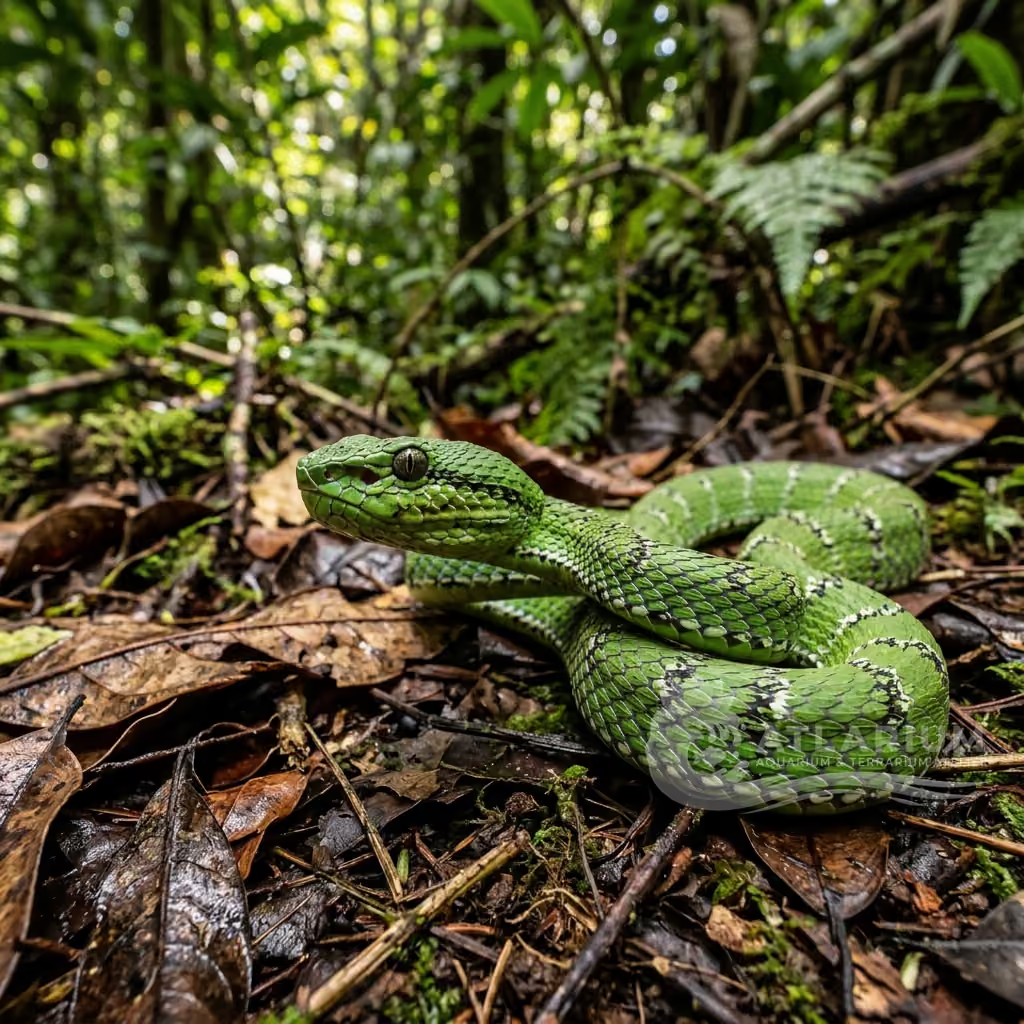
A mesmerizing, brilliant green Asian arboreal pit viper with piercing reddish eyes. Native to dense Southeast Asian canopies, it is strictly reserved for experienced experts.
Environment
Terrestrial
Humidity
60 - 80 %
Day temperature
24 - 28 °C
Night temperature
20 - 22 °C
Adult size
75 cm

Species description
Geographical Origin and Habitat: Trimeresurus popeiorum (commonly known as Pope's pit viper) is native to Southeast Asia, with a distribution ranging from northeastern India, Myanmar, Thailand, Laos, and Vietnam to Peninsular Malaysia. It mainly inhabits wet montane forests and hilly rainforests at elevations between 500 and 2,000 meters. It is frequently found near cool mountain streams, dense bamboo groves, and low bushes.
Taxonomy and Genetics: Belonging to the family Viperidae and subfamily Crotalinae (pit vipers). It is scientifically classified as Trimeresurus popeiorum, though sometimes grouped under the genus Popeia. Its genetic profile is closely linked to other green tree vipers of Asia, exhibiting evolutionary adaptations for nocturnal hunting and heat detection. There are no commercial breeds or morphs.
Behavior and Habits: Exhibits strictly nocturnal and arboreal habits. It spends daylight hours coiled tightly on branches, relying on its green coloration for camouflage. Although generally sedentary and non-aggressive if left alone, it can strike with remarkable speed and precision if provoked. It possesses a potent hemotoxic venom, making safe handling with hooks and tongs mandatory.
Morphology: Features a triangular head distinct from the neck, with large eyes having reddish-orange irises and vertical pupils. Lorentz pits (heat-sensing organs) are visible on the snout. The body is moderately slender with keeled scales and a prehensile tail tipped with reddish-brown. Coloration is bright green dorsally, with males showing a distinct white and red lateral stripe on the lower flanks.

Care, breeding and tankmates
Terrarium Setup: A vertically oriented, highly secure enclosure (minimum 80x50x90 cm) with a reliable lock is mandatory. The setup must include numerous sturdy climbing branches of varying thicknesses and dense live or artificial plants to provide shaded cover and elevated hides. Substrates like coconut husk, peat moss, or cypress mulch are ideal for humidity retention.
Lighting and Heating: Provide a 12-hour light cycle using a low-output (2%) UVB bulb to maintain natural photoperiods. Heating should be supplied from above via ceramic heaters or heat lamps, which must be fully enclosed in wire guards to prevent thermal injuries. Maintain a hot spot of 26-28°C, a cool side of 22-23°C, and night drops to 19-20°C.
Humidity and Hydration: High humidity levels between 70% and 80% are essential. Daily misting of the enclosure in the evening with warm water is required. These vipers rarely drink standing water; instead, they drink water droplets from leaves and branches. Proper ventilation (via double mesh vents) is critical to prevent stagnant, damp air.
Feeding and Supplementation: Preys on small rodents, birds, and lizards in the wild. In captivity, they should be fed size-appropriate thawed mice using long safety tongs. Feed adult snakes every 12-15 days. They have a slow metabolism and are prone to regurgitation if fed too frequently. Supplementation is not required if feeding high-quality whole prey.
Compatibility: Strictly solitary animals. They must be housed individually. Co-housing is a major source of stress and can lead to dangerous combat, injuries, or accidental feeding strikes. Bringing a male and female together for breeding purposes should only be attempted by professional herpetologists under close observation.
Health and Common Diseases: Highly vulnerable to respiratory infections (RIs) if kept in cool, poorly ventilated, or overly wet conditions. Stuck sheds, especially on the prehensile tail and eye caps, occur if humidity drops. Due to their dangerous venom, veterinary care must be conducted using specialized containment tubes and secure protocols.

Geographic origin and distribution
Trimeresurus popeiorum (commonly known as Pope's pit viper) is native to Southeast Asia, with a distribution ranging from northeastern India, Myanmar, Thailand, Laos, and Vietnam to Peninsular Malaysia. It mainly inhabits wet montane forests and hilly rainforests at elevations between 500 and 2,000 meters. It is frequently found near cool mountain streams, dense bamboo groves, and low bushes.
Origin
North AmericaSouth and Southeast AsiaEast Asia

Reptile profile
- Diet
- Carnivore
- The feeding ecology of Pope's pit viper is characterized by its highly specialized predatory behavior. As a strict carnivorous, this species primarily targets frogs, lizards, small mammals, and occasionally birds. Its sensory adaptations, including advanced olfactory mechanisms and, in some cases, heat-sensing pits, allow it to detect the minute physiological signatures of its prey with remarkable precision. This predatory efficiency plays a crucial role in maintaining the trophic balance within its natural habitat.\n\nIn terms of foraging strategy, Pope's pit viper demonstrates an energy-conserving ambush technique. By remaining motionless for extended periods, the snake capitalizes on its cryptic coloration to blend seamlessly into its surroundings. Once an unsuspecting prey item approaches within strike range, the snake delivers a rapid, venomous bite. The venom initiates both immobilization and preliminary digestion, which is vital for consuming frogs, lizards, small mammals, and occasionally birds efficiently.\n\nDigestive physiology in this species is highly adapted to process sporadic but substantial meals. After a successful hunt, Pope's pit viper typically retreats to a secure microhabitat where the extended metabolic process of digestion can occur safely. This adaptation is particularly important given the variable availability of frogs, lizards, small mammals, and occasionally birds in its environment, allowing the snake to survive prolonged periods between feeding events.
- Adult size
- 75 cm
- Lifestyle/Microhabitat
- Arboreal
- Being predominantly arboreal, this pit viper spends its life in the canopy of trees, shrubs, and bamboo thickets. They possess a prehensile tail that aids in navigating branches and striking prey from elevated positions. The terrarium must be vertically oriented, equipped with numerous climbing branches and dense foliage to satisfy their climbing instincts.
- Activity cycle
- Nocturnal
- This species is primarily nocturnal, remaining hidden during the daylight hours to avoid extreme heat and predators. As dusk approaches, the Trimeresurus popeiorum becomes active, emerging from its diurnal retreat to forage and hunt. Enclosure lighting should reflect a natural day-night cycle, but the snake will exhibit its most natural active behaviors after the lights go out.
- Sociality
- Solitary
- Behaviorally, Pope's pit viper exhibits a distinctly solitary lifestyle. Interactions with conspecifics are generally rare and primarily confined to the breeding season or incidental encounters in areas of high resource overlap. This solitary nature minimizes intraspecific competition for food and optimal thermoregulatory sites, which is essential for survival in its specific ecological niche.\n\nThe daily activity pattern and spatial distribution of Pope's pit viper are deeply influenced by its arboreal and nocturnal, relying on its prehensile tail and camouflage. Whether utilizing leaf litter, rocky crevices, or arboreal perches, the snake's primary defensive strategy is avoidance and camouflage. However, if cornered or directly threatened, it will not hesitate to display defensive behaviors, which may include physical posturing, hissing, and ultimately striking.\n\nThermoregulation is a critical aspect of its solitary existence. Pope's pit viper carefully selects microhabitats that offer the ideal gradient of temperature and humidity, balancing the need to warm its body for digestion with the imperative to remain hidden from natural predators. This continuous spatial adjustment underscores the complex, self-reliant nature of its arboreal and nocturnal, relying on its prehensile tail and camouflage lifestyle.
- Reproduction
- Viviparous
- The reproductive strategy of Pope's pit viper is defined by its ovoviviparous nature. This specific reproductive modality—live-bearing reproduction (ovoviviparous), common among arboreal pit vipers—is a critical evolutionary adaptation that maximizes the survival rate of the offspring in its native environment. The physiological investment required for this reproductive cycle dictates much of the female's seasonal behavior and energy allocation.\n\nEnvironmental cues such as temperature fluctuations and seasonal precipitation often trigger the onset of the mating season. During this period, males may engage in complex chemosensory trailing to locate receptive females. Following successful copulation, the gestation or incubation period begins, heavily dependent on optimal microclimatic conditions. The specifics of live-bearing reproduction (ovoviviparous), common among arboreal pit vipers ensure that the developing embryos are protected during their most vulnerable stages.\n\nUpon emergence, the neonates of Pope's pit viper are fully formed and equipped with the necessary venom and instinctual behaviors to survive independently. There is typically no extended parental care post-birth or post-hatching, meaning the juveniles must immediately navigate the challenges of predation and foraging. This life-history strategy highlights the evolutionary trade-offs between offspring quantity and the intensive physiological costs of reproduction.
- Handling tolerance
- Display only
- Due to its highly potent and medically significant venom, the Trimeresurus popeiorum is strictly a display-only species. Under no circumstances should this snake be free-handled. All interactions, enclosure maintenance, and feeding must be performed using professional snake hooks, secure lockable terrariums, and strict safety protocols to prevent life-threatening envenomation.
- Brumation
- Not required
- Originating from relatively stable, warm climates, this species does not require a true winter brumation period. Maintaining consistent ambient temperatures year-round is ideal for their health. However, slight nocturnal temperature drops and seasonal changes in rainfall or humidity can be provided to mimic their native environment and stimulate natural behaviors.
- Molting
- Periodic
- Originating from highly humid tropical environments, this snake requires consistently elevated ambient humidity to shed its skin properly. Frequent daily misting or a rain system should be utilized when the snake goes into blue. A properly humidified enclosure prevents dysecdysis (abnormal shedding), which can lead to restricted blood flow or infection.

Related species
Recommendations grouped by close relatives, companion choices, and similar care.