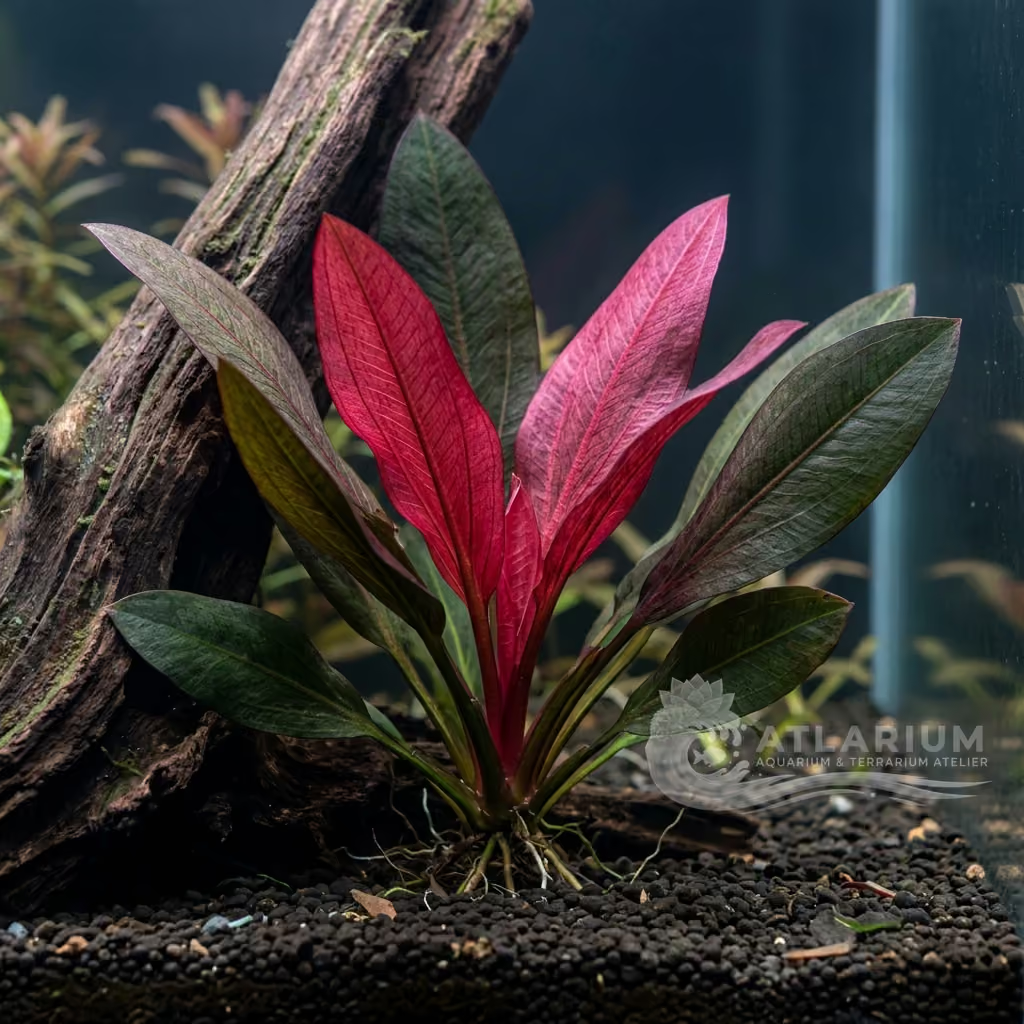
Ceratophyllum demersum
Ceratophyllum demersum
Hornwort is an indestructible, rootless cosmopolitan aquatic plant with stiff, needle-like green whorls. It floats freely, aggressively absorbing nutrients from the water column under varied lighting.
Water Temperature
10 - 28 °C
pH Value
6 - 8.5
Water type
Freshwater
Light
Low
CO2
Low
Expected height
80 cm
Expected width
15 cm
GH
4 - 20 dGH
KH
5 - 24 dKH

Species description
Geographical Origin and Habitat: Ceratophyllum demersum, globally renowned as Hornwort, is a true cosmopolitan aquatic plant. With the exception of Antarctica, it is natively found completely submerged in virtually every freshwater ecosystem on the planet. It is an apex aquatic survivor, aggressively dominating stagnant ponds, slow-moving rivers, marshes, and highly eutrophic (nutrient-polluted) lakes. It thrives in extreme, nutrient-dense environments where it rapidly outcompetes algae by forming massive, impenetrable, floating mats just below the water's surface.
Taxonomy & Genetics: Scientifically classified as the type species of the Ceratophyllaceae family, Hornwort is taxonomically unique and ancient. It is completely, biologically rootless. Its genetics lack any mechanism to produce true roots to absorb nutrients from the soil. Instead, it has evolved into a hyper-efficient aquatic vacuum, absorbing massive amounts of nitrogen, ammonia, and phosphates directly from the water column through its deeply modified, highly specialized leaves.
Physical Structure: The architectural structure of Hornwort is perfectly engineered for massive, explosive aquatic volume. Because it cannot produce roots, it exists as a free-floating, deeply branching stem. The central stems are incredibly thick, somewhat brittle, and can easily grow up to 3 meters (10 feet) long in the wild. The defining feature is the foliage: the leaves are extremely narrow, rigid, strictly needle-like, and grow in dense, symmetrical whorls (circular clusters) around the central stem, giving the plant a highly bushy, bottle-brush appearance.
Color & Texture: The standard C. demersum is characterized by a bright, vibrant, solid light-green to dark-olive coloration, depending entirely on lighting intensity and nitrate availability. It possesses zero capability to produce red or purple pigments. The texture is notoriously rigid, stiff, and surprisingly brittle. The needle-like leaves feel incredibly coarse and slightly scratchy to the touch. Because the stems are highly brittle, physical handling easily snaps them into smaller pieces, which is the plant's primary method of vegetative reproduction.

Care, breeding and tankmates
Lighting & CO2: It is arguably the least demanding, most indestructible aquatic plant in existence. It will survive and slowly grow in nearly pitch-black, deeply shaded aquariums. However, when exposed to high-intensity LED lighting, its growth rate becomes terrifyingly explosive, capable of growing several inches in a single day. Injecting pressurized CO2 is absolutely unnecessary for its survival, though adding it will cause the plant to aggressively monopolize the entire tank, requiring daily, massive pruning.
Nutrition & Substrate: Hornwort is an absolute biological powerhouse. Being completely rootless, it MUST NEVER be forcibly buried deep into thick aquasoil or gravel, as the buried stem segment will instantly rot, releasing the plant to float to the surface. It feeds 100% from the water column. It is highly valued as a "nutrient sponge" in the hobby, aggressively absorbing toxic ammonia, heavy nitrates, and phosphates. If the water column becomes completely stripped of nutrients, the stiff green needles will rapidly turn pale yellow and shed.
Water Chemistry: It is practically invincible regarding water parameters. It thrives equally in freezing cold outdoor ponds (overwintering by sinking to the bottom) and in standard heated tropical aquariums (up to 30°C/86°F). It effortlessly adapts to extreme pH ranges (6.0 - 8.5) and highly alkaline, hard tap water. In fact, it actually prefers harder water because it can biogenically decalcify the water, actively extracting carbon directly from calcium carbonate when dissolved CO2 is depleted.
Space Management & Placement: Due to its rootless nature and explosive growth, Hornwort is incredibly difficult to use in strict, organized aquascapes. It is primarily used as a functional utility plant rather than an aesthetic one. It is the ultimate background filler or floating surface cover for newly established tanks to prevent algae outbreaks (by outcompeting algae for nutrients). It is also the premier choice for breeder tanks, as its dense, prickly whorls provide impenetrable, predator-proof hiding spaces for newborn fish fry and baby shrimp.
Pruning: Pruning is a constant, weekly battle if grown under strong light. Because the stems grow infinitely and float at the surface, they will quickly block all light from reaching the plants below. Do not attempt to delicately trim it; simply grab massive handfuls of the excess stems and physically snap them off or cut them with scissors, discarding the extra mass. Every single snapped fragment of a stem will instantly begin growing into a massive new plant.
Risks & Diseases: Hornwort is essentially immune to disease, but it has one devastating weakness: it is violently allergic to liquid carbon supplements (like Seachem Excel) and copper-based fish medications. Exposure to Glutaraldehyde (liquid carbon) will cause the entire massive plant to panic, violently shedding millions of its stiff green needles simultaneously. This creates a catastrophic, rotting mess across the aquarium substrate that can instantly spike ammonia levels and crash the entire tank.

Geographic origin and distribution
Ceratophyllum demersum, globally renowned as Hornwort, is a true cosmopolitan aquatic plant. With the exception of Antarctica, it is natively found completely submerged in virtually every freshwater ecosystem on the planet. It is an apex aquatic survivor, aggressively dominating stagnant ponds, slow-moving rivers, marshes, and highly eutrophic (nutrient-polluted) lakes. It thrives in extreme, nutrient-dense environments where it rapidly outcompetes algae by forming massive, impenetrable, floating mats just below the water's surface.
Origin
Extra-Amazon South AmericaCentral America and CaribbeanNorth AmericaAfrica and MadagascarEurope, Mediterranean, and West AsiaSouth and Southeast AsiaEast AsiaCosmopolitan or introduced

Plant profile
- Placement
- Floating
- It can be left to float freely at the water's surface or loosely anchored to decorations and driftwood. It does not possess true roots, so burying it in the substrate will often cause the buried portion to rot.
- Botanical form
- Stem
- It features stiff, dark green, needle-like leaves arranged in whorls along a somewhat brittle stem. The dense, bushy structure provides excellent hiding spaces for fish fry and small invertebrates.
- Growth
- Fast
- This plant is renowned for its incredibly fast growth rate, often growing several inches per week. Its rapid development requires frequent management to prevent it from blocking light to lower-level plants.
- Substrate
- None
- Ceratophyllum demersum, commonly known as hornwort, lacks true roots entirely and has no specific substrate requirements. It thrives perfectly as a free-floating plant, absorbing all essential nutrients directly from the water column. If planting is desired for aesthetic reasons, the lower stems can be loosely anchored into any inert gravel or sand. However, burying the stems too deeply may lead to rot, so securing them with weights or letting them drift is ideal.
- Column fertilization
- Recommended
- It relies entirely on the water column for its nutritional needs, absorbing minerals directly through its leaves. Liquid fertilizers containing a balanced mix of macro and micro nutrients will significantly boost its growth.
- Root fertilization
- None
- Root fertilization is completely irrelevant since Ceratophyllum demersum lacks true roots and does not absorb nutrients from the substrate.
- Trimming
- Occasional
- Trimming is as simple as cutting the stem to the desired length and discarding the excess. Frequent pruning is necessary to maintain a tidy appearance and prevent it from overgrowing the entire aquarium.
- Propagation
- Cuttings
- Propagation is exceptionally easy and occurs naturally through stem fragmentation. Simply snapping a stem in half and allowing both pieces to float will result in two healthy, growing plants.
- Sensitivity
- Moderate
- Hornwort is known to be sensitive to certain chemical treatments, particularly liquid carbon products and some medications, which can cause it to shed its needles rapidly. It prefers cooler to moderate temperatures and can struggle in very warm water.
- Layout role
- Midground, Background
- It is often used as a background plant or a floating canopy to provide shade and a sense of security for timid fish. Its dense growth is highly valued in breeding tanks for protecting fry from adult fish.

Image gallery
Licensed images linked to the species or, when marked, to the closest representative taxon.

Related species
Recommendations grouped by close relatives, companion choices, and similar care.