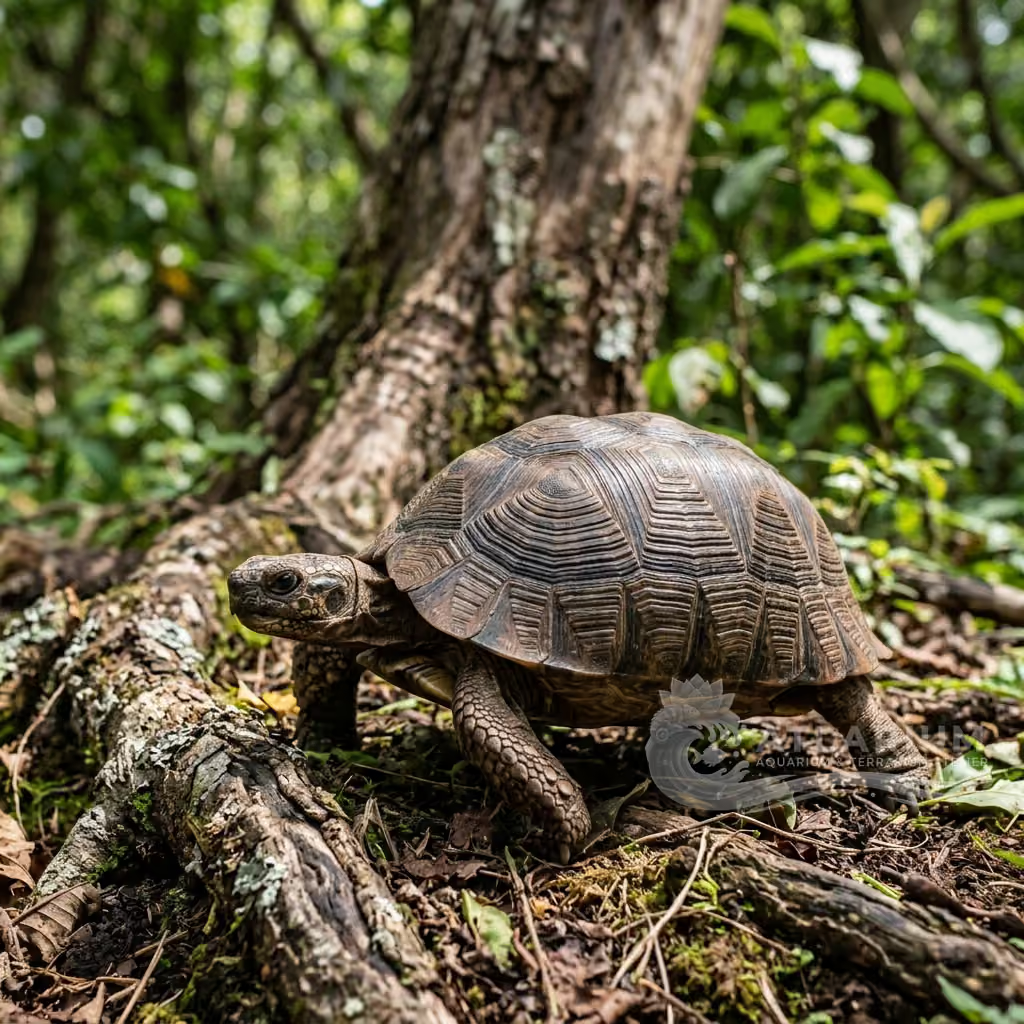
Hermann's Tortoise
Testudo hermanni
Meet Hermann's Tortoise, a majestic Mediterranean herbivore. Long-lived and deeply rewarding to keep, this diurnal reptile thrives in sun-drenched outdoor enclosures with a fiber-rich weed diet.
Ambiente
Terrestre
Umidade
40 - 60 %
Temperatura diurna
18 - 35 °C
Temperatura noturna
18 - 22 °C
Tamanho adulto
20 cm
UVB
Ferguson 3
UVI
1 - 2,6 UVI

Descrição da espécie
Geographical Origin and Habitat: Hermann's Tortoise is native to the Mediterranean regions of Europe, including Italy, Greece, the Balkans, southern France, and eastern Spain. It thrives in Mediterranean oak and beech forests, scrublands, rocky hillsides, and coastal meadows with dense vegetation for cover and open patches for basking.
Taxonomy and Genetics: A reptile belonging to the Testudinidae family. It is classically divided into two main subspecies: the Western Hermann's tortoise (Testudo hermanni hermanni) and the larger Eastern Hermann's tortoise (Testudo hermanni boettgeri).
Behavior and Habits: It is strongly diurnal and heavily reliant on solar thermoregulation. It actively browses for food in the morning, hides during the hottest hours of the day, and becomes active again in the late afternoon. In the wild, it undergoes winter brumation (hibernation) to survive cold months.
Morphology: Features a moderately domed, oval carapace with highly contrasting yellow and black markings. A key identifying trait is the presence of a horny scale or "spur" at the tip of the tail. The supracaudal scute (shield above the tail) is typically divided.

Cuidado, criação e companheiros de tanque
Terrarium Setup: An outdoor, secure enclosure is vastly superior to any indoor setup and should be provided whenever weather permits. If housed indoors, a large open-top tortoise table is required (minimum 4x8 feet for an adult). Use a deep substrate of topsoil mixed with play sand. Glass tanks are inappropriate as they restrict ventilation and cause stress.
Lighting and Heating: Excellent lighting is paramount. A high-quality UVB source (Ferguson Zone 3) is strictly required for calcium metabolism. Provide a basking spot of 32-35°C (90-95°F) with a cooler ambient end around 21-24°C (70-75°F). Nighttime temperatures can drop safely to 15-18°C (60-65°F).
Humidity and Hydration: Ambient humidity should be 40-60%. Provide a shallow dish of fresh water for drinking and soaking. Microclimates are essential; offering a humid hide helps prevent shell pyramiding, especially during the crucial juvenile growth stages.
Feeding and Supplementation: Strictly herbivorous. The diet should be high in fiber, rich in calcium, and low in protein and sugars. Feed a diverse mix of wild weeds (dandelion, plantain, clover, mallow) and edible flowers. Avoid fruits, iceberg lettuce, and animal protein completely. Dust food with a calcium supplement daily and vitamins weekly.
Compatibility: Best kept solitary. If keeping a group, a massive enclosure is needed with many visual barriers. Males are notoriously territorial and aggressive, constantly harassing females to mate, so a ratio of one male to at least three females is required if cohabiting.
Health and Common Diseases: Vulnerable to respiratory infections if kept cold and damp. Shell pyramiding is a common developmental disease caused by incorrect humidity and diet. Also susceptible to metabolic bone disease (MBD) if UVB or calcium is lacking.

Origem e distribuição geográfica
Hermann's Tortoise is native to the Mediterranean regions of Europe, including Italy, Greece, the Balkans, southern France, and eastern Spain. It thrives in Mediterranean oak and beech forests, scrublands, rocky hillsides, and coastal meadows with dense vegetation for cover and open patches for basking.
Origem
Europa, Mediterrâneo e Ásia Ocidental

Perfil de réptil
- Dieta
- Herbivore
- Hermann's tortoises are strict herbivores that require a diet high in fiber and calcium, but very low in protein and fats. Their natural diet consists of a wide variety of broadleaf weeds, grasses, flowers, and leafy greens found in Mediterranean environments. Fruit should be entirely avoided or offered extremely rarely, as their digestive systems are not equipped to process high amounts of sugar.
- Expectativa de vida
- 60-80 years
- Tamanho adulto
- 20 cm
- Estilo de vida/Microhabitat
- Terrestrial
- Adapted to Mediterranean scrublands and forests, they thrive in environments featuring warm, dry summers and mild, rainy winters. They rely heavily on dense vegetation for shelter from predators and extreme weather, utilizing microclimates within shrubs to thermoregulate effectively. As long-lived reptiles, a commitment of 50 to over 80 years is required when keeping them in optimal captive conditions.
- Ciclo de atividades
- Diurnal
- Hermann's tortoises are strictly diurnal and exhibit a bimodal activity pattern during the hottest summer months to avoid peak midday temperatures. They are most active in the early morning, when they bask to raise their body temperature before foraging, and again in the late afternoon. During the cooler parts of spring and autumn, their activity tends to spread more evenly throughout the midday hours.
- Socialidade
- Gregarious
- These tortoises are active, terrestrial explorers that spend a large portion of their day foraging and basking to thermoregulate. Males are notoriously territorial and aggressive towards one another, making it necessary to house them separately or with multiple females in very large enclosures. They are adept climbers and diggers, capable of escaping enclosures that lack secure, deeply buried physical barriers.
- Reprodução
- Oviparous
- Mating occurs immediately following emergence from brumation in the spring, characterized by the male actively pursuing, biting, and ramming the female's shell. Females dig flask-shaped nests in loose, well-draining soil exposed to full sun to deposit a clutch of 2 to 9 hard-shelled eggs. Incubation temperatures determine the sex of the hatchlings, with higher temperatures generally producing females and lower temperatures yielding males.
- Tolerância de tratamento
- Tolerant
- Tortoises generally do not enjoy being handled and often experience significant stress when their feet are lifted off the ground. Handling should be restricted to necessary health checks, soaking routines, or transferring them between enclosures. When picking them up, they must be firmly supported with both hands around the sides of their shell to prevent accidental drops, which can cause fatal shell fractures.
- Brumação
- Obrigatório
- Brumation is a natural and essential part of their annual cycle, typically lasting 3 to 5 months during the winter. A carefully controlled fasting period is necessary before cooling them down to ensure their digestive tract is entirely empty; undigested food will rot and cause fatal sepsis at low temperatures. In captivity, hibernation must take place in a heavily monitored, temperature-controlled environment kept consistently between 4°C and 7°C.
- Muda
- Regular
- Tortoises do not shed their skin in one continuous piece like snakes; instead, their skin flakes off continually in small patches from their neck, limbs, and tail. Their keratinized shell scutes also grow and slightly peel or flake over time as the animal expands. It is critical never to peel away loose skin or scutes forcibly, as this can expose sensitive underlying tissue to painful infections.

Espécies relacionadas
Recomendações agrupadas por parentes próximos, escolhas de acompanhantes e cuidados semelhantes.