Whitetail Dascyllus
Dascyllus aruanus
An incredibly hardy Indo-Pacific damselfish marked by bold black-and-white bands. Exceptionally resilient for beginners, but its fierce territorial aggression demands spacious tanks and tough companions.
Température de l’eau
24 - 27 °C
Valeur du pH
8.1 - 8.4
Type d'eau
Marin
Niveau dans le bac
Fond et milieu
Taille adulte
10 cm
Volume minimal du bac
>= 120 L
Groupe minimal
>= 1
KH
8 - 12 dKH

Description de l'espèce
Geographical Origin and Habitat: Widely distributed in the tropical coral reefs of the Indo-Pacific, from the Red Sea and East Africa to the Line and Tuamotu Islands, and north to southern Japan. It lives in large waves closely associated with branching Acropora coral colonies in shallow lagoons and protected reefs at depths of 1-20 meters.
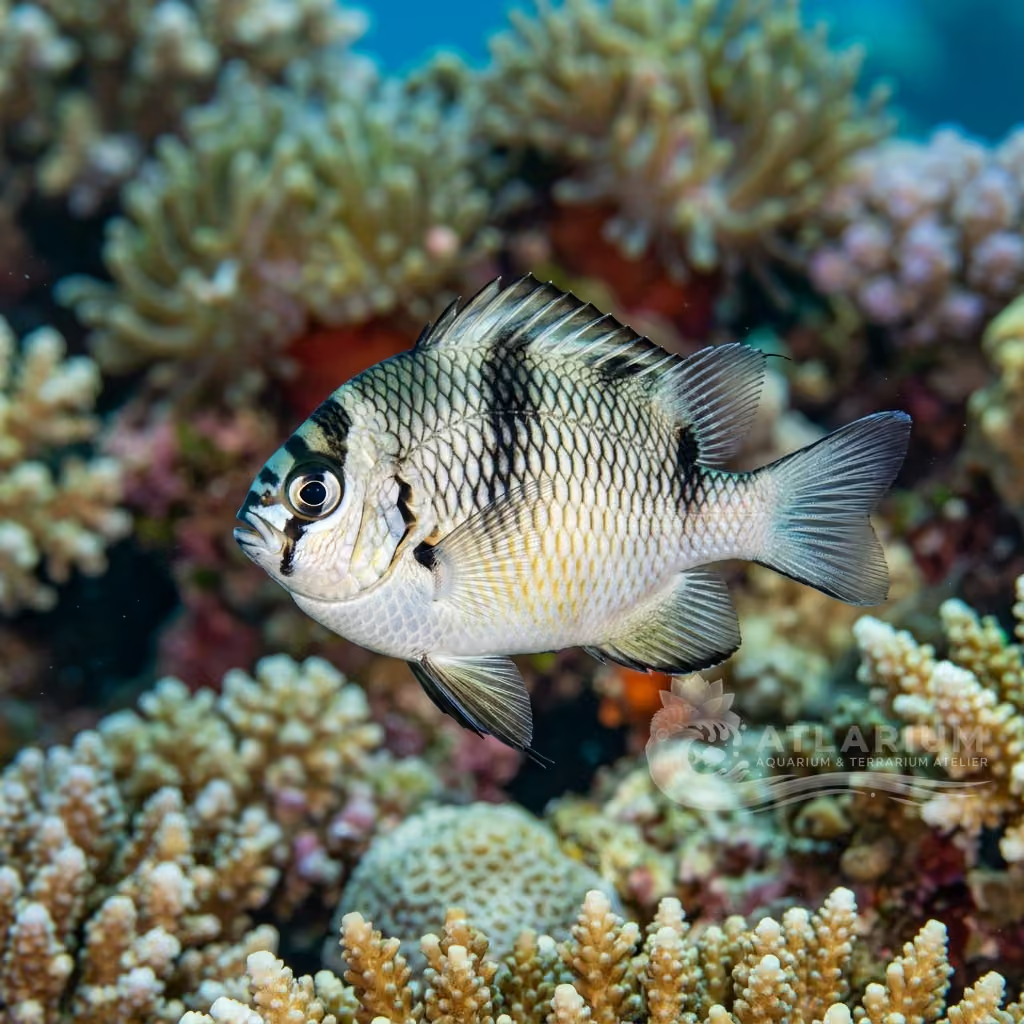
Taxonomy and Morphology: Belongs to the family Pomacentridae, subfamily Chrominae, genus Dascyllus. It features a deep, discoid, and laterally compressed body with a small terminal mouth. Maximum size is about 8-10 cm (3-4 inches) in adulthood. Scales are large and prominent, with robust spines on dorsal and anal fins.
Social Behavior: Highly territorial, hierarchical, and aggressive. In nature, they live in structured groups where dominant members occupy upper coral branches for plankton feeding while submissives stay at the base. In aquariums, it shows severe intraspecific and interspecific aggression, attacking larger fish to defend its territory.
Coloration and Sexual Dimorphism: The pattern features three distinct vertical black bands alternating with white bands. The first black band runs from the snout through the eye to the nape; the second from the dorsal fin to the pelvic fins; the third across the posterior body to the anal fin. Tail is entirely white. No visual sexual dimorphism.

Soins, reproduction et cohabitation
Aquarium Setup: Needs an aquarium of at least 150-200 liters (40-55 gallons) to manage its high aggression. The layout should include rocky structures and branching corals (even synthetic ones) that provide defined territories. If keeping a group, a large tank with multiple separate shelters is critical to disperse aggression.
Diet and Feeding: Voracious and opportunistic omnivore. It immediately accepts any food offered: dry flakes or pellets, frozen mysis, brine shrimp, krill, and algae-based preparations. A varied diet maintains excellent health and preserves the stark black-and-white contrast of its pattern.
Water Quality: Incredibly hardy species, capable of tolerating less-than-perfect water conditions, making it suitable for beginners. Ideal parameters are: temperature between 24°C and 28°C (75°F - 82°F), pH 8.1-8.4, salinity/specific gravity of 1.021-1.025, and dKH of 8-12. Regular maintenance is still recommended.
Compatibility and Cohabitation: Due to its high aggressiveness, it must be introduced to the tank last. Do not house with timid or slow fish (like pipefish, dwarf gobies, or delicate angels). Compatible only with robust, assertive fish of larger size (tangs, large clownfish, triggerfish, fast wrasses). Reef-safe.
Aquarium Breeding: Spawning in home aquariums is relatively common. During courtship, the male performs rapid vertical swimming displays. Adhesive eggs are laid on a cleaned rock surface and defended fiercely by the male, who fans them until hatching. Raising fry requires microscopic live zooplankton.
Risks and Diseases: One of the hardiest marine fish available. Rarely falls ill, and only contracts external parasites under extreme stress or poor hygiene. The primary risk in captivity is physical injury resulting from territorial fights with other fish due to its aggressive temperament.

Origine et répartition géographiques
Widely distributed in the tropical coral reefs of the Indo-Pacific, from the Red Sea and East Africa to the Line and Tuamotu Islands, and north to southern Japan. It lives in large waves closely associated with branching Acropora coral colonies in shallow lagoons and protected reefs at depths of 1-20 meters.
Origine
Océans tropicaux et récifsAfrique et MadagascarAsie de l'Est

Profil de poisson
- Tempérament
- Aggressive
- The Whitetail Dascyllus is a highly aggressive and incredibly territorial damselfish that punches well above its weight class. They are completely fearless when defending their claimed area, often attacking much larger fish and biting the hands of the aquarist during cleaning. Due to this extreme belligerence, they must be housed carefully with tank mates that are equally tough and capable of holding their own. Delicate, slow-moving, or overly peaceful species will quickly succumb to the constant harassment from this fish. This species should generally be considered only for aggressive predator tanks or specialized biotope displays.
- Régime alimentaire
- Omnivore
- In the wild, Dascyllus aruanus feeds primarily on zooplankton, benthic invertebrates, and various types of algae found on the reef. In the home aquarium, they are unfussy omnivores that eagerly accept almost any food offered to them. A staple diet of high-quality marine flakes and micro-pellets should be supplemented with frozen mysis, brine shrimp, and cyclops. Offering small amounts of spirulina or seaweed-based foods will ensure their herbivorous needs are met. This varied diet is essential for sustaining their immune system and bold color contrast.
- Espérance de vie
- 5-8 years
- Taille adulte
- 10 cm
- Ratio des sexes
- Solitary
- In their natural habitat, they are often found in large aggregations hovering above Acropora coral heads. In captivity, maintaining a group requires a sufficiently large aquarium, as they will establish a strict pecking order that can be brutal to the lowest-ranking individuals. For most standard aquariums, keeping a single specimen or a bonded pair is the most successful strategy to minimize intraspecific violence. If a group is desired, introduce several small juveniles simultaneously and allow them to establish dominance over time. A dominant individual will transition into the male role, governing the harem of females.
- Fréquence d'alimentation
- 2-3 times daily
- To mimic their natural feeding habits, Dascyllus aruanus should be fed small portions two to three times daily. Their high metabolism and constant activity require regular caloric intake to prevent them from becoming overly aggressive at feeding time. Care should be taken not to overfeed during a single session, as uneaten food will degrade water parameters. Utilizing an automatic feeder can help maintain a consistent schedule if the aquarist is away during the day. Broadcasting the food throughout the water column helps ensure less dominant fish also receive adequate nutrition.
- Charge biologique
- Low to Medium
- Dascyllus aruanus, commonly known as the Whitetail Dascyllus, produces a relatively low to moderate bioload per individual. Due to their small adult size, their overall waste output is manageable for most standard marine filtration setups. However, because they are often kept in shoals, the cumulative bioload can quickly add up in smaller aquariums. Consistent maintenance, including protein skimming and routine water changes, is necessary to keep nutrient levels low. Maintaining high water quality will help prevent stress and disease in these active little fish.
- Courant
- Strong
- The Whitetail Dascyllus naturally inhabits shallow lagoons and outer reef slopes where water movement is quite dynamic. They prefer an aquarium environment with moderate to turbulent flow that mimics these natural wave actions. Strong currents keep them active and help deliver suspended food particles right to their territory. Powerheads should be positioned to create a chaotic, random flow pattern rather than a single unidirectional stream. Ample flow also prevents detritus from settling in the dense rockwork where these fish typically reside.
- Risque de saut
- No
- Reproduction
- Oviparous
- This species frequently breeds in the home aquarium when optimal conditions and a mature pair are present. They are substrate spawners that will thoroughly clean a flat rock surface or the glass base before depositing their eggs. The male takes on the primary responsibility of guarding the nest fiercely against any approaching fish and fanning the eggs to prevent fungal infections. Hatching occurs within three to five days depending on the temperature, yielding hundreds of microscopic larvae. Rearing the fry requires dedicated separate systems and highly specialized microscopic live foods like rotifers.
- Compatibilité et compagnons
- Reef safe
- This black-and-white damselfish is infamous for its pugnacious attitude, especially once established in an aquarium. It is not recommended for a peaceful community tank, as it will likely bully passive fish like firefish, small gobies, or peaceful wrasses. Ideal tank mates include larger dottybacks, triggerfish, robust angelfish, and moderately aggressive tangs. They are completely reef safe and will not harm corals or sessile invertebrates, often using branching stony corals as a preferred refuge. It is always wise to introduce this species to the aquarium last to mitigate its territorial aggression toward newcomers.
- Niveau dans le bac
- Middle/Bottom
- Dascyllus aruanus primarily occupies the middle and lower regions of the aquarium, rarely venturing to the very surface unless actively feeding. They are extremely structure-dependent and will usually claim a specific rock structure or coral skeleton as their permanent base of operations. They hover just above this chosen territory and will instantly retreat into the crevices at the first sign of danger. Providing intricate rockwork with plenty of tight spaces is essential for their sense of security. An open tank with minimal décor will cause them severe stress and likely increase their aggression levels.

Modèles et paramètres scientifiques
FishBase
Fenêtre sur les données scientifiques officielles de l’espèce
FishBase v25.04Données synchronisées le : 15/06/2026
- Niveau trophique
- 3,3 ± 0,42 se
- Résilience
- Moyenne (1,4 - 4,4 ans)
- Singularité phylogénétique (PD50)
- 0.5005
- Relation bayésienne longueur-poids
- a = 0.02239, b = 2.95
- VulnérabilitéVulnérabilité faible (10 / 100)

Espèces associées
Recommandations regroupées par proches parents, compagnons et soins similaires.