Red gracilaria
Gracilaria parvispora
Beautiful red marine macroalgae that forms intricate spherical bushes. Excellent for refugiums or displays, acting as a natural nutrient export system.
Température de l’eau
24 - 28 °C
Valeur du pH
8.1 - 8.4
Type d'eau
Marin
Lumière
Moyenne
CO2
Faible
Hauteur attendue
20 cm
Largeur attendue
15 cm
GH
4 - 20 dGH
KH
2 - 15 dKH

Description de l'espèce
Geographical Origin and Habitat: Red Gracilaria (often referring to the species *Gracilaria parvispora*, also known as "Ogo") is a marine macroalgae native to temperate and tropical seas, with a particular concentration in the Indo-Pacific and along the coasts of Hawaii. It thrives in shallow, nutrient-rich coastal waters subject to lively water exchange, anchoring to coral rubble, submerged rocks, or mollusk shells in areas protected from direct ocean breakers.
Taxonomy & Genetics: It is a rhodophyte (red algae) belonging to the Gracilariaceae family. The red coloration is due to the presence of phycoerythrin, an accessory pigment that allows it to effectively capture the blue and green light spectrum that penetrates deep water. Unlike invasive green algae such as Caulerpa, Gracilaria is a complex multicellular organism, making it structurally more stable and free from the risk of "meltdown" (coenocytic collapse).
Physical Structure: It lacks roots, instead possessing a small basal adhesive disc from which fleshy, cylindrical stems arise. The thallus branches repeatedly in a dichotomous or irregular manner, forming dense, intricate spherical bushes. The branches are turgid, translucent, and relatively thick, giving the entire structure a bushy, almost sculptural appearance that is highly prized ornamentally.
Color & Texture: Its livery ranges from a deep ruby red to a translucent pink or burgundy, depending on light intensity and iron concentration in the water. The surface is perfectly smooth, silky, and slightly rubbery or cartilaginous to the touch. The actively growing tips often appear lighter, almost pinkish or orange.

Soins, reproduction et cohabitation
Lighting & CO2: It grows optimally under medium lighting. Too dazzling a light (especially with a strong white or UV component) can cause it to lose its red pigments, turning it into an unpleasant yellow-orange or brownish color. A PAR between 100 and 200 is recommended. It exploits the carbonates present in the water, therefore requiring no additional CO2 injections in the system.
Nutrition & Substrate: It is considered a true nutrient "sponge": it absorbs nitrates and phosphates with incredible voracity directly from the water column through its epidermis. It can be kept floating in a refugium or attached to the rocky substrate in the main display. For the branches to remain fleshy and bright red, it requires constant supplementation of chelated iron and iodine.
Water Chemistry: Relatively robust, it tolerates temperatures from 22 to 28°C and classic marine density (1.024-1.026). Excessively sterile environments (ULNS, Ultra Low Nutrient Systems) will cause the rapid thinning and disintegration of the branches due to starvation. It is vital that there is always a traceable level of organic pollutants.
Space Management & Placement: Highly decorative, it is one of the few macroalgae recommended for the main aquarium. The basal disc can be glued to a rock. It is not invasive in nature and does not infest rocks with creeping rhizoids; it grows upward in a compact bush. If kept in a refugium, it will provide an unparalleled substrate for the proliferation of amphipods and copepods.
Pruning: Maintenance is extremely simple. To limit its growth or export nutrients, simply snap or cut the excess branches with your hands or scissors. The cut fragments, if wedged between rocks or glued, will give rise to new bushes in a short time. The removed portion constitutes an excellent food for herbivorous fish.
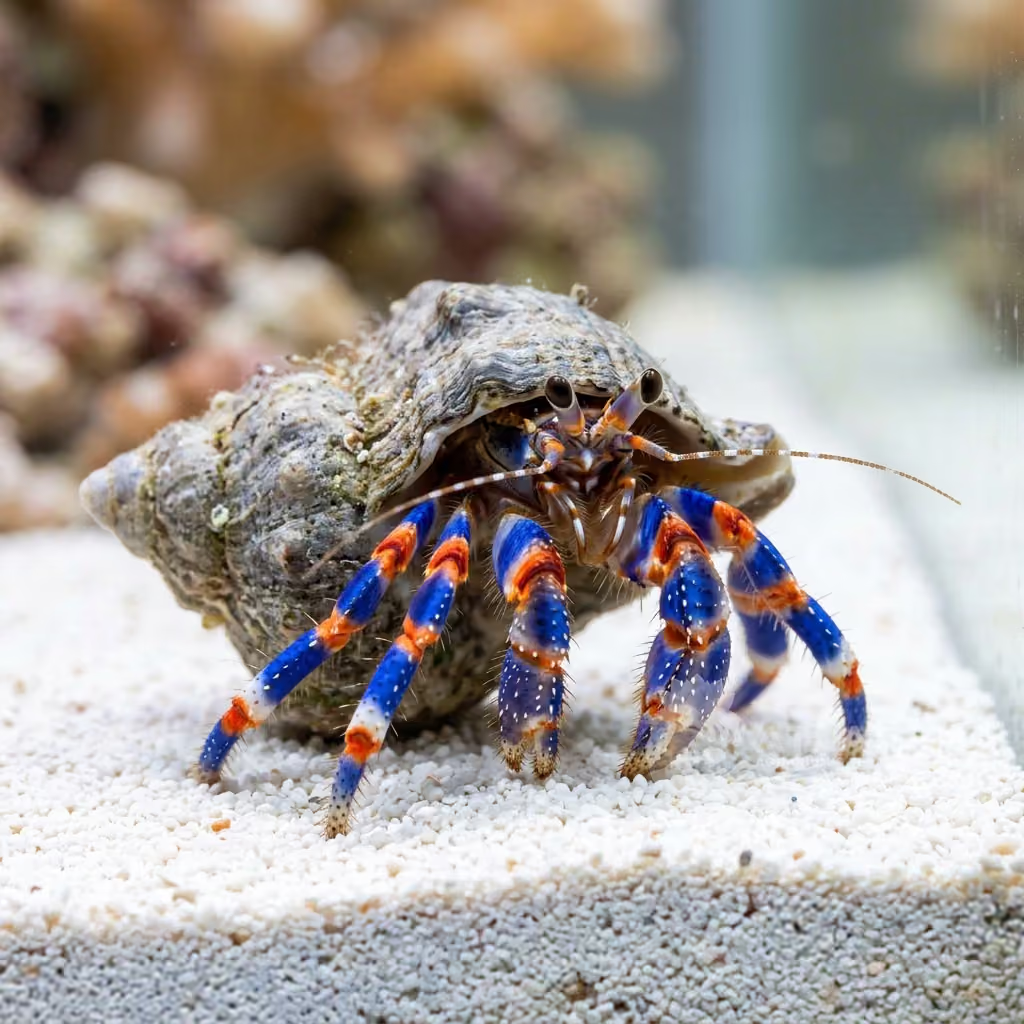
Risks & Diseases: Besides the loss of turgor due to the absence of nitrates, the main risk in the aquarium is that it is rapidly decimated. It is the absolute favorite food of Zebrasoma, Acanthurus, Rabbitfish, and even hermit crabs. If placed in a display with herbivorous fish, it will be devoured down to the base in a few hours, which is why it is often cultivated in sumps solely for feeding purposes (as zero-mile live food).

Origine et répartition géographiques
Red Gracilaria (often referring to the species *Gracilaria parvispora*, also known as "Ogo") is a marine macroalgae native to temperate and tropical seas, with a particular concentration in the Indo-Pacific and along the coasts of Hawaii. It thrives in shallow, nutrient-rich coastal waters subject to lively water exchange, anchoring to coral rubble, submerged rocks, or mollusk shells in areas protected from direct ocean breakers.
Origine
Océans tropicaux et récifsAsie du Sud et du Sud-EstAustralie, Nouvelle-Guinée et Océanie

Profil de plante
- Emplacement
- Plan intermédiaire
- Commonly placed in a refugium for nutrient export, or in the main display tank as ornamental macroalgae. It requires moderate to high water flow to keep detritus from settling on its branches. Ensure it has enough space to expand its bushy structure.
- Forme botanique
- Algue
- A striking red macroalgae characterized by its heavily branched, fleshy, and somewhat brittle structure. It forms dense, bush-like clumps that provide shelter for small marine life. The branches are cylindrical and tapering at the tips.
- Croissance
- Moyenne
- Exhibits a fast growth rate when nutrient levels are elevated and lighting is adequate. It can quickly double in mass under ideal refugium conditions. Regular harvesting is necessary to export the absorbed nutrients.
- Substrat
- Faible
- Gracilaria parvispora is a marine macroalga that does not possess true roots, absorbing all its required nutrients directly from the water column. In the aquarium, it can be left free-floating or gently anchored to inert substrates, live rock, or coarse aragonite sand using thread or glue. Substrate depth and composition are largely irrelevant to its health, as long as it receives adequate water flow to keep its delicate fronds clean and nutrient-rich.
- Fertilisation de la colonne d'eau
- Aucune
- Relies entirely on elements dissolved in the water column for its nutrition. Dosing trace elements, particularly iron and manganese, enhances its vivid red pigmentation. It helps maintain pristine water quality by outcompeting nuisance algae for nutrients.
- Fertilisation racinaire
- Aucune
- Does not possess true roots and therefore does not require substrate fertilization. It anchors itself to rocks using a holdfast or can be grown free-floating in a tumbling macroalgae setup. Sand beds do not provide direct nutritional benefits.
- Taille
- Occasionnelle
- Prune by simply breaking off portions of the branches by hand or with scissors. Frequent harvesting promotes continuous growth and maximizes nutrient export. Removed portions can be fed to herbivorous fish like tangs.
- Propagation
- Fragmentation
- Easily propagated through fragmentation. Any broken piece can continue to grow and form a new clump if provided with proper conditions. It can be attached to rubble using a rubber band until a holdfast forms.
- Sensibilité
- Sensible
- Sensitive to sudden changes in salinity and temperature, which can cause it to bleach or turn mushy. High levels of heavy metals or medications containing copper are toxic to it. It requires sufficient flow to prevent cyano or detritus buildup.
- Rôle dans le décor
- Macroalga / Refugium
- Provides a brilliant splash of red color and intricate texture to the display tank. In refugiums, it functions primarily as a nutrient exporter and habitat for copepods. It adds a natural, dynamic element to marine setups.

Galerie d'images
Images sous licence liées à l'espèce ou, lorsqu'elles sont indiquées, au taxon représentatif le plus proche.

Espèces associées
Recommandations regroupées par proches parents, compagnons et soins similaires.