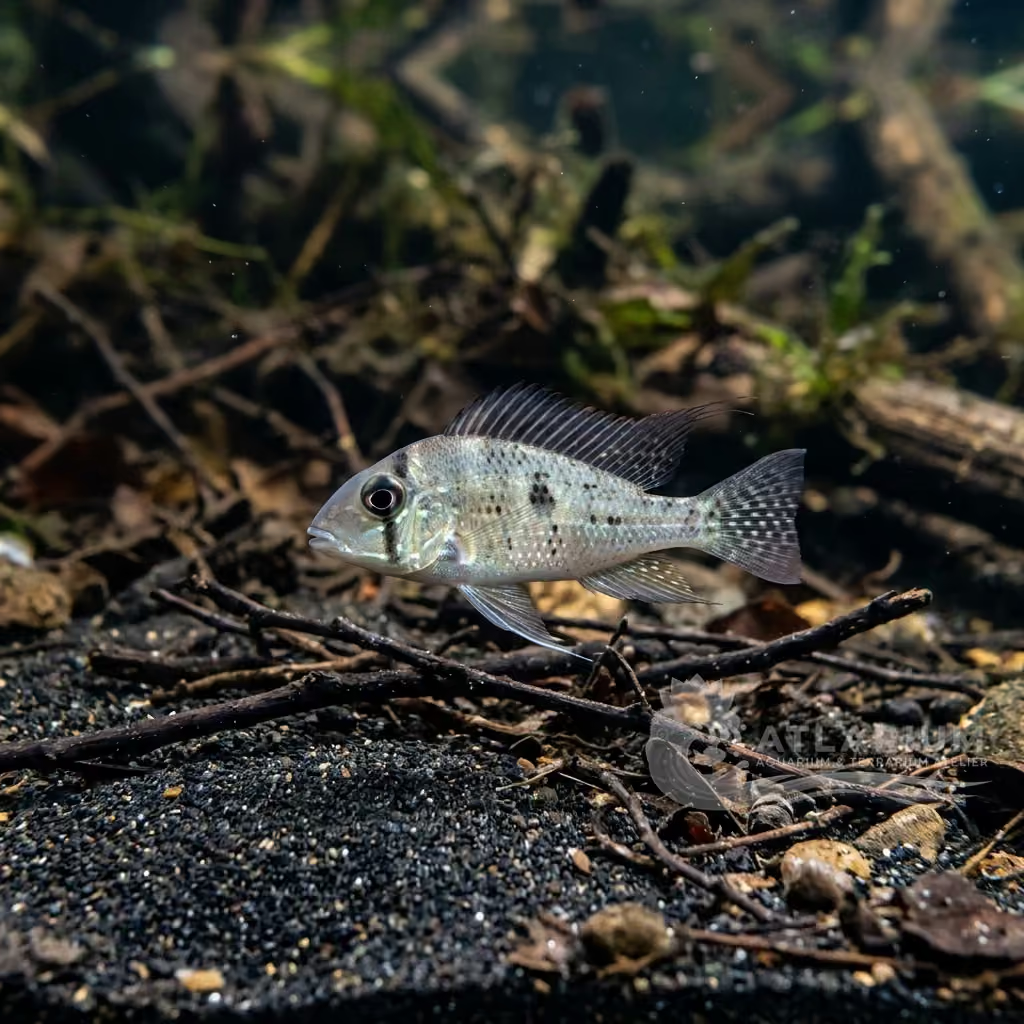
Arapaima (Pirarucu)
Arapaima gigas
Arapaima gigas, known as pirarucu or paiche, is an enormous South American freshwater fish associated with Amazonian floodplains. It is an obligate air-breather, a predator whose diet changes with size, and a paired parent during breeding. It belongs only in professionally managed, purpose-built systems; its taxonomic and geographic scope needs care because older literature applied A. gigas broadly across the genus.
Water type
Freshwater
Tank level
Surface and middle
Adult size
300 cm

Species description
Geographic Origin and Habitat: Arapaima gigas is associated with the Amazon basin and seasonally flooded tropical floodplains. It moves laterally into flooded forest in the rainy season and uses large oxbow lakes and deep river channels in the dry season. Its obligate air breathing permits use of oxygen-poor water, but it must reach the surface; that adaptation is not evidence that poor water quality is acceptable in captivity. Reviewed classifications establish no stable subfamily rank.
Taxonomy and Morphology: The accepted name used here is Arapaima gigas (Schinz, 1822), with Sudis gigas as its basionym. Modern revision recognises several Arapaima species, so older reports using A. gigas may cover more than the exact taxon. It has a long, laterally compressed body, posterior dorsal and anal fins, a bony tongue, and large mineralised cycloid scales. Published maximum lengths conflict across sources and measurement contexts.
Social Behaviour: Adults are ambush predators that engulf smaller fish by suction; diet and prey change with body size. During the rainy season, a pair constructs a nest and both parents guard eggs and larvae. After yolk absorption, fingerlings school around the male while the female guards the nesting area. These observations do not make mixed housing predictable: size, breeding state, space and individual behaviour can change risk quickly.
Colouration and Sexual Dimorphism: Adults are described as olive-brown above and silver-grey below, with characteristic red pigment along the posterior margins of the scales. Juveniles are darker and blotched, then develop stronger posterior red markings as they mature. The published sources do not establish a reliable external sexual dimorphism for routine sexing. Do not infer sex from colour, size or head shape alone; use an appropriate professional method when sex matters for management.

Care, breeding and tankmates
Aquarium Setup: Arapaima is not a home-aquarium fish. This giant obligate air-breather moves seasonally across floodplains; FishBase lists public-aquarium use, with no evidence for a 500 L minimum. House it only in a legal, professionally designed system with open surface access, overhead clearance, secure containment and transfer or separation plans. No verified exact-taxon source confirms 15–20 years in captivity or a quantified jump rate. Plan long term for health, growth and licensed-institution capacity.
Diet and Feeding: Match food and ration to ontogeny. Young fish use zooplankton and a varied mix that includes insects, fish, crustaceans and molluscs; larger fish are mainly piscivorous, and adults may opportunistically take small terrestrial vertebrates. Commercial pellets can be used in aquaculture contexts, but the reviewed sources do not validate a single product, live prey or fixed schedule for all settings. Professional oversight should link feeding to condition, growth, intake and water-quality capacity.
Water Quality: Obligatory air breathing supplies oxygen but does not excuse polluted water. Keep surface access clear; monitor temperature, nitrogen compounds, solids and pathogens. Seasonal flooded forest, oxbows and deep channels mean no current or water recipe is universal. No evidence supports 25–29 °C, pH 6.0–7.5, GH 4–15, KH 2–7, TDS 80–295, conductivity 125–461 or minimum group size 1 as universal requirements. Do not transfer aquaculture dissolved-oxygen thresholds to displays without site assessment.
Compatibility and Cohabitation: Do not treat large size as proof of compatibility. Smaller fish can be engulfed, while breeding pairs guard a nest and young. No published source provides a safe mixed-species list or a domestic cohabitation formula. Any association must be planned by qualified staff from each animal's size, welfare, water needs, enclosure geometry and separation options. Stop and reassess if chasing, injury, blocked surface access, food competition or territorial defence appears.
Aquarium Breeding: Reproductive reports describe pairs nesting in clear, shallow, shaded water over hard substrate during the rainy season. The female deposits adhesive eggs, the male fertilizes them, and both parents guard eggs and larvae; later fry school around the male while the female guards territory. These are documented biological observations, not an instruction to induce breeding. Attempt breeding only within a lawful, professionally supervised programme that can protect adults, young and other animals.
Risks and Disease: Farmed juveniles have documented parasites on gills, skin, stomach and swim bladder, including Dawestrema and Trichodina in particular farm contexts. These reports do not diagnose an individual or justify routine medication. Prevention includes biosecure sourcing, quarantine, water-quality and parasite monitoring, and avoiding release outside the native range. Seek aquatic-veterinary or fish-health assessment; treatment, control and movement restrictions must follow diagnosis and local law.

Geographic origin and distribution
This species originates from: Bacino dell'Amazzonia.
Origin
Amazon, Orinoco, and Guianas

Fish profile
- Temperament
- Semi-aggressive
- The evidence supports a very large predatory fish that forms pairs during breeding and protects a nest and young. It does not justify a blanket claim that all individuals are peaceful, aggressive, or safe with other large species. Interactions depend on size, breeding state, space and individual behaviour. Treat any pairing or mixed-species display as an institutional welfare decision with separation capacity, not as an aquarium compatibility recipe.
- Diet
- Carnivore
- Diet shifts markedly with size. Very young fish eat a broad mix including zooplankton, insects, fish, crustaceans and molluscs; larger fish feed mainly on fish, with some size classes taking apple snails. Adults are ambush predators that may opportunistically take small terrestrial vertebrates. The carnivore classification reflects the predatory habits of adults, not a claim that every life stage needs an identical ration or that live prey is required.
- Adult size
- 300 cm
- Sex ratio
- 1:1 ratio
- Arapaima form pairs in the rainy season and both parents provide care, so a pair is the documented reproductive social unit. The 1:1 ratio describes that observation; it does not establish external sexing criteria, guarantee pair formation, or mean that two arbitrary adults can be housed together safely. Pair formation, breeding and any group management require facilities able to monitor behaviour and separate animals without crowding or injury.
- Bioload
- Extreme
- Its adult size, carnivorous diet and large food intake justify an extreme-bioload warning, but the published sources do not quantify a universal filtration rate or water-change percentage. Air breathing does not remove the need to control ammonia, nitrite, solids, temperature or pathogen load. Size life-support, monitoring and waste handling from actual biomass, feeding and measured water chemistry under professional management.
- Jump risk
- Yes
- Arapaima are powerful, large-bodied fish, but published evidence does not establish a taxon-specific quantified jumping rate. A jump-risk warning is therefore a prudent containment signal rather than a measured behavioural probability. Design barriers, overhead clearance and staff safety procedures for the consequence of an escape or collision; never represent a cover or net as a substitute for an enclosure designed by qualified professionals.
- Reproduction
- Oviparous
- Arapaima form pairs during the rainy season. In documented natural-history accounts they build a nest on hard substrate in clear, shallow water with overhead shade; the female lays adhesive eggs, the male fertilizes them, and both parents guard eggs and larvae. Fingerlings later school around the male while the female guards the territory. This supports oviparity and paired care, not a claim that breeding can be reproduced in ordinary aquarium conditions.
- Compatibility & tankmates
- With caution
- There is no published evidence for a safe universal community list. A fish small enough to be engulfed is at obvious risk, and breeding adults defend a nest and young. The correct compatibility decision is therefore case-specific: assess species identity, body size, enclosure geometry, escape routes, water requirements, legal status and the ability to separate animals immediately. A with-caution assessment must never be read as approval for private mixed-species keeping.
- Tank level
- Top/Middle
- Arapaima use the middle and upper water column and must reach the air–water interface to breathe. A top-middle description is useful only as a broad display cue: it does not mean the animal occupies a fixed layer or that depth can compensate for inadequate surface access. Any enclosure needs a clear, unobstructed surfacing route and must prevent contact injuries during abrupt movement near the surface.

Scientific Parameters & Models
FishBase
Window to the official scientific data of the species
FishBase v25.04Data synced on: 06/15/2026
- Trophic level
- 4.5 ± 0 se
- Resilience
- Low (4.5 - 14 years)
- Generation time
- 11.1 years
- Phylogenetic uniqueness (PD50)
- 0.5469
- Bayesian Length-Weight
- a = 0.01096, b = 2.94
- VulnerabilityModerate to high vulnerability (54 / 100)

Related species
Recommendations grouped by close relatives, companion choices, and similar care.