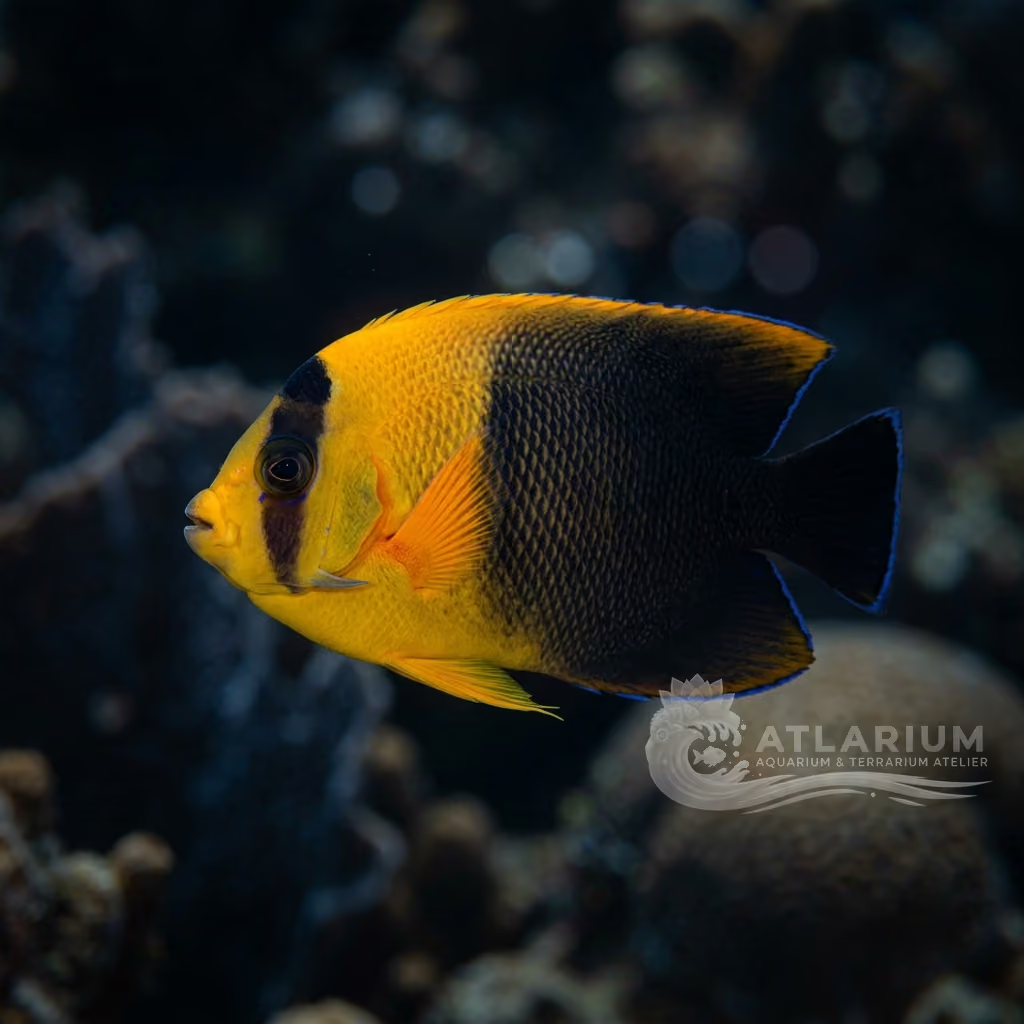
Keyhole angelfish
Centropyge tibicen
The Keyhole Angelfish is recognized by its solid dark blue-black body and distinct white oval patch. It's a hardy but territorial dwarf angelfish for large tanks.
Wassertemperatur
24 - 28 °C
pH-Wert
8.1 - 8.4
Wassertyp
Meerwasser
Tankfüllstand
Unten und in der Mitte
Erwachsenengröße
19 cm
Mindesttankvolumen
>= 200 L
Mindestgruppe
>= 1
KH
8 - 12 dKH

Artbeschreibung
Geographical Origin and Habitat: The Keyhole Angelfish is widely distributed in the Indo-West Pacific, ranging from southern Japan to northwestern Australia, eastward through Micronesia and Melanesia. It inhabits coral-rich lagoons, harbors, and seaward reefs, particularly areas with rubble, caves, and algal growth at depths of 4 to 30 meters.
Taxonomy and Morphology: Belonging to the family Pomacanthidae and the genus Centropyge. It is one of the largest species within the dwarf angelfish genus, capable of reaching a maximum length of 18-19 cm. It possesses a deep, oval, compressed body with a prominent preopercular spine characteristic of angelfish.
Social Behavior: Semi-aggressive and territorial. It typically lives in small harems consisting of one dominant male and two to seven females. It is a shy species that darts quickly into rockwork when threatened. It can become highly territorial toward other dwarf angelfish or similarly shaped tankmates.
Coloration and Sexual Dimorphism: The body is uniform dark blue-black, contrasted by a prominent vertical oval white patch on the mid-dorsum. The lower margins of the anal and pelvic fins are trimmed in bright yellow. Males are slightly larger than females and may show iridescent blue highlights on the edges of their fins.

Pflege, Zucht und Mitbewohner
Aquarium Setup: A spacious aquarium of at least 250 liters (approx. 65 gallons) is necessary. The tank must contain a large amount of mature live rock, configured to create numerous caves, tunnels, and hiding places. Provide adequate open areas for swimming.
Diet and Feeding: Omnivorous, requiring a varied diet rich in algae. Feed spirulina, marine seaweed (nori), specialized angelfish preparations containing sponge matter, and frozen meaty foods like mysis shrimp, brine shrimp, and krill. Offer food 2-3 times daily in small amounts.
Water Quality: Requires stable water parameters. Maintain temperature at 24-27°C (75-81°F), pH 8.1-8.4, specific gravity 1.020-1.025, and alkalinity (dKH) 8-12. Weekly or bi-weekly water changes are essential to control nitrates and maintain trace elements.
Compatibility and Cohabitation: Can be housed with tangs, wrasses, damselfishes, and gobies. It is considered semi-reef safe; it may nip at large polyp stony (LPS) corals, soft corals, and clam mantles, especially if underfed or kept in small tanks.
Aquarium Breeding: Breeding in home aquaria is very difficult. They are protogynous hermaphrodites, where the largest female in a group transforms into a male. Spawning occurs at dusk in the water column. Raising the pelagic larvae requires specialized live micro-zooplankton.
Risks and Diseases: Prone to marine ich (Cryptocaryon), velvet (Amyloodinium), and Head and Lateral Line Erosion (HLLE). HLLE is often linked to activated carbon dust or nutritional deficiencies, so high-quality food and carbon rinsing are critical.

Geografische Herkunft und Verbreitung
The Keyhole Angelfish is widely distributed in the Indo-West Pacific, ranging from southern Japan to northwestern Australia, eastward through Micronesia and Melanesia. It inhabits coral-rich lagoons, harbors, and seaward reefs, particularly areas with rubble, caves, and algal growth at depths of 4 to 30 meters.
Ursprung
Tropische Ozeane und RiffeOstasienAustralien, Neuguinea und Ozeanien

Fischprofil
- Temperament
- Semi-aggressive
- The Keyhole Angelfish is generally classified as a semi-aggressive species, especially once established in its tank. They are highly territorial toward other dwarf angelfish, particularly those with a similar shape or coloration. They may also display dominance over passive bottom-dwellers or newly introduced fish. To minimize territorial behavior, it is advisable to introduce this species last to the community.
- Diät
- Omnivore
- As omnivores, Keyhole Angelfish require a varied diet consisting of both plant matter and protein sources. In the wild, they graze constantly on microalgae, detritus, and small benthic invertebrates on the reef. In captivity, they should be offered high-quality marine algae, spirulina, and prepared foods containing sponge material. This should be supplemented with frozen foods like mysis shrimp, brine shrimp, and finely chopped seafood to maintain their health and color.
- Lebenserwartung
- 5-10 years
- Erwachsenengröße
- 19 cm
- Geschlechterverhältnis
- Harem
- In their natural habitat, Keyhole Angelfish live in harems consisting of one dominant male and several females. In a home aquarium, they are best kept singly to prevent territorial aggression unless the tank is exceptionally large. If attempting to keep a pair or harem, they should be introduced simultaneously to a spacious system with plenty of hiding spots. They are protogynous hermaphrodites, meaning the largest and most dominant female will transition into a male if the male is removed.
- Fütterungsfrequenz
- Twice daily
- Due to their active nature and small stomachs, Keyhole Angelfish benefit from being fed small portions two to three times a day. If the aquarium has a mature growth of natural microalgae on the rocks, they will graze throughout the day between feedings. Providing multiple small meals helps reduce food waste and prevents spikes in dissolved nutrients. Consistent feeding also helps curb their tendency to nip at corals or sessile invertebrates.
- Bioload
- Medium
- The Keyhole Angelfish (Centropyge tibicen) is one of the larger species of dwarf angelfish and therefore produces a moderate biological load. A mature aquarium setup with a robust filtration system, such as a high-quality protein skimmer, is essential to manage their organic waste. Regular water changes and a well-established nitrogen cycle are required to keep ammonia and nitrate levels at a minimum. Providing ample live rock also helps in biological filtration while offering surfaces for natural grazing.
- Fluss
- Moderate
- The Keyhole Angelfish prefers moderate water flow, which mimics the shallow lagoon and reef slopes of its native Western Pacific habitat. Well-oxygenated water is important, so strong filtration and powerheads should be positioned to create good circulation. However, there should also be calmer areas within the rockwork where the fish can rest and hide. A balance of moderate currents and sheltered zones will create the ideal environment for this species.
- Sprungrisiko
- Yes
- Keyhole Angelfish are quick, agile swimmers that can easily jump out of an open aquarium if they are startled or chased. Because they can be easily spooked by sudden light changes or aggressive tank mates, a tight-fitting lid or mesh cover is strongly recommended. Providing plenty of rockwork and secure caves will help reduce their stress levels and limit their urge to leap. Safe introduction procedures, such as dimming the lights, can also prevent jump-related accidents.
- Reproduktion
- Oviparous
- Breeding the Keyhole Angelfish in captivity is exceptionally difficult and rarely achieved by home aquarists. They are pelagic spawners that release their gametes high in the water column during twilight hours. The resulting eggs are buoyant and hatch into microscopic, fragile larvae that require highly specialized planktonic food. Rearing these larvae through their long developmental phase is a complex process requiring specialized facilities and live cultures.
- Kompatibilität & Tankkameraden
- Territorial
- The Keyhole Angelfish is semi-compatible with other reef fish but should not be housed with similar dwarf angelfish due to aggression. They do well with larger, moderately active species like tangs, wrasses, and damsels, but may bully peaceful or shy tank mates. Additionally, they are not entirely reef-safe as they frequently nip at large-polyp stony corals, clam mantles, and zoanthids. Close observation is necessary if introducing them into a mixed reef system.
- Tankfüllstand
- Middle/Bottom
- This species is active and primarily occupies the lower and middle zones of the aquarium. They spend most of their time darting in and out of rock crevices, caves, and overhangs in search of food. While they prefer staying close to protective shelter, they will occasionally venture into the open water column. Ensuring an aquascape with complex structures will encourage natural swimming behavior throughout these levels.

Wissenschaftliche Modelle & Parameter
FishBase
Zugang zu den offiziellen wissenschaftlichen Daten der Art
FishBase v25.04Daten synchronisiert am: 15.06.2026
- Trophäenniveau
- 2,8 ± 0,35 se
- Belastbarkeit
- Mittel (1,4 - 4,4 Jahre)
- Phylogenetische Einzigartigkeit (PD50)
- 0.5
- Bayessche Längen-Gewichts-Beziehung
- a = 0.03548, b = 2.85
- AnfälligkeitGeringe Anfälligkeit (10 / 100)

Verwandte Arten
Empfehlungen gruppiert nach nahen Verwandten, Auswahl von Begleitern und ähnlicher Betreuung.