Eau douceAvancée
©AI Generated·Proprietary
Nothobranchius furzeri — African turquoise killifish

African turquoise killifish

Nothobranchius furzeri

The vertebrate with the shortest lifespan in the world: median longevity of just 4–6 months in captivity, with sexual maturity reached in 2–4 weeks post-hatching — an incredibly compressed life cycle. Native to ephemeral pools of Zimbabwe and Mozambique, its existence is a concentrate of birth, growth, reproduction and aging in a few months. An extremely important model organism for aging research (gerontology). The male is spectacular: intense turquoise-blue body with red spots. Eggs need embryonic diapause in dry mud — mandatory annual cycle.

Température de l’eau

21 - 30 °C

Valeur du pH

6.5 - 7

Type d'eau

Eau douce

Niveau dans le bac

Fond et milieu

Taille adulte

6,5 cm

Volume minimal du bac

>= 20 L

Groupe minimal

>= 2

GH

7 - 14 dGH

KH

3 - 7 dKH

TDS

135 - 280 ppm

Conductivité

211 - 438 uS/cm

Description de l'espèce

Geographical Origin and Habitat: Endemic exclusively to an incredibly harsh, semi-arid geographical range within southern Mozambique and Zimbabwe in southeastern Africa. Nothobranchius furzeri (universally known as the Turquoise Killifish) natively colonizes shallow, intensely ephemeral rain pools, mudholes, and deeply isolated swamp depressions. These micro-habitats are completely disconnected from permanent river systems and are characterized by high turbidity, intense sunlight, and absolutely zero permanent aquatic vegetation. Crucially, these pools completely evaporate during the brutal dry season, turning into cracked, sun-baked clay.
Taxonomy and Morphology: Scientifically classified within the Nothobranchiidae family, it is an astonishingly unique, biologically famous, and highly specialized "annual" killifish. In fact, it holds the biological record for the shortest lifespan of any known vertebrate that can be bred in captivity (often living only 3 to 6 months total). Morphologically, fully mature adult males reach roughly 5.0 to 6.0 centimeters (2.0-2.4 inches) in length. It possesses a deeply robust, heavily compressed, and cylindrical body profile. Its defining anatomical feature is an exceptionally large, rounded dorsal fin and a massive, paddle-like caudal (tail) fin.
Social Behavior: They are hyper-active, intensely driven, and strictly temporary bottom-dwelling fish. Because their entire lifespan is compressed into a few frantic months before their pool evaporates, their existence is governed by an overwhelming, relentless drive to feed and spawn continuously. Males are intensely territorial and fiercely hyper-aggressive toward other males, engaging in constant, violent sparring. They MUST be kept in a specialized "harem" setup: one spectacular male housed with 3 to 5 females to disperse his relentless, aggressive breeding pursuit.
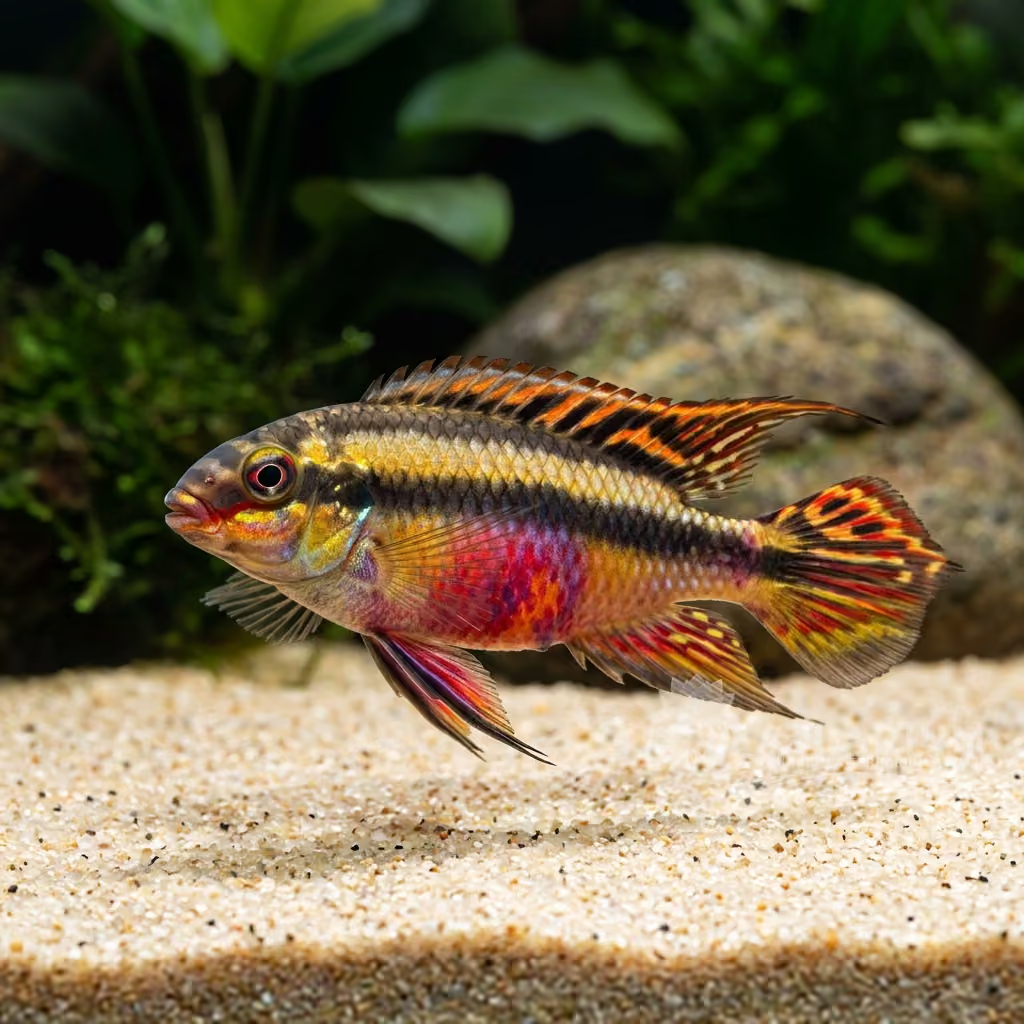
Coloration and Sexual Dimorphism: Sexual dimorphism is spectacular, massive, and absolute. Mature males are undeniably among the most brilliantly colored freshwater fish in existence: their base body color is an intensely glowing, highly saturated turquoise, sky-blue, or metallic teal. Their scales are heavily edged with deep maroon or crimson, creating a stunning reticulated (net-like) pattern. The massive dorsal and anal fins are heavily flushed with bright yellow or red. Females are completely devoid of any color, exhibiting a plain, perfectly uniform pale silvery-brown or grey.

Soins, reproduction et cohabitation

Aquarium Setup: The aquarium architecture MUST flawlessly accommodate their unique breeding biology and hyper-aggressive nature. A minimum 40-liter (10-gallon) dedicated species tank is strictly required for a single male and his harem. The tank MUST feature significant line-of-sight breaks (like dense thickets of Java Moss or small driftwood) so females can escape the male. Crucially, the bottom MUST be completely covered in a deep layer of extremely soft, fine peat moss or specialized spawning coir, which is an absolute biological requirement for collecting and preserving their eggs.
Diet and Feeding: They are highly specialized, intensely voracious micro-predators (carnivores) with an unimaginably rapid metabolism (driven by their microscopic lifespan). They are notoriously picky and will frequently categorically reject commercial dry flakes or pellets. You MUST feed them a heavily varied, high-protein diet to fuel their relentless, daily spawning. Daily, heavy offerings of live or high-quality frozen foods are absolutely mandatory: massive amounts of bloodworms, Daphnia, Artemia (brine shrimp), and mosquito larvae. Malnutrition will quickly halt breeding and lead to immediate physiological collapse.
Water Quality: Originating from temporary African mud pools, their water requirements differ completely from typical community fish. They thrive in warm tropical temperatures (24-28°C / 75-82°F). Crucially, they demand moderately soft to moderately hard water (GH 4-12) and a slightly acidic to neutral pH (6.5 - 7.5). They possess absolute zero tolerance for dissolved organic waste; rigorous weekly water changes are mandatory. The water flow MUST be extremely gentle; strong currents will violently exhaust them and completely prevent them from performing their delicate substrate-spawning dives.
Compatibility and Cohabitation: Compatibility is virtually non-existent for standard community setups. Due to their incredibly short lifespan (3-6 months), intense male-on-male aggression, hyper-aggressive breeding behavior, and specific requirement for deep peat substrate, they MUST be kept exclusively in a dedicated, single-species breeding tank. They are NOT community fish. Housing multiple males in a small tank will result in lethal combat. They should be kept strictly as one male to a harem of 3-5 females to prevent the females from being bred to death.
Aquarium Breeding: Breeding is the entire purpose of keeping this species. They are "annual" killifish; the adults die when the pool dries, but the eggs survive in the baked mud. The male aggressively drives the female into the deep peat substrate, where they dive into the mud to deposit single, hard-shelled eggs. This occurs dozens of times daily. To hatch the fry, the aquarist MUST remove the peat, squeeze it damp-dry, seal it in a bag, and incubate it at room temperature for roughly 3-5 months before re-wetting it to trigger explosive hatching.
Risks and Diseases: The absolute greatest physical risk is lethal exhaustion and stress to the females caused by the male's relentless, hyper-aggressive mating drive; a harem is strictly mandatory. The second major risk is lethal Velvet Disease (Oodinium), to which Nothobranchius species are uniquely and severely susceptible; adding a small amount of aquarium salt to the water is highly recommended as a preventative measure. Finally, remember their lifespan is biologically fixed at roughly 3-6 months; they undergo rapid senescence (aging) and die naturally very quickly.

Origine et répartition géographiques

Endemic exclusively to an incredibly harsh, semi-arid geographical range within southern Mozambique and Zimbabwe in southeastern Africa. Nothobranchius furzeri (universally known as the Turquoise Killifish) natively colonizes shallow, intensely ephemeral rain pools, mudholes, and deeply isolated swamp depressions. These micro-habitats are completely disconnected from permanent river systems and are characterized by high turbidity, intense sunlight, and absolutely zero permanent aquatic vegetation. Crucially, these pools completely evaporate during the brutal dry season, turning into cracked, sun-baked clay.

Origine

Afrique et Madagascar

Profil de poisson

Tempérament
Semi-aggressive
Peaceful overall, though males can be aggressive towards one another. They are incredibly active and constantly in motion, driven by the biological clock of their short lives. They display brilliant colors when courting or posturing against rivals.
Régime alimentaire
Micro-predator
An obligate carnivore that demands a varied diet of live foods to reach maturity quickly. Live daphnia, grindal worms, and baby brine shrimp are essential. They can sometimes be coaxed to eat frozen bloodworms, but live food yields the best results.
Espérance de vie
0.25-0.5 years
Taille adulte
6.5 cm
Ratio des sexes
Harem
One male to multiple females is the ideal setup to prevent females from being bred to death. Males are relentless in their pursuit of females. Providing dense mops or plants gives females a place to rest.
Fréquence d'alimentation
Twice daily
They require heavy, frequent feeding, up to three or four times a day. Because they only live a few months, their growth rate is explosive and demands constant high-protein fuel. Never allow uneaten food to decay in their small enclosures.
Charge biologique
Low
Produces a very minimal bioload, making them ideal for nano aquariums. Small, gentle filtration like a sponge filter is adequate. Frequent water changes are necessary to keep their environment pristine given their remarkably short lifespan.
Courant
Stagnant
Prefers nearly stagnant water, replicating the temporary seasonal pools they inhabit in the wild. A sponge filter should be adjusted to the lowest possible output. Any significant current will stress them and shorten their already brief lifespan.
Risque de saut
Yes
They are exceptional jumpers capable of escaping through the smallest gaps. A tight, perfectly fitted lid is an absolute requirement. Ensure no gaps exist around airline tubing or heater cables.
Reproduction
Substrate spawner
A classic annual species whose eggs require a dry incubation period to develop. They spawn daily, burying their eggs in a layer of peat moss provided by the aquarist. The peat must be collected, dried to a damp state, and stored for several months before rewetting to induce hatching.
Compatibilité et compagnons
Species only
Best kept strictly in a species-only tank to focus on their unique lifecycle and breeding. They are highly specialized and easily outcompeted for food by faster fish. Other species will also likely eat their precious eggs.
Niveau dans le bac
Middle/Bottom
They stay primarily in the lower to middle sections of the aquarium. They are constantly inspecting the substrate to find food and optimal spawning spots. A dark, soft substrate is highly recommended.

Modèles et paramètres scientifiques

FishBase

Fenêtre sur les données scientifiques officielles de l’espèce

FishBase v25.04Données synchronisées le : 15/06/2026
Niveau trophique
3,2 ± 0,4 se
Résilience
Élevée (moins de 15 mois)
Singularité phylogénétique (PD50)
0.5
Relation bayésienne longueur-poids
a = 0.00603, b = 3.13
VulnérabilitéVulnérabilité faible (10 / 100)