Encyclopaedia
PlantFreshwaterEasy
©AI Generated·Proprietary
Fissidens zippelianus
Fissidens zippelianus
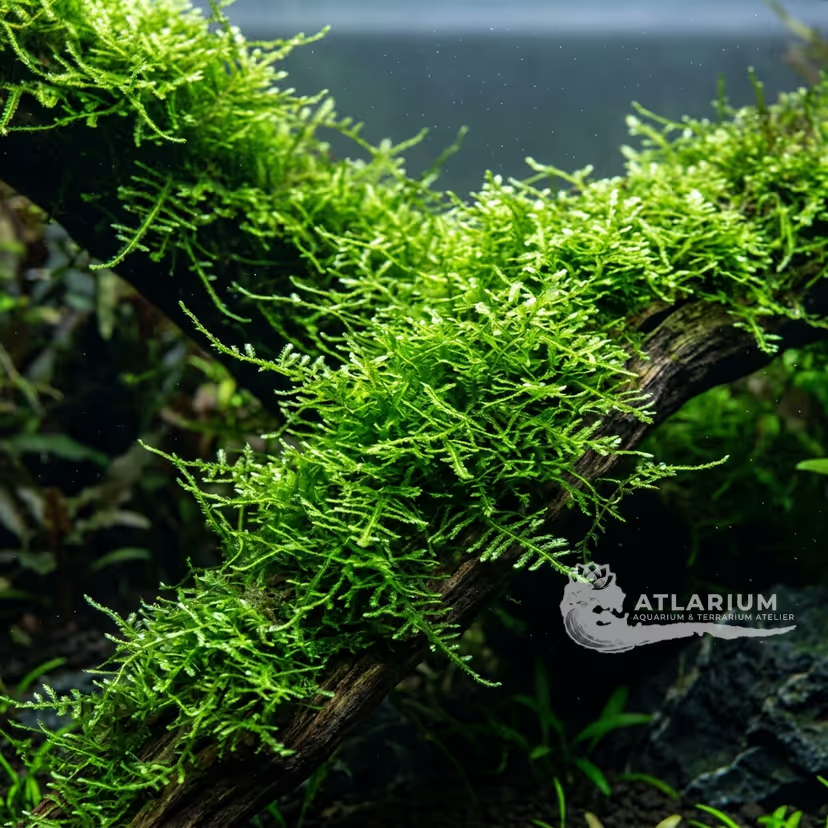
Fissidens zippelianus is an elegant aquatic moss featuring dark green feathery fronds that grow on rocks and driftwood, ideal as an epiphyte in the midground.
Class:Liliopsida
Order:Dicranales
Family:Fissidentaceae
Genus:Fissidens
Species:Fissidens zippelianus
Share
Check out Fissidens zippelianus on Atlarium
Water Temperature
15 - 28 °C
pH Value
5 - 7.5
Water type
Freshwater
Light
Low
CO2
Low
Expected height
3 cm
Expected width
3 cm
GH
0 - 20 dGH
KH
0 - 14 dKH
Species description
Geographical Origin and Habitat: This fascinating aquatic moss is widely distributed in the tropical and subtropical regions of Asia, including southern China, Japan, India, Indonesia, and the Philippines. It inhabits humid and riparian environments such as forest stream banks, rocks wet by waterfall spray, damp logs, and muddy soils subject to flooding. It grows in shaded or filtered light areas, anchoring itself firmly to any hard surface thanks to its tenacious rhizoids.
Taxonomy & Genetics: It belongs to the family Fissidentaceae and is a pure species of the vast genus Fissidens. The species is also known under trade names such as 'Zipper Moss' or 'Phoenix Moss' (although the latter is more properly associated with Fissidens fontanus). Its genetics are adapted to stable environments with clean, running water, developing a symmetrical and complex leaf structure that clearly distinguishes it from common mosses. It propagates vegetatively by fragmentation of the fronds.
Physical Structure: It presents a creeping and erect structure, formed by small stems covered with leaves arranged symmetrically in two opposite rows, giving each frond the appearance of a feather or a zipper (hence 'zippelianus'). The fronds are short and compact, usually 1-3 cm long. It does not possess true roots but rhizoids, thread-like structures used exclusively for anchoring to rocks, wood, or other solid supports.
Color & Texture: The color of the submerged moss is a deep and elegant dark green, which creates a magnificent contrast with light green plants or hardscape. Active young fronds can show bright green tips. The visual texture is very fine, feathery, and geometric. To the touch, it has a soft but compact consistency, forming dense cushions of vegetation that develop following the shape of the support on which they grow.
Care, breeding and tankmates
Lighting & CO2: Tolerates a wide spectrum of lighting, from low to medium-high. It does not require strong light to survive, but good light intensity combined with CO2 injection promotes much faster, denser growth and better-structured fronds. With low light, growth remains extremely slow but healthy.
Nutrition & Substrate: Does not require a fertile substrate because it does not absorb nutrients from the soil and should never be buried. Being an epiphytic moss, it absorbs all nutrients directly from the
Water Chemistry: Adapts to temperatures between 15°C and 28°C. Prefers soft to moderately hard waters with a weakly acidic or neutral pH (5.5 - 7.5). Requires very clean water and efficient filtration; suspended particulate matter or dirty water can settle on the fronds, choking the moss and promoting algae.
Space Management & Placement: Its ideal placement is as an epiphytic plant in the foreground or midground of the aquarium. It should be tied or glued (using cyanoacrylate glue or nylon thread) onto rocks, driftwood, or lava rock. Thanks to its compact growth and feathery appearance, it is perfect for covering hardscape details, creating a very natural and mature look.
Pruning: Pruning is done by trimming the fronds with sharp scissors to maintain the desired cushion shape and prevent the moss from growing too thick. If the layer becomes excessively thick, the lower parts no longer receive light and can rot, detaching the entire clump from the support. Trimmed fragments can be reused to create new colonies.
Risks & Diseases: The main risk is the accumulation of dirt and debris between the feathery fronds, which promotes the growth of filamentous algae that are difficult to remove. It is advisable to position it in areas with good water circulation and optionally introduce shrimp (such as Caridina multidentata) or algae-eating fish that keep the moss clean. Avoid drastic treatments with chemical algaecides.
Geographic Origin and Distribution
This fascinating aquatic moss is widely distributed in the tropical and subtropical regions of Asia, including southern China, Japan, India, Indonesia, and the Philippines. It inhabits humid and riparian environments such as forest stream banks, rocks wet by waterfall spray, damp logs, and muddy soils subject to flooding. It grows in shaded or filtered light areas, anchoring itself firmly to any hard surface thanks to its tenacious rhizoids.
Origin
South and Southeast AsiaEast Asia
Plant profile
- Placement
- No verified data available
- Botanical form
- No verified data available
- Growth
- No verified data available
- Substrate
- No verified data available
- Column fertilization
- No verified data available
- Root fertilization
- No verified data available
- Trimming
- No verified data available
- Propagation
- No verified data available
- Nutrients
- No verified data available
- Sensitivity
- No verified data available
- Layout role
- No verified data available
Image gallery
Licensed images linked to the species or, when marked, to the closest representative taxon.
Related species
Recommendations grouped by close relatives, companion choices, and similar care.