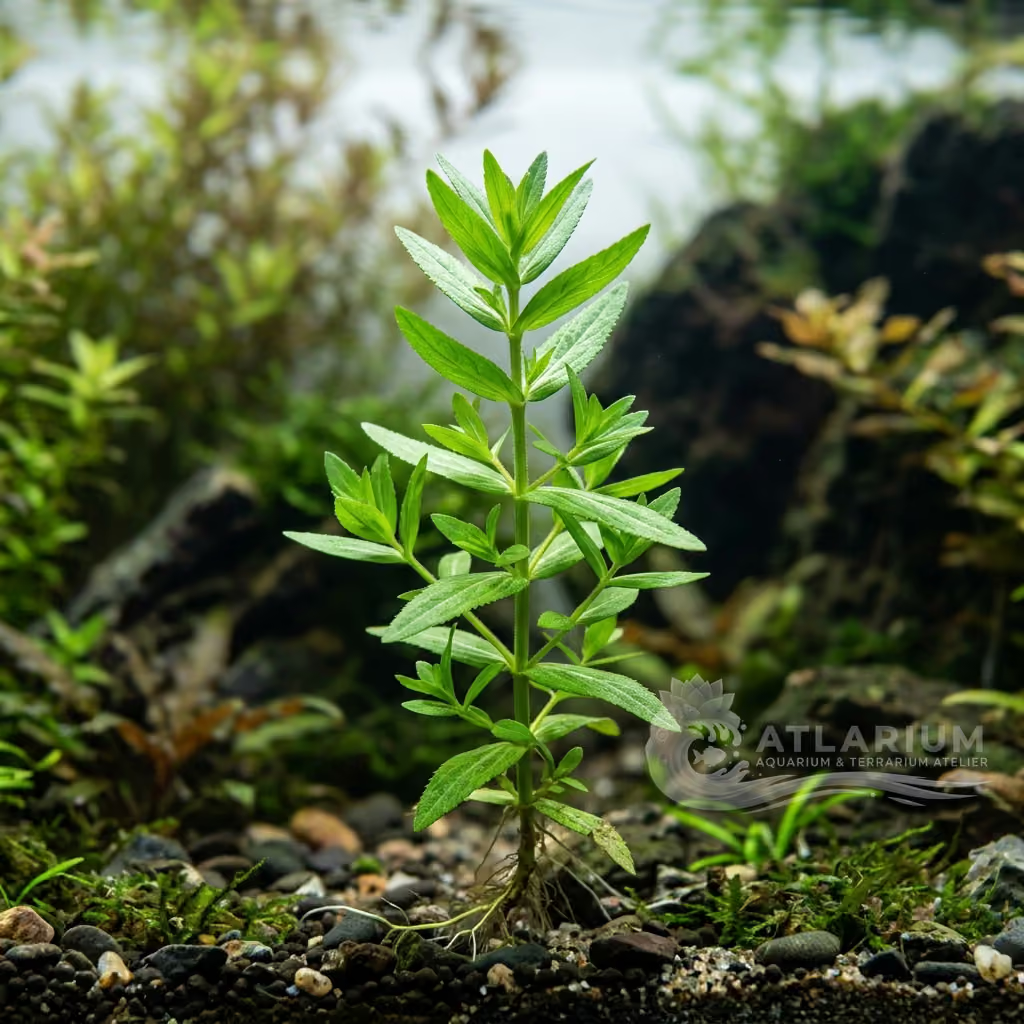
Eichhornia azurea
Pontederia azurea
A striking stem plant from Latin America with uniquely textured, alternate leaves. Requires intense lighting and regular CO2 injection to support its horizontal growth.
Water Temperature
6 - 33 °C
pH Value
5 - 7.5
Water type
Freshwater
Light
Medium - High
CO2
Medium - High
GH
0 - 20 dGH
KH
0 - 10 dKH

Species description
Geographical Origin and Habitat: Widespread throughout the tropical and subtropical zones of Latin America, particularly in the Amazon basin. It populates slow rivers, lagoons, and very sunny open marsh areas.
Taxonomy & Genetics: Belongs to the Pontederiaceae family. It shows a marked dimorphism between the submerged form (with leaves arranged in a flat fan) and the emerged form (with petiolate, round leaves that float on the surface).
Physical Structure: Develops robust and thick stems that grow very quickly toward the light. The submerged form is exceptional for its two-dimensional appearance and the geometric symmetry of its leaves.
Color & Texture: The submerged leaves are bright green, long, and tape-like. The texture is smooth and robust, capable of withstanding moderate water currents.

Care, breeding and tankmates
Lighting & CO2: Requires intense lighting. CO2 is necessary to support fast growth and prevent the plant from losing leaves at the base.
Nutrition & Substrate: A fertile substrate is recommended to support the development of strong roots. Requires abundant liquid fertilization including iron and potassium.
Water Chemistry: Very tolerant, temperature range between 6 and 33 °C. Optimal pH between 5.0 and 7.5 with low water hardness (KH 0-10).
Space Management & Placement: Place in the background or midground. Needs plenty of free space as the leaves spread out considerably.
Pruning: Pruning must be frequent. Cut the top of the stem and replant it to rejuvenate the group.
Risks & Diseases: If it reaches the water surface, it changes shape to the emerged form, which is less decorative for traditional planted aquariums. Trim before it emerges.

Geographic origin and distribution
Widespread throughout the tropical and subtropical zones of Latin America, particularly in the Amazon basin. It populates slow rivers, lagoons, and very sunny open marsh areas.
Origin
Amazon, Orinoco, and GuianasExtra-Amazon South AmericaCentral America and Caribbean

Plant profile
- Placement
- Midground
- This species is best utilized as a striking background or midground focal point in large aquariums. Due to its significant size and rapid growth, it needs ample vertical space to stretch towards the light. Placing it strategically allows its unique, fan-like submerged leaves to be fully appreciated without overshadowing smaller foreground plants. It is not suitable for nano tanks.
- Botanical form
- Stem
- In its submerged state, Eichhornia azurea develops highly distinctive, alternately arranged leaves that resemble a palm frond. The stem is thick and fleshy, supporting these bright green, lanceolate leaves. When allowed to breach the surface, the leaves change shape entirely, becoming round and leathery, and the plant may produce beautiful azure-blue flowers.
- Growth
- Fast
- Under optimal conditions with high light and CO2, Eichhornia azurea exhibits a very rapid growth rate. It can quickly reach the surface, where it will attempt to produce emergent leaves and flowers. Frequent maintenance is required to manage this vigorous growth and keep it submerged. Its fast metabolism makes it excellent for nutrient export in well-lit setups.
- Substrate
- High
- Eichhornia azurea develops a thick stem and robust roots that anchor it securely in the bottom. This vigorous aquatic plant thrives in a rich, nutrient-dense substrate like aqua soil, which supports its exceptionally fast growth. A substrate depth of at least 5-7 centimeters is recommended to accommodate its strong root system and prevent it from being uprooted by water currents. While it heavily feeds from the water column, a fertile base ensures long-term health and prevents nutrient deficiencies.
- Column fertilization
- Recommended
- Liquid column fertilization is absolutely critical for the success of Eichhornia azurea. It aggressively pulls nutrients directly from the water column through its leaves and stem. Regular dosing of a comprehensive liquid fertilizer containing both macro and micronutrients is highly recommended. Iron supplementation will help maintain its vibrant green coloration.
- Root fertilization
- None
- While it draws heavily from the water column, a nutrient-rich substrate or the addition of root tabs will significantly bolster its overall health. A strong root system helps anchor its large, buoyant stems against water currents. The combination of root and column feeding ensures the plant never experiences a nutrient deficiency.
- Trimming
- Regular
- Trimming must be done carefully, as the plant does not branch as prolifically as typical stem plants when cut. It is often best to uproot the plant, trim the lower, older portion, and replant the healthy top. Allowing it to reach the surface will encourage emergent growth, which may not be desired in a purely submerged aquascape. Regular topping is necessary to maintain its submerged form.
- Propagation
- Cuttings
- Propagation is primarily achieved by taking cuttings of the main stem and replanting them in the substrate. However, lateral shoots are sometimes produced, which can be carefully separated and planted once they have developed a few leaves. Ensuring the cuttings have adequate light immediately after planting will help them establish quickly. Strong growth is necessary for successful propagation.
- Sensitivity
- Moderate
- This plant is exceptionally sensitive to low light and lack of CO2; without both, its lower leaves will quickly blacken and melt. It also does not tolerate sudden shifts in water parameters or nutrient drop-offs. Herbivorous fish or large snails might damage its delicate submerged leaves. Careful handling is required to avoid snapping its brittle stems during maintenance.
- Layout role
- Midground, Background
- Eichhornia azurea serves as an extraordinary, attention-grabbing specimen plant in Dutch-style or large nature aquariums. Its palmate submerged leaves offer a texture unlike almost any other aquatic plant. It functions perfectly as a structural backdrop or a dominant midground focal point. Its bold appearance requires careful placement to avoid visually overwhelming delicate neighboring species.

Related species
Recommendations grouped by close relatives, companion choices, and similar care.