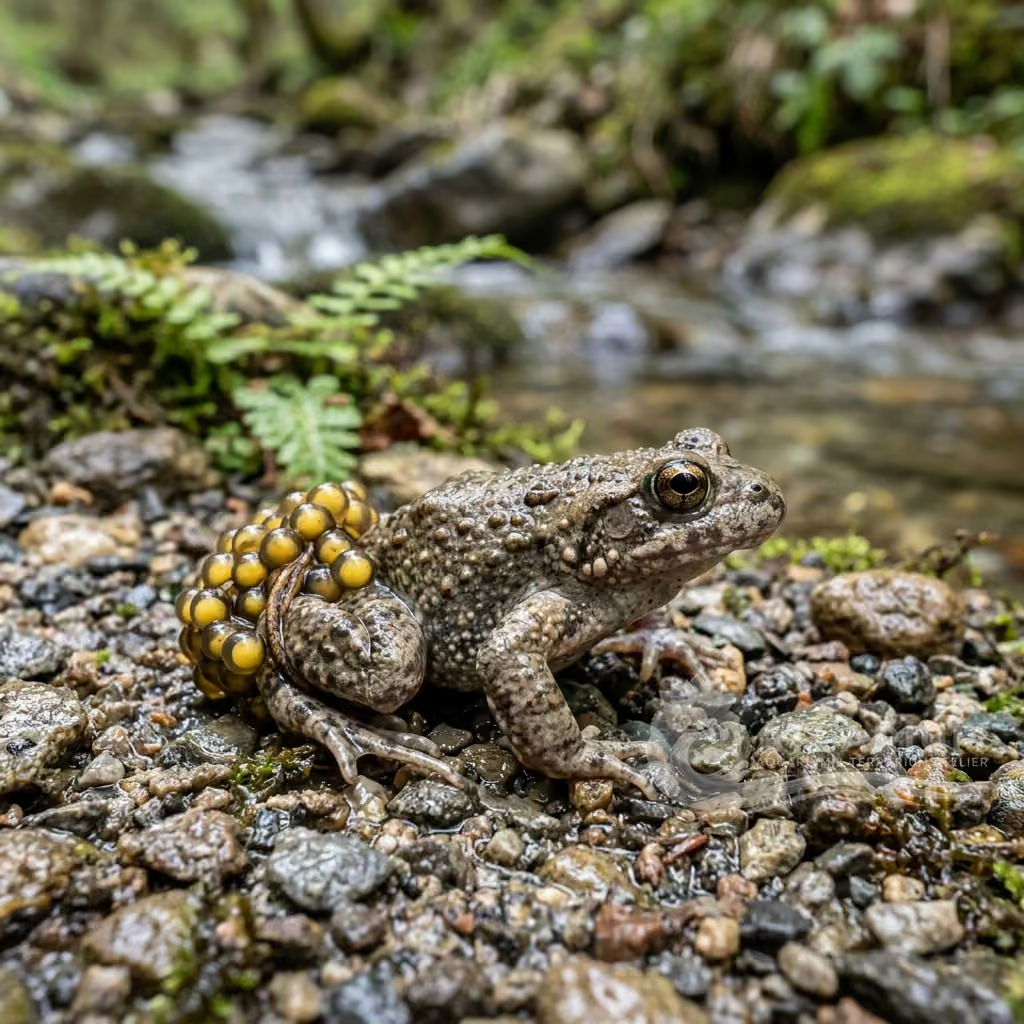
Madagascan Painted Mantella
Mantella madagascariensis
The Madagascar Mantella is a strikingly beautiful terrestrial frog featuring bold black, green, and orange patches. It requires cool temperatures, leaf litter, and a moisture-rich forest floor setup.
Environment
Terrestrial
Humidity
80 - 100 %
Day temperature
20 - 23 °C
Night temperature
16 - 18 °C
Ambient temperature
20 - 23 °C
Minimum enclosure
>= 45 L

Species description
Geographical Origin and Habitat: This species is native to the eastern and central regions of Madagascar. It inhabits primary montane and submontane tropical rainforests, distributing itself along the banks of fast-flowing forest streams, natural springs, and damp swampy areas covered with thick leaf litter. It occurs at elevations between 700 and 1,200 meters above sea level, where the microclimate is constantly humid but influenced by cooler nighttime temperatures due to the high altitude.
Taxonomy and Genetics: Mantella madagascariensis belongs to the family Mantellidae, subfamily Mantellinae. It is phylogenetically closely related to other mantella species such as Mantella aurantiaca and Mantella baroni, with which it shares parts of its range and exhibits evolutionary convergence. While genetic lines are stable, wild populations are threatened by habitat fragmentation and overcollection for the pet trade, leading to its listing under CITES Appendix II.
Behavior and Habits: Primarily diurnal and terrestrial. It spends the daylight hours actively foraging through the leaf litter on the forest floor for small invertebrates. Because of its warning coloration (aposematism), it is bold and does not hesitate to show itself in the open. Males establish and defend small breeding territories near damp rock crevices or root cavities, emitting short, clicking advertisement calls to attract females.
Morphology: This is a very small frog, with adults measuring between 2 and 3 cm in length; females are generally larger and more robust than males. The coloration is among the most striking in the genus: a glossy black back with bright green or lime-yellow longitudinal patches on the shoulders, greenish-yellow forelimbs, and black hindlimbs blotched with bright orange or red (especially on the thighs, creating flash colors). The belly is black with round blue or white spots.

Care, breeding and tankmates
Terrarium Setup: Requires a horizontal forest-type terrarium measuring at least 60x40x40 cm for a small group of 4-6 specimens. The substrate should consist of a clay drainage layer, a mesh barrier, and a mix of coco coir and peat moss, topped with a thick layer of sterilized oak or beech leaves and damp sphagnum moss. Provide ample hiding places like cork bark flats, low branches, and live plants (Pothos, bromeliads, small ferns).
Lighting and Heating: Requires moderate lighting as a forest floor inhabitant. Install a low-output (2% or 5%) linear UVB bulb to support vitamin D3 synthesis and maintain live plants. Temperature parameters must reflect its highland origin: keep daytime temperatures at 20-23°C (68-73°F), with a maximum basking spot of 24°C (75°F). Nighttime temperatures must drop to 16-18°C (60-64°F). Do not use under-tank heating.
Humidity and Hydration: Maintain high humidity levels, between 80% and 90% during the day, rising to 95-100% at night. Mist the enclosure with reverse osmosis water 2-3 times daily. Provide a very shallow water area (no deeper than 1 cm) or a shallow dish filled with pebbles to prevent drowning, as these frogs are poor swimmers and cannot survive in deep water. Use declorinated water.
Feeding and Supplementation: Strictly insectivorous, requiring small, live prey. Feed daily with fruit flies (Drosophila melanogaster), springtails, pea aphids, pinhead crickets, and small beetles. Dust prey insects with pure calcium carbonate at every feeding, and supplement with a high-quality multivitamin containing preformed vitamin A and D3 twice a week to prevent short-tongue syndrome and metabolic bone disease.
Compatibility: Can be housed in colonies of several individuals, provided there is enough space and food to prevent competition. Males may engage in minor, harmless territorial wrestling. Never cohabitate with other amphibian species (such as South American dart frogs) to avoid stress and the potential transmission of trans-specific pathogens.
Health and Common Diseases: Highly sensitive to temperatures above 25-26°C (77-79°F), which can cause fatal heat stress. Stagnant air is equally dangerous; ensure excellent cross-ventilation using fine mesh screens. Susceptible to chytridiomycosis (fungal infection) and systemic bacterial infections (red leg disease). Handle only when necessary, using wet, powder-free nitrile gloves.

Geographic origin and distribution
This species is native to the eastern and central regions of Madagascar. It inhabits primary montane and submontane tropical rainforests, distributing itself along the banks of fast-flowing forest streams, natural springs, and damp swampy areas covered with thick leaf litter. It occurs at elevations between 700 and 1,200 meters above sea level, where the microclimate is constantly humid but influenced by cooler nighttime temperatures due to the high altitude.
Origin
Africa and MadagascarEast Asia

Amphibian profile
- Diet
- Insectivore
- Eat bugs. Feed daily. Add vitamins.
- Life expectancy
- 5-10 years
- Adult size
- 3 cm
- Lifestyle/Microhabitat
- Terrestrial
- Need high humidity. Forage constantly. Stable temps.
- Activity cycle
- Diurnal
- Strictly diurnal. Morning peaks. 12h cycle.
- Sociality
- Gregarious
- Very active. Males defend. Add barriers.
- Reproduction
- Oviparous
- Breed in rain. Males call. Tads swim.
- Toxicity
- Harmless
- Through convergent evolution, Mantellas have developed skin toxins (lipophilic alkaloids) strikingly similar to those of South American poison dart frogs, derived entirely from their wild diet of ants and mites. Their vibrant coloration warns predators of this toxicity. Captive-bred Mantellas, fed on standard domestic insects, are completely harmless.
- Life stage
- Metamorphosis
- Eggs require a constantly humid environment and typically hatch into tadpoles within 10 to 14 days. The tadpoles are herbivorous and detritivorous, thriving in small, nutrient-rich pools. Metamorphosis occurs after 6 to 8 weeks, yielding tiny froglets that grow rapidly and can reach adulthood in less than a year.
- Handling tolerance
- Display only
- The Madagascan Painted Mantella is considered a display-only species. Their delicate skin is highly permeable and easily damaged by the natural oils, salts, and chemicals on human hands. Handling induces severe stress and should be strictly avoided except during essential health checks or enclosure transfers.
- Brumation
- The Madagascan Painted Mantella originates from relatively stable tropical or subtropical environments and does not undergo a true brumation. They require consistently warm and stable temperatures year-round to maintain proper digestion, metabolic activity, and overall immune health.
- Molting
- Periodic
- High ambient humidity (typically 70-90%) is critical for the Madagascan Painted Mantella. Like most amphibians, they routinely shed their outer layer of skin and rely on moisture to prevent it from sticking or restricting movement. They often consume the shed skin for nutrient recycling.

Related species
Recommendations grouped by close relatives, companion choices, and similar care.