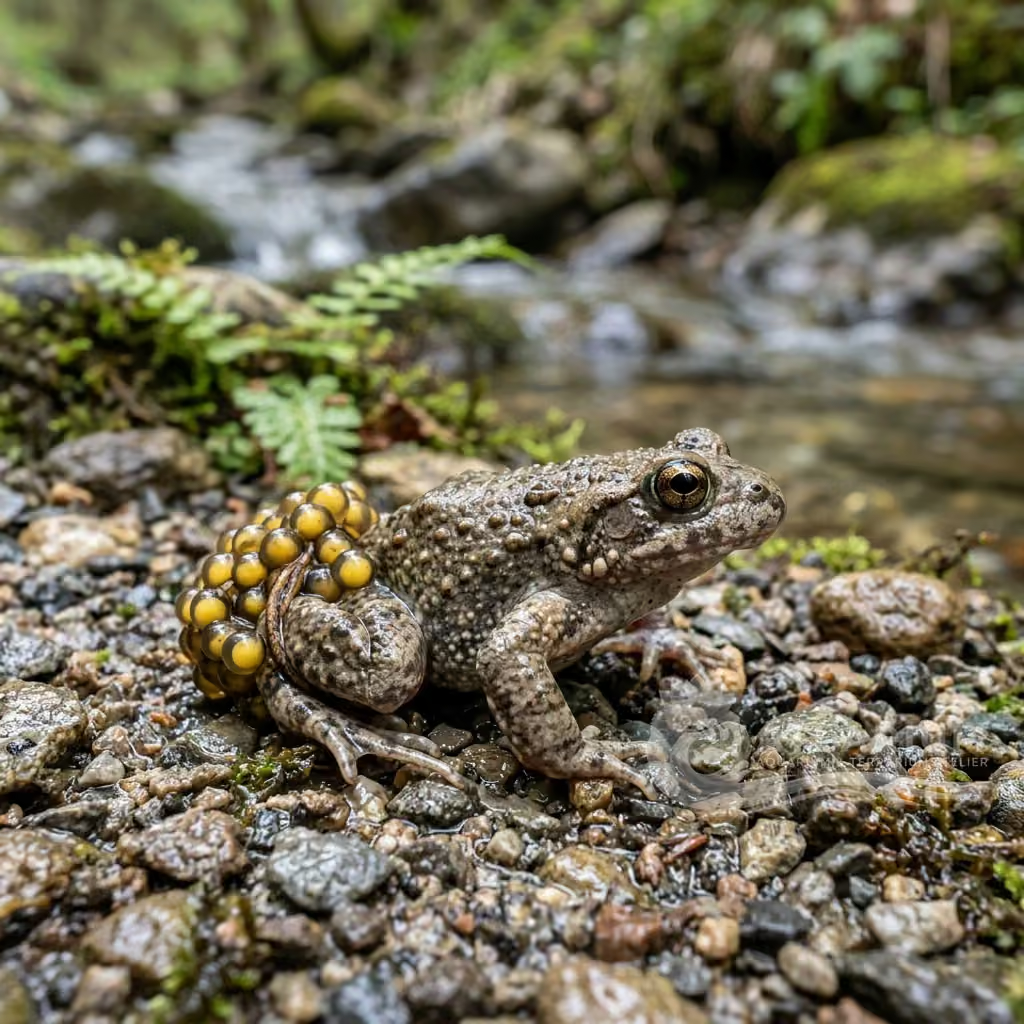
Darwin's frog
Rhinoderma darwinii
A small South American frog famous for its unique breeding strategy, where the male mouth-broods the eggs and developing tadpoles inside his vocal sac.
Environment
Terrestrial
Humidity
80 - 100 %
Day temperature
22 - 23 °C
Night temperature
11 °C
Ambient temperature
22 - 23 °C
Minimum enclosure
>= 45 L

Species description
Geographical Origin and Habitat: This species is endemic to the cool, temperate Southern Beech (Nothofagus) forests of southern Chile and southwestern Argentina. It lives on the forest floor, preferring cool, shady, and highly humid habitats covered with thick moss beds, damp leaf litter, and small forest streams, which provide excellent camouflage.
Taxonomy and Genetics: Belongs to the family Rhinodermatidae and the genus Rhinoderma. It represents a highly specialized evolutionary branch of South American amphibians. It is globally endangered due to habitat loss and the spread of the chytrid fungus (Batrachochytrium dendrobatidis). No domestic genetic strains exist.
Behavior and Habits: Primarily diurnal and slow-moving, it relies heavily on camouflage. When threatened, it displays a unique defense mechanism: it flips onto its back, exposing its dark belly and playing dead to resemble a fallen, decaying leaf. Males are known for producing bird-like chirping advertisement calls.
Morphology: A very small frog, measuring only 2.5 to 3 cm in snout-vent length. It features a distinctive fleshy, pointed snout projection resembling a leaf stem. Dorsal coloration is highly variable, ranging from bright green to dark brown to blend with the environment, while the ventral surface has a contrasting black-and-white pattern.

Care, breeding and tankmates
Terrarium Setup: Requires a humid, bioactive terrarium of at least 60x45x45 cm (approx. 24x18x18 inches) for a small group. A drainage layer of clay pebbles is essential, topped with a moist soil substrate, thick mats of live sphagnum moss, and sterile leaf litter. Decorate with small branches, damp cave hides, and moisture-loving live plants such as ferns, mosses, and creeping figs.
Lighting and Heating: Keeping this species cool is critical for survival. The temperature must be kept between 15°C and 20°C (59-68°F); temperatures consistently exceeding 22-23°C (72°F) are rapidly fatal. A cooling system or air-conditioned room is mandatory during summer. Provide low-heat LED lighting with low-output UVB (2% to 5%) to simulate the shaded forest floor.
Humidity and Hydration: Demands high relative humidity levels between 80% and 95%. Installing an automated misting system using RO water is highly recommended to mist the tank 2-3 times daily. Provide a very shallow water dish (no deeper than 1 cm) to prevent drowning, filled with clean, dechlorinated water that is changed daily.
Feeding and Supplementation: Insectivorous. Due to their small size, they require tiny live prey. Feed fruit flies (Drosophila), springtails, micro-crickets, and aphids. Food items must be dusted with high-quality calcium and multivitamin supplements specifically formulated for amphibians at every feeding (2-3 times a week) to prevent deficiencies.
Compatibility: Peaceful and social, they can be housed in small same-species groups (e.g., one male and two females). They must never be housed with other amphibian or reptile species, as this increases the risk of introducing lethal pathogens (like chytrid) and causes unnecessary stress to these sensitive frogs.
Health and Common Diseases: Highly vulnerable to chytridiomycosis (caused by the fungus Batrachochytrium dendrobatidis), which leads to rapid death. Strict quarantine and hygiene protocols are essential. They are also prone to heat stress if kept above 22°C, and bacterial skin infections (red leg disease) if the enclosure substrate becomes stagnant and dirty.

Geographic origin and distribution
This species is endemic to the cool, temperate Southern Beech (Nothofagus) forests of southern Chile and southwestern Argentina. It lives on the forest floor, preferring cool, shady, and highly humid habitats covered with thick moss beds, damp leaf litter, and small forest streams, which provide excellent camouflage.
Origin
Extra-Amazon South America

Amphibian profile
- Diet
- Insectivore
- Darwin's Frog relies on a diet consisting of small insects, spiders, and various leaf-litter invertebrates found in temperate forests. They employ a sit-and-wait hunting strategy, relying on their leaf-like camouflage to remain undetected until prey comes near. A quick strike of their sticky tongue is usually enough to secure a meal from the forest floor.
- Life expectancy
- 5-15 years
- Adult size
- 3.5 cm
- Lifestyle/Microhabitat
- Terrestrial
- They are terrestrial frogs native to cold temperate rainforests, favoring damp ground cover near cold, clear streams.
- Activity cycle
- Diurnal
- Darwin's Frogs are generally diurnal, foraging during the day on the forest floor and relying on their dead-leaf camouflage to evade predation.
- Sociality
- Solitary
- Darwin's Frog is primarily diurnal and spends its time hopping among the damp leaves of the forest floor. Their most notable behavior is their exceptional camouflage; they look exactly like dead leaves, complete with a fleshy, leaf-stem-like snout. When threatened, they often play dead by flipping onto their backs and remaining perfectly still to avoid detection.
- Reproduction
- Oviparous
- This species is famous for its astonishing reproductive strategy, where males practice vocal sac brooding. Females lay eggs on moist ground, and once the eggs begin to hatch, the attending male swallows the tadpoles, incubating them inside his vocal sac. The tadpoles develop entirely within the male's vocal sac until they are fully formed froglets, at which point he 'coughs' them up.
- Toxicity
- Harmless
- Unlike many brightly colored amphibians, Darwin's Frog does not rely on toxic skin secretions for defense. Instead, their primary defense mechanism is their extraordinary morphological mimicry and cryptic behavior. Their reliance on camouflage eliminates the need for the biologically expensive production of toxins.
- Life stage
- Metamorphosis
- The early life stages of Darwin's Frog are uniquely sheltered, as the tadpoles bypass a free-living aquatic phase altogether. Sheltered safely inside the father's vocal sac, they nourish themselves entirely from their large egg yolks. They finally enter the outside world as fully metamorphosed, miniature versions of the adult frogs.
- Handling tolerance
- Display only
- These small, delicate amphibians should only be considered display animals. They are incredibly sensitive to temperature changes from human hands.
- Brumation
- Living in the cool climate of southern Chile and Argentina, they require significantly cooler temperatures than most tropical frogs and may brumate briefly in winter.
- Molting
- Periodic
- High, cool humidity is essential. Shedding behavior is typical of frogs, consuming the dead skin, but must take place in an entirely saturated microenvironment.

Related species
Recommendations grouped by close relatives, companion choices, and similar care.