Encyclopaedia
InvertebrateTerrestrialEasy
©AI Generated·Proprietary
Indo-Pacific Land Hermit Crab
Coenobita brevimanus
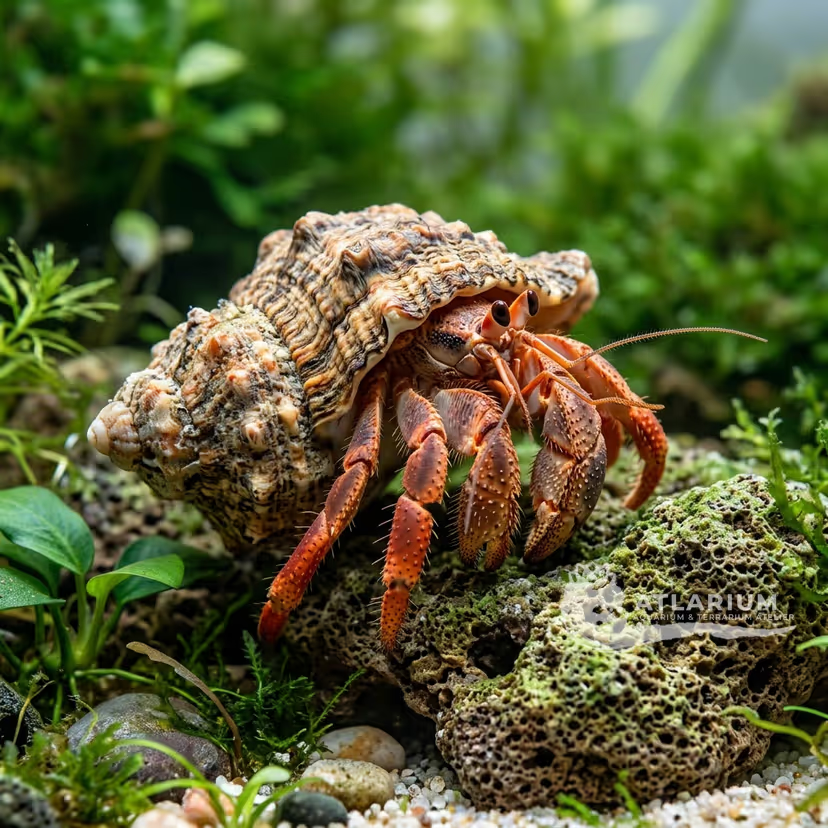
A large, terrestrial hermit crab from the Indo-Pacific, known for its massive purple left claw. It requires high humidity, a deep substrate for molting, and access to both fresh and saltwater.
Class:Malacostraca
Order:Decapoda
Family:Coenobitidae
Genus:Coenobita
Species:Coenobita brevimanus
Share
Check out Indo-Pacific Land Hermit Crab on Atlarium
Environment
Terrestrial
Minimum group
>= 3
Species description
Geographical Origin and Habitat: Coenobita brevimanus, commonly known as the Indonesian Land Hermit Crab or Indo Hermit Crab, is widely distributed across the tropical Indo-Pacific region. Its range extends from the East African coast (Zanzibar) through the Indian Ocean to Indonesia, the Philippines, southern Japan, and eastward to Tahiti and the Tuamotu Islands. Unlike most crustaceans, it is a highly terrestrial species that inhabits coastal forests, rainforests near the sea, sandy dunes, and areas covered with dense shrubby vegetation, returning to the shore only to wet its gills and spawn.
Taxonomy: This species belongs to the infraorder Anomura, family Coenobitidae, and genus Coenobita. The family Coenobitidae groups together terrestrial hermit crabs that have evolved special adaptations to live out of water, such as modified gills that function like lungs when kept moist. To protect its soft, uncalcified abdomen from predators and desiccation, Coenobita brevimanus utilizes empty shells of terrestrial or marine gastropods, particularly from the Turbo or Tonna genera.
Social Behavior: These are social and gregarious animals that form small colonies or groups in the wild, benefiting from community life to search for food and share resources (including empty shells). They have nocturnal and crepuscular habits, spending the day hidden under fallen logs, leaf litter, or burrowed into the damp soil to avoid dehydration. They exhibit high curiosity and are excellent climbers.
Coloration and Sexual Dimorphism: Coenobita brevimanus is easily distinguished from other land hermit crabs by its massive size and distinct coloration. Its defining feature is a disproportionately large, smooth, purple-to-violet left claw. The rest of the body shows shades varying from dark brown to olive-green or grey. The eyes are cylindrical, and the eyestalks are dark. Sexual dimorphism is not visible externally; females are identified by abdominal pleopods used to hold eggs.
Care, breeding and tankmates
Tank Setup: Although the terminology requires this header, the enclosure must be a spacious, dry terrarium (minimum 80-100 liters for a small group). The substrate is the most critical element: it must be a damp mixture of fine play sand and coconut fiber (4:1 ratio) at least 15-20 cm deep, allowing the crabs to burrow completely for molting. Provide climbing enrichment such as driftwood, cork bark, and flat rocks, alongside several dark hiding spots.
Diet and Feeding: An opportunistic omnivore. The diet should be extremely varied: fresh fruits (banana, apple, mango), vegetables (carrots, zucchini), dry leaves (oak, catappa), and animal proteins (fish, dried shrimp, unseasoned boiled meat). Constant access to calcium, such as crushed cuttlebone or sterilized eggshells, is essential to support exoskeleton regeneration and successful molting.
Water Quality: As a terrestrial animal, it does not live submerged in water, but it requires two separate water bowls: one for dechlorinated fresh water and one for marine saltwater (prepared using aquarium-grade marine salt at a salinity of 1.022-1.024). Both bowls must be deep enough for the crabs to submerge but equipped with stones or ramps to prevent drowning. Maintain relative air humidity between 70% and 80% by regular misting.
Compatibility and Tankmates: Very peaceful with its own species; they must be kept in small groups to prevent stress and loneliness. They should not be housed with predatory animals or small species that could be pinched or stressed by their activity. They can cohabitate with other land hermit crab species of the genus Coenobita if space and food are plentiful.
Aquarium Breeding: Breeding in captivity is exceptionally difficult and rarely documented. In nature, after mating on land, females migrate to the ocean shore to release eggs into the sea, where the larvae undergo several marine planctonic stages before transforming into post-larvae and colonizing terrestrial habitats.
Risks and Diseases: The most serious risk is dehydration caused by relative humidity falling below 70%, which permanently damages their modified gills and leads to suffocation. The lack of empty Turbo shells of appropriate sizes causes severe stress and can lead to fighting. During the molting process (which occurs deep in the substrate), the crab must never be disturbed or dug up.
Geographic Origin and Distribution
Coenobita brevimanus, commonly known as the Indonesian Land Hermit Crab or Indo Hermit Crab, is widely distributed across the tropical Indo-Pacific region. Its range extends from the East African coast (Zanzibar) through the Indian Ocean to Indonesia, the Philippines, southern Japan, and eastward to Tahiti and the Tuamotu Islands. Unlike most crustaceans, it is a highly terrestrial species that inhabits coastal forests, rainforests near the sea, sandy dunes, and areas covered with dense shrubby vegetation, returning to the shore only to wet its gills and spawn.
Origin
Cosmopolitan or introducedAfrica and MadagascarSouth and Southeast AsiaEast AsiaTropical oceans and reefs
Invertebrate profile
- Diet
- No verified data available
- Ecological role
- No verified data available
- Life expectancy
- No verified data available
- Adult size
- No verified data available
- Jump risk
- No verified data available
- Shock sensitivity
- No verified data available
- Calcium and minerals
- No verified data available
- Molting
- No verified data available
- Reproduction
- No verified data available
- Compatibility & tankmates
- No verified data available
Image gallery
Licensed images linked to the species or, when marked, to the closest representative taxon.
Related species
Recommendations grouped by close relatives, companion choices, and similar care.