Encyclopaedia
InvertebrateTerrestrialAdvanced
©AI Generated·Proprietary
Coconut Crab
Birgus latro
The Coconut Crab is the largest terrestrial arthropod in the world, renowned for its unbelievable claw crushing strength and ability to crack open coconuts.
Class:Malacostraca
Order:Decapoda
Family:Coenobitidae
Genus:Birgus
Species:Birgus latro
Share
Check out Coconut Crab on Atlarium
Environment
Terrestrial
Minimum group
>= 1
Species description
Geographical Origin and Habitat: Birgus latro, commonly known as the Coconut Crab, is native to tropical islands across the Indian Ocean and the western Pacific Ocean. Its range extends from African coastal islands like Zanzibar to the Cook Islands and east to Tahiti. It lives primarily in coastal forests, areas rich in rocky crevices, subterranean caves, or soft sandy soil suitable for digging. Although it hatches in the sea, as an adult it leads a strictly terrestrial life, having lost the ability to breathe underwater.
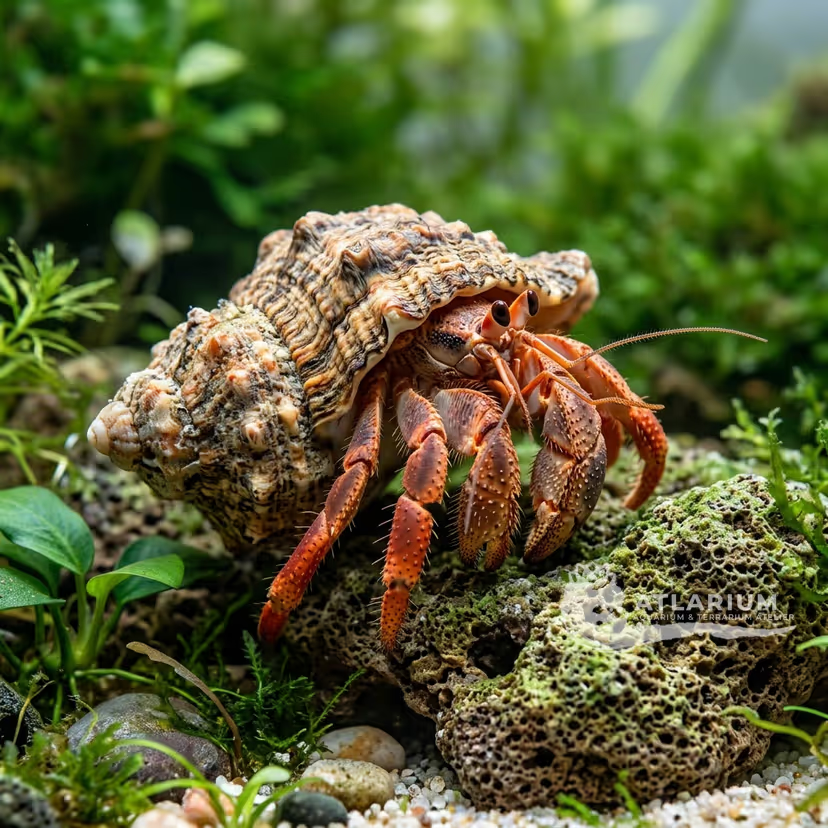
Taxonomy: This species belongs to the infraorder Anomura, family Coenobitidae, and genus Birgus, of which it is the only living representative. Although commonly called a crab, taxonomically it is a highly evolved terrestrial hermit crab. It has developed a hardened, calcified abdomen that eliminates the need for a protective gastropod shell, which it only uses during its early juvenile life stages.
Social Behavior: It is a solitary, nocturnal, and highly territorial animal. During the day, it remains hidden inside deep underground burrows or rocky fissures to protect itself from heat and minimize body moisture loss. It emerges only at dusk to forage. Its claws are exceptionally powerful, exerting a crushing force exceeding 3000 Newtons, which it uses to crack coconuts and lift heavy weights. It shows a strong propensity for climbing trees.
Coloration and Sexual Dimorphism: The coloration varies depending on the geographical region, ranging from bright blue or deep purple to orange, rusty red, or dark brown, often with striped legs. The eyes are black, and the eyestalks are thick. It grows to gigantic sizes, reaching up to 4 kg in weight and 1 meter in leg span. Sexual dimorphism is visible mainly in size, with males growing much larger than females, and in the presence of degenerate abdominal pleopods in females for carrying eggs.
Care, breeding and tankmates
Tank Setup: Due to its colossal size and destructive strength, this animal cannot be housed in standard glass aquariums or terrariums, which it would easily shatter. It requires a massive, heavy-duty custom enclosure built from reinforced sealed wood or masonry (minimum 3x2 meters per crab). The substrate must be at least 50-80 cm deep, consisting of a damp mix of sand and coconut fiber to allow for burrowing during molting. Sturdy climbing structures are essential.
Diet and Feeding: An omnivore and scavenger. In captivity, it must receive a highly varied, nutrient-dense diet: freshly cracked coconuts, tropical fruits (banana, papaya, mango), vegetables, seeds, nuts, fresh fish, shrimp, and unseasoned boiled meat. It also requires a constant source of calcium (crushed cuttlebone or sterile eggshells) to support the hardening of its massive exoskeleton.
Water Quality: As a terrestrial animal, it cannot tolerate prolonged submersion, which will lead to drowning. However, it requires two wide but shallow water bowls for drinking and soaking: one filled with dechlorinated fresh water, and one with marine saltwater (salinity 1.022-1.024). Relative air humidity is the most critical parameter and must be kept constantly between 70% and 80% to allow its modified branchial lungs to function.
Compatibility and Tankmates: A solitary and highly territorial animal. Multiple specimens must never be housed together in confined spaces, as this will result in fatal fights and severe mutilation. It must not be housed with other animals, as it will actively prey on them or be disturbed during delicate underground molting phases.
Aquarium Breeding: Breeding in captivity is considered impossible and is completely undocumented. In nature, after terrestrial mating, the female carries fertilized eggs under her abdomen, releasing them into the sea during high tide. The larvae undergo a complex marine planktonic metamorphosis before finding a shell and migrating onto land.
Risks and Diseases: The primary risk is a failed or interrupted molt underground. During molting, the crab is soft and defenseless; if the substrate is not deep or moist enough, the new exoskeleton will not harden correctly, resulting in death. Humidity drops below 60% cause rapid suffocation. The crushing force of the claws also poses a severe injury risk to keepers.
Geographic Origin and Distribution
Birgus latro, commonly known as the Coconut Crab, is native to tropical islands across the Indian Ocean and the western Pacific Ocean. Its range extends from African coastal islands like Zanzibar to the Cook Islands and east to Tahiti. It lives primarily in coastal forests, areas rich in rocky crevices, subterranean caves, or soft sandy soil suitable for digging. Although it hatches in the sea, as an adult it leads a strictly terrestrial life, having lost the ability to breathe underwater.
Origin
Tropical oceans and reefsAfrica and MadagascarSouth and Southeast Asia
Invertebrate profile
- Diet
- No verified data available
- Ecological role
- No verified data available
- Life expectancy
- No verified data available
- Adult size
- No verified data available
- Jump risk
- No verified data available
- Shock sensitivity
- No verified data available
- Calcium and minerals
- No verified data available
- Molting
- No verified data available
- Reproduction
- No verified data available
- Compatibility & tankmates
- No verified data available
Image gallery
Licensed images linked to the species or, when marked, to the closest representative taxon.
Related species
Recommendations grouped by close relatives, companion choices, and similar care.